

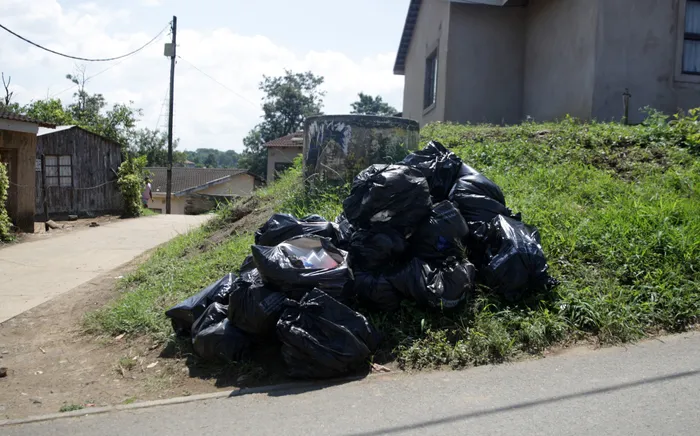
RESIDENTS in Tongaat and surrounding areas are facing mounting health risks and financial burdens as the eThekwini Municipality fails to provide essential refuse bags, forcing households to purchase their own despite paying for the service.
Image: Bongani Mbatha African News Agency(ANA)
RESIDENTS in Tongaat and surrounding areas are facing mounting health risks and financial burdens as the eThekwini Municipality fails to provide essential refuse bags, forcing households to purchase their own despite paying for the service.
The city said there was a "temporary shortage" of bin bags and encouraged residents to practise "responsible waste management". This included avoiding littering and illegal dumping.
Councillor Yogis Govender, the DA eThekwini Exco Member, said Durban Solid Waste (DSW), under the leadership of the IFP’s Mdu Nkosi, was facing mounting criticism for its continued failure to provide basic waste management services.
She warned that the shortage posed “serious health and environmental risks” to residents.
Officials reportedly waited weeks for a delivery of refuse bags, only to receive 1 600 packs, far short of the stock needed to service more than 50 000 households.
Govender said the unit had offered “no sustainable solution” and had instead deflected blame onto supply chain inefficiencies, while advising residents to use grocery or garden refuse bags, a move she described as “an inadequate and short-sighted response".
“The eThekwini Municipality's confirmation of a temporary shortage of black refuse bags follows a recent public exposé by myself. Residents have been complaining for months about non-delivery and the city said nothing. This is plain inefficiency in management as this happened previously,” said Govender.
“Residents have only now been advised to use makeshift alternatives, such as grocery or garden bags, while the city says they are fast-tracking tender processes to restore supply. Thousands are being billed for a service they did not receive.
"The DA demands that residents be reimbursed for this. Many have been forced to buy bin bags from stores. At the time of this comment only 1 600 packs were received with an estimated 50 000 households to be serviced."
In response, the eThekwini Municipality’s Marketing and Communications Directorate acknowledged the shortage, attributing it to delays in product verification.
“eThekwini Municipality advises residents of a temporary shortage of black refuse bags in some areas. This follows the South African Bureau of Standards verification of test samples, an essential step to ensure that all products supplied to the city meet approved quality standards,” the statement read.
“The municipality is working closely with all stakeholders to fast-track the tender process and ensure that supply is restored as soon as possible. Residents will be updated on developments. In the interim, the city encourages residents to continue practising responsible waste management, including avoiding littering and illegal dumping.
"Collective efforts play a vital role in keeping eThekwini clean, safe, and sustainable. eThekwini Municipality apologises for any inconvenience caused and thanks residents for their patience and cooperation during this period.”
However, residents in Tongaat, who have been voicing their concerns on a WhatsApp group, said the shortage had already taken a financial and environmental toll.
Jerusha Gopal, from Flamingo Heights, said the lack of refuse bags had become increasingly costly for households.
“Not everybody has money to buy black packets. We buy them every month. The bags cost R40 and sometimes I have to buy two packs. We pay all our bills to receive our packets but we did not receive them. Even sending one pack every three months is not enough but now we do not get it at all."
“It is inconvenient for people to buy bags. Not many people can afford it. You cannot even put it in a different packet because a DSW worker would not pick it up. It is sad that we do not even have a simple service provided to us,” she added.
Abdool Ganie, who resides in the Tongaat CBD, said: “We have not received black bin packets for many months. Our councillor sent a group WhatsApp message from the municipality stating that they are sorting out the issue and are trying to make the packets better quality. I feel they are not concerned about the quality. They are lying to save face. The quality of the bags were never good. It always tore whenever we used it."
Ganie added: “The streets are dirty because people are using normal packets which are tearing. It is frustrating that we pay for refuse removal but do not receive our black bin packets. I have to buy a pack three times a month at R36 a pack. We even started cutting down on the amount of packets we use because it is becoming costly. It is upsetting how we are treated in Tongaat."
Rachael Naidoo, secretary of the Tongaat Civic Association (TCA), warned that the shortage, coupled with a recent heatwave, could have serious public health consequences.
“The shortage of refuse exacerbated with the heat wave poses health risks, such as increased vermin (rats and snakes) and potential disease outbreaks from uncollected waste,” said Naidoo.
She said the association believed the problem pointed to deeper systemic failures within the municipality’s supply chain management processes.
“The primary issue as per the statement issued by the municipality is the verification delays by the SABS. It is our opinion as the TCA that this clearly demonstrates the lack of planning and chronic failures of poor and incompetent supply chain management related processes by the city.
“The failure by the city to provide specific timeframes for the restoration of the supply of these refuse bags further amplifies the ongoing failures of the city to provide basic services.”
Naidoo added that the TCA demanded greater transparency and accountability from the unit.
“As the Tongaat Civic Association, we demand that the DSW unit provide weekly progress on the tender and verification status. We also state that residents should not be charged the full refuse levy on their municipal utility bills for months when the city fails to provide the contracted bags. If the ‘temporary’ shortage persists, the TCA will join other civic bodies in seeking higher government intervention or legal recourse,” she said.