Ramaphosa threatens criminal charges against municipal managers over water supply failures
INFRASTRUCTURE CHALLENGES
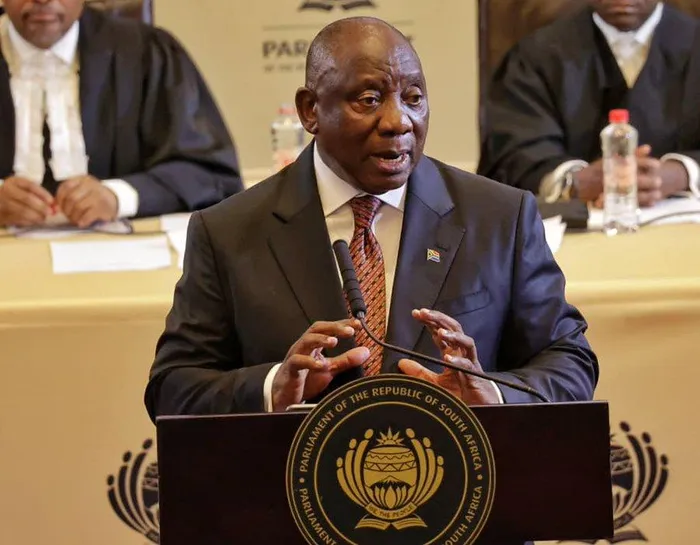
During his SONA last night, President Cyril Ramaphosa threatened criminal charges against municipal managers over water supply failures
Image: GCIS
PRESIDENT Ramaphosa has warned municipal managers they will face personal criminal charges for water supply failures, with 56 municipalities already facing cases.
Speaking during his State of the Nation Address (SONA), he announced the formation of a National Water Crisis Committee and R156 billion in funding to address South Africa's urgent water infrastructure challenges.
He said they would be charged under the National Water Act, with 56 municipalities already facing criminal cases for failing to meet their obligations, IOL reported.
Ramaphosa said that water shortages have become one of the country’s most urgent issues, alongside crime, affecting cities, towns, and rural communities alike.
He said water, alongside crime, has become one of the country’s most pressing issues, affecting large cities like Johannesburg, smaller towns such as Knysna, and rural areas including Giyani.
He noted that recent protests in Gauteng were fueled by frustration over inadequate access to basic services.
He said he has directed the Minister of Water and Sanitation, her deputy, and the Minister of Cooperative Governance and Traditional Affairs to engage directly with communities, explaining government plans to address shortages.
According to Ramaphosa, damaged pipes are being repaired, and reservoirs are filling, but the root causes remain years of poor planning, inadequate maintenance, and systemic failures in municipalities.
“There is no silver bullet to address this challenge, which has its roots in systemic failures and many years of neglecting infrastructure,” he said.
He added that long-term solutions include building new dams and upgrading existing water infrastructure.
Ramaphosa said the government had committed more than R156 billion in public funding for water and sanitation infrastructure over the next three years, including projects such as the Lesotho Highlands Water Project and the Ntabelanga Dam, part of the Mzimvubu Water Project in the Eastern Cape.
He also said a National Water Resource Infrastructure Agency is in its final stages of establishment to manage the country’s water systems more effectively and mobilise funding.
''To address the challenges effectively, we will not hesitate to use the powers enshrined in the Constitution and in the Water Services Act to intervene in municipalities where necessary. We will hold to account those who neglect their responsibility to supply water to our people.
''Government has already laid criminal charges against 56 municipalities that have failed to meet their obligations. We will now move to lay charges against municipal managers in their personal capacity for violating the National Water Act,'' he said.
The president stressed that the real challenge is not water availability but getting water to people’s taps.
The Water Services Amendment Bill will hold water service providers accountable and allow the withdrawal of licenses from those who fail to deliver, he said.
“If a municipality is not willing or able to provide a service to its residents, it must be done by another structure that can.''
To tackle the immediate crisis, Ramaphosa announced the formation of a National Water Crisis Committee, which he will chair, to coordinate national efforts, deploy technical experts, and direct resources to municipalities experiencing water challenges.
He drew parallels with the National Energy Crisis Committee established three years ago during rolling power cuts, noting that a focused, well-coordinated plan helped overcome what had seemed like an insurmountable challenge.
Ramaphosa said revenue mismanagement was another major concern. In many metros, cities, and towns, funds collected from water services were being diverted to other purposes, leaving little for infrastructure maintenance.
To address this, he said the government has introduced a R54 billion incentive for metros to ensure that revenues from water, sanitation, and electricity services are reinvested into infrastructure, including pipes, reservoirs, and pumping stations
The president also highlighted the systemic dysfunction in many municipalities.
''Water outages are a symptom of a local government system that is not working.''
He said local government administrations are weak and often governed by patronage rather than technical capacity or merit.
According to the Auditor-General, local government is “characterised by insufficient accountability, failing service delivery, poor financial management and governance, weak institutional capability and widespread instability,” he said.
“Arresting the decline of local government will require our collective action. We are now taking collective action,” Ramaphosa said.