
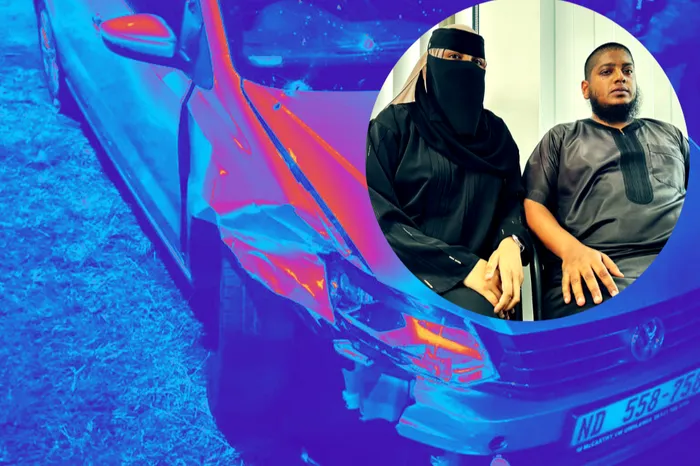
The lives of Omar and Asma Ismail have been completely changed. The couple and their 21-month-old daughter, Yusraa, were caught in the crossfire between the police and hijackers and now they are pleading for intervention from the police minister.
Image: IOL Graphics
THREE years after police bullets tore through their car in Durban, Omar Ismail lives with a bullet in his brain, his toddler carries shrapnel in her body, and his wife Asma lost her leg.
As their health deteriorates, they fight for justice against a police service that claimed they drove into crossfire - a narrative the family claimed evidence had thoroughly disproven.
For Omar, fragments remain lodged in his skull and are too dangerous to remove, IOL reports.
Doctors have warned that surgery could kill him. So he wakes each morning knowing the metal is still there, pressing against his brain, shaping his memory, his speech, his future.
His little girl, Yusraa, carries her own burden. Shrapnel remains in her small torso. It cannot be removed. Loud sounds still frighten her. Car rides still unsettle her. She was just 22-months-old when she was shot.
His wife, Asma Mahomed, once strong and independent, lives with a missing limb. A single police bullet tore through her lower right leg. Surgeons amputated it to save her life and the life of the unborn child she carried that night.
This is the reality the Durban family has lived with for years.
Now, they are pleading, again, to be heard.
In recent weeks, Omar and Asma sent fresh memorandums to the office of Police Minister Professor Firoz Cachalia.
Their nightmare began on a short drive home along Sheringham Road in Overport on the evening of July 16, 2021.
Without warning, police opened fire. Bullets tore through their VW Polo. Omar was shot in the head. Asma’s leg was shattered. Their toddler was struck by shrapnel.
The family has since launched legal action against the Minister of Police, arguing that officers acted recklessly.
Police, however, maintain they were pursuing armed suspects in a silver Toyota Etios and that the Ismails were caught in crossfire during the operation.
In their latest submission to the minister, they describe a trial that stripped away the police narrative piece by piece. They point to CCTV footage, ballistic evidence, and eyewitness testimony which they say shows there was no hijacking and no fleeing suspects. They say police officers fired directly at their vehicle.
They describe how police vehicles showed no bullet damage. How no officers were injured. How an independent eyewitness testified that only police officers were shooting. How a police ballistic expert’s findings supported their account, not the State’s.
They say the defence relied on a silver Toyota Etios that never existed at the scene. They say photographs used to justify the shooting do not match the vehicle police later presented as evidence.
For Omar and Asma, this is not about winning an argument in court. It is about time running out.
Asma said the incident has also left her family struggling to cope with the long-term physical and emotional scars.
"Every day is a reminder of what happened. Our lives have been completely changed. We want the police behind the incident to be held accountable,” she said.
In their letters, they tell the minister that Omar’s health continues to decline. Bullet fragments remain in his brain. His cognitive abilities are deteriorating. They fear what will happen if judgment drags on for years through appeals.
They write about their daughter, who will grow up with shrapnel inside her body and memories she is too young to understand. They write about Asma learning to live on a prosthetic limb, her career and independence stripped away in seconds.
They write about dreams that died on that road. Plans to move abroad. A stable future. Financial security. All gone.
Now they live with Asma’s mother. They rely on family. They survive day by day.
“We desperately need your help,” they wrote.
They say they sent memorandum after memorandum. They say they received silence.
Police have stood by their version of events. The family stands by the wounds etched into their bodies.
As the High Court prepares to deliver judgment, the Ismails remain suspended in the aftermath of gunfire that never truly stopped.
A bullet still sits in Omar’s skull. Shrapnel still lies in his child’s body. A leg is still missing.
According to Ismail's legal team, instead of taking responsibility for their actions, the police have argued that Omar Ismail effectively consented to the risk by driving into what they describe as an active shooting scene, a defence the family strongly disputes.
“They raised issues which are in the pleading that Omar here had been responsible for the injuries to his wife and his child and himself because he knew he was driving into gunfire and therefore he is what you call consenting to self-inflicting injuries.”
“In other words, when you go on the Big Swing [like at Moses Mabhida Stadium], and you decide that I'm taking a voluntary risk of harm, it's a legal principle in our law. “You take it, you sign off a waiver. He didn't sign any waiver; he's just driving on the road in this way.”
The police ministry did not answer detail questions sent to it by the time of publication.