Surtie family's R1.35 trillion claim: settlement negotiations on the horizon
DECADES OF LEGAL BATTLES
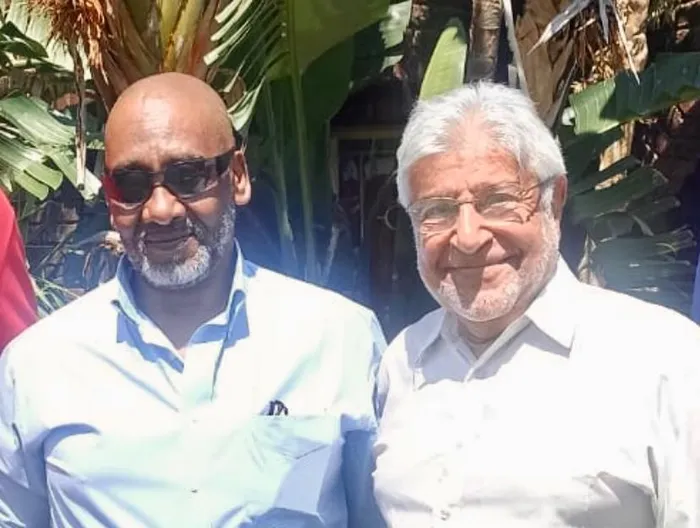
Jeff Koorbonally (left), forensic investigator who is assisting the Surtie family in their claim against the PIC and finance minister, with former Judge AB Mahomed.
Image: Supplied
AFTER decades of legal battles, the Surtie family's massive R1.35 trillion claim against the Public Investment Corporation could finally be heading toward settlement.
Financial expert and forensic expert, Edward Koorbanally revealed the family might accept R800 billion to resolve the dispute over offshore inheritance assets dating back to apartheid-era South Africa.
The claim stemmed from an offshore inheritance worth multi-billions belonging to the late Abdul Razak Tayob Surtie, IOL reported.
Koorbanally, who was instructed by the family to assist them in instituting the claim, said the first step was to add Finance Minister Enoch Godongwana, in his official capacity, as a party to the proceedings.
This application will be launched on an unopposed basis on April 16 before the Gauteng High Court, Pretoria.
The lawsuit brought by the Surtie family against the Public Investment Corporation (PIC) and the Government concerns the payment of R1.35 trillion, which is thought to have been held by the PIC.
The late Abdul Razak Tayob Surtie's wife and executrix is at the centre of the legal dispute.
The Surtie family stated that the late Surtie was the beneficiary of offshore inheritance assets, which were repatriated in 1984 after the process was initiated by the Lesotho Branch of Barclays Bank Limited.
The Surtie family has been embroiled in protracted legal proceedings in a bid to recover the money from the PIC.
The family alleges that offshore inheritance assets valued at more than $36 billion in 1984 and grew to R1.35 trillion through government bond investments, were held in a restricted account by the PIC.
The funds originated from diamond mining claims and share portfolios managed by Barclays Bank International.
Koorbanally has established from the Absa Group that assets relating to the share certificate belonging to the deceased, of $36 billion, were transferred into the deceased’s account in 1984.
The funds, it is said, were deposited into a special restricted account in the 1980s. Under the apartheid government’s regulations and laws, such payment was prohibited. The PIC subsequently invested the funds in South African government bonds, which were underwritten by the South African Reserve Bank, the claimants said.
In the latest developments, Koorbanally and the family said in the amended plea that the minister acted unlawfully when he directed that the money should be retained by the PIC.
The claimants argue that without mandatory relief from the court, they will suffer irreparable harm, as the PIC will not be required to repay the assets unless a decision is made by the minister.
While this legal saga has been dragging on for years, Koorbanally has said that there is a possibility that an out-of-court settlement could be reached between the parties.
He explained that once the finance minister is formally joined to the Surtie matter, the case moves out of the "procedural completion" phase and into substantive resolution.
In outlining the roadmap for the legal proceedings, he said that once the minister is joined, he can either choose to file an intention to defend and file his official defence to the claim.
But Koorbanally pointed out that in a 2022 judgment, the court had already confirmed the existence of the account and the bonds. The minister can also choose to remain a passive joinder to the litigation.
Koorbanally added that if settlement negotiations do not materialise, a pre-trial conference to map out the way forward will be held after pleadings have closed, whereafter trial dates will be allocated.
But Koorbanally predicts that an out-of-court settlement, rather than a full trial, is more likely.
Regarding possible mediation and subsequent settlement negotiations on the amount, Koorbanally said that while they are claiming R1.35 trillion plus interest from 2019 on this amount, they may be willing to abandon the interest.
Further, they are also willing to consider reducing the R1.35 trillion to R800 billion. But he made it clear that this is as far as he and the family are willing to go.
According to Koorbanally, mediation leading to a possible settlement is a sensible route to follow in this matter, given the already heavy caseloads of the courts.