
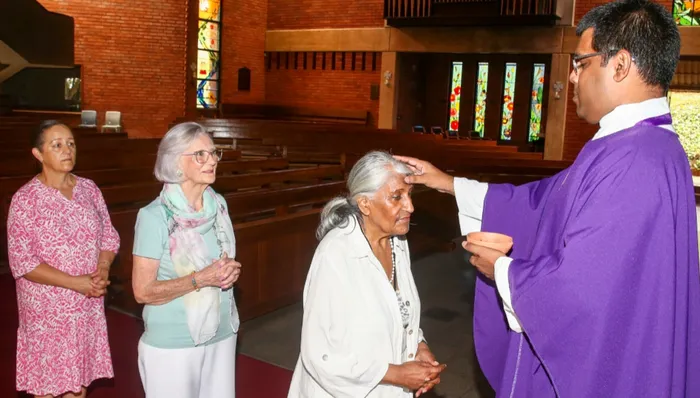
Father Michael Nadaraju, the parish priest of the Parish of St Joseph on Florida Road, places ash on the forehead of parishioner, Maureen Veeriah. Behind her is Maureen André and Therais Duval. Ash is placed on the forehead to mark the beginning of Lent, symbolising repentance, mortality, and humility before God.
Image: Leon Lestrade/Independent Newspapers
ASH Wednesday marks the beginning of the holy season of Lent, a 40-day journey of prayer, fasting and almsgiving that prepares Christians for the celebration of Easter. On this day, we come forward to receive ashes on our foreheads and hear the sobering words, “remember that you are dust, and to dust you shall return”, or “repent and believe in the Gospel".
These words are not meant to discourage us, but rather to awaken us – to remind us of who we are, whose we are, and how we are called to live. At its heart, Ash Wednesday calls us to humility. The ashes, made from burned palms of the previous year’s Palm Sunday, remind us that worldly success, power and status are temporary.
In a world that often celebrates wealth, influence and outward achievement, Ash Wednesday gently but firmly shifts our focus back to what truly matters: our relationship with God and with one another. It invites us to pause, reflect and acknowledge our dependence on God’s mercy and grace. This message of humility and repentance speaks powerfully into the reality of our country today.
We live in a time marked by deep challenges – economic hardship, unemployment, corruption, crime, inequality and social division. Many people feel disillusioned, angry or hopeless. There is a growing sense of mistrust: mistrust in leadership, mistrust between communities, and even mistrust in institutions meant to protect and serve.
Ash Wednesday asks us to look honestly at ourselves, not just as individuals, but as a nation. Repentance, one of the central themes of Ash Wednesday, is not merely about feeling sorry for personal sins; it is about a change of heart that leads to changed actions. As a country, Lent invites us to ask difficult questions: where have we lost our moral compass? Where have selfishness, greed and indifference taken root? How have we contributed – through action or silence – to systems that harm the vulnerable?
These are uncomfortable questions, but Ash Wednesday reminds us that healing begins with truth. The practice of fasting during Lent also carries a strong message for our current context. Fasting is not simply about giving up food or small comforts; it is about learning self-control and solidarity with those who have less. In a society where many go hungry while others live in excess, fasting challenges us to become more conscious of inequality and to respond with compassion. It invites us to live more simply so that others may simply live.
Almsgiving, another pillar of Lent, speaks directly to the widespread poverty and desperation we see around us. Ash Wednesday calls us to move beyond charity that is convenient and into generosity that is sacrificial. It challenges us to open our eyes to the suffering of our neighbours, and to become instruments of God’s love and justice. Small acts of kindness, advocacy for fairness, and support for community initiatives can all be expressions of living out the Gospel in practical ways.
Perhaps most importantly, Ash Wednesday offers hope. While the ashes remind us of our fragility, they are placed in the shape of a cross – a powerful sign that suffering and death do not have the final word. In a country weary from broken promises and ongoing struggles, this is a message we desperately need. God is still at work. Renewal is possible. Conversion – personal and collective – can lead to transformation.
As we begin Lent, Ash Wednesday invites us to recommit ourselves to being people of integrity, compassion and courage. It challenges us to examine our hearts, to repent where we have gone wrong, and to choose a better way forward. If we take its message seriously, Ash Wednesday can become more than a ritual; it can be the starting point for healing – within ourselves and within our nation.
Father Michael Nadaraju is the parish priest of the Parish of St Joseph on Florida Road.