

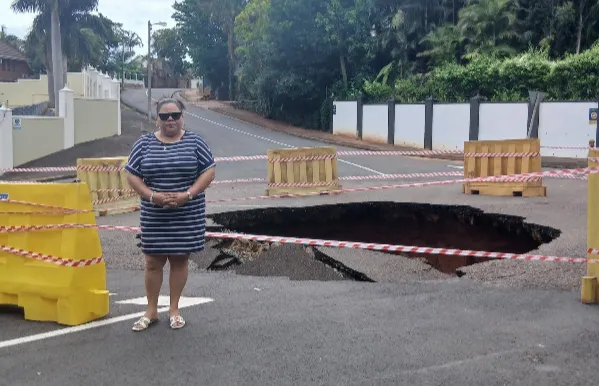
Ward 33 councillor Fran Kristopher stands in front of a sinkhole at the intersection of Howard and Sir Duncan roads in Glenwood.
Image: SUPPLIED
RESIDENTS of Glenwood and Bulwer are facing a troubling surge in sinkholes, with 16 incidents reported in the last seven months, raising concerns about local infrastructure and safety.
The latest incident unfolded over the weekend, driven by heavy rains, with a significant sinkhole emerging at the intersection of Howard Avenue and Sir Duncan Road in Glenwood.
A video shared on Facebook by Ward 33 councillor Fran Kristopher captured the alarming scene.
She told POST: “I was alerted by my local security team regarding the road caving in during the early hours of Saturday, due to the storm. I immediately contacted both the metro police and the city’s roads department for a traffic management plan, and safety measures to be put in place.
“The city’s roads and stormwater departments assessed the damage this morning (Monday), and a rehabilitation plan is in progress as I believe the stormwater pipe has collapsed. I urge all motorists to avoid the area as the road is extremely dangerous and unstable.
Keyuren Maharaj, chairperson of the Glenwood/Bulwer Ratepayers and Residents Association, said this was not just a once-off incident, but pointed to a deeper infrastructure strain.
“Over the past six to seven months, we have seen a noticeable increase in sinkholes and broader structural failures in the Glenwood and Berea area. In fact, 16 sinkholes have been reported in this area alone during that period.
“However, what is encouraging is that this specific sinkhole was logged directly on CityMenderSA. That’s exactly how the system is meant to work. Residents report the issue, which is then time-stamped, mapped, escalated, and can be tracked publicly.
“We are actively teaching residents how to use the platform because the only way we solve infrastructure failure long-term is through historic data, accurate tracking, and better planning. If issues aren’t recorded and monitored over time, they simply disappear into the system,” he said.
Maharaj said technology like this doesn’t replace municipalities, it strengthens them.
“It provides structured data, patterns, ward-level insights, and early warning signals. It helps cities move from reactive repairs to proactive planning. We are currently engaging the city in discussions around a broader partnership to expand this type of infrastructure tracking into more areas.”
Gugu Sisilana, the eThekwini Municipality’s marketing and communications deputy director, said: “The city is aware of the sinkhole and has already engaged with the ward councillor regarding the matter. The city's roads and stormwater maintenance division has securely barricaded the area as a precautionary measure. Municipal teams are currently assessing the cause, after which the appropriate remedial steps will be communicated.”