

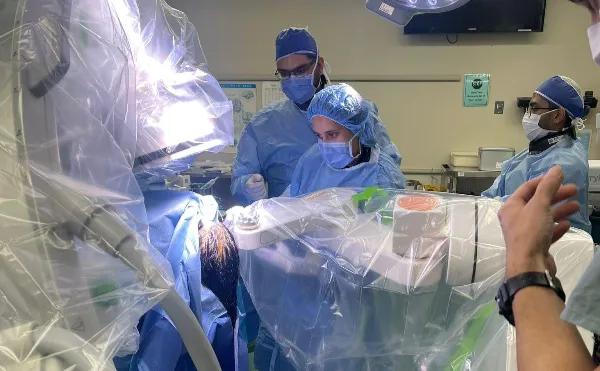
Hope for epilepsy patients: Dr Aayesha Soni's groundbreaking surgical programme.
Image: SUPPLIED
DOCTOR Aayesha Soni, South Africa's first female adult epileptologist, is transforming epilepsy treatment through her innovative surgical programme, offering hope and independence to countless patients
"It's kind of been like a journey that chose me. I never aimed to be the first,” said Dr Soni.
At just 35, she has carved her name into South Africa's medical history as the country's first female adult epileptologist, and she is determined to change what epilepsy means for thousands of families.
For her, it is no longer only about managing seizures with lifelong medication. It is about the possibility of freedom.
She pioneered the Restoration of Independence through Surgery for Epilepsy (Rise) programme, a bold initiative aimed at offering permanent surgical treatment in the public sector.
On Saturday, that vision will take tangible form at Groote Schuur Hospital, where she has organised a free day of epilepsy procedures, a first for a public institution in the country.
Behind the milestone is a woman who speaks with calm conviction about work that transforms lives.
The initiative will start by carrying out two temporal lobectomies, a type of brain surgery used to treat severe epilepsy that does not respond to medication.
The doctor explained also what actually causeD epilepsy. She described it as a 'scar in the brain', an area that cannot heal like other tissues.
That scar becomes a hotspot where seizures originate. "It's literally an electrical storm in the brain, because how the brain communicates is with electricity. When there's a scar, it causes dysfunction and then it causes an electrical storm."
Epilepsy affects more people than HIV, she emphasised, yet it is still widely misunderstood and often poorly treated.
With Rise, Soni works alongside the Gift of the Givers and two neurosurgeons, Dr Sally Rothemeyer and Dr Jesse Bulabula, a collaboration she hopes will signal the start of something far bigger than a single surgical day.
For many, brain surgery sounds terrifying. But she gently dispels the fear.
"It's a rather safe surgery in terms of neurosurgical procedures, with low postoperative complications rates. There will generally only be a fairly small scar on the side of the head," she told IOL.
She said that the operation typically lasts just several hours and carried a strong safety profile.
"There's a really low complication rate...A lot of these patients have multiple seizures a week, and they can't drive or work. They are, most of the time, depressed, anxious, with the condition affecting the relationships."
The procedure specifically targets the area of the brain responsible for triggering seizures. Recovery, she explains, is often quicker than people expect.
"Usually, patients stay in the hospital for maximum a week, recovery is quite fast. If there are no complications, recovery can be within a month, and they can actually then be seizure-free," she said.
Seizure-free. Two words that can mean the difference between dependency and independence. Between stigma and dignity and between a life confined by unpredictability and one reclaimed.
Yet, despite the life-altering potential of surgery, access remains heartbreakingly limited. There are no epilepsy surgical programmes in any of South Africa's public hospitals.
The sole established private programme is at Mediclinic Constantiaberg Hospital, alongside a medical clinic in Cape Town. Patients from across the country, and even from Sub-Saharan Africa, must travel there in hope to get the procedure.
For families without means, the journey is often impossible. The ambitious doctor assured IOL that the surgery is not experimental.
"The Food and Drug Administration (FDA) approved it back in 2001 already, and it's being used all over the world.
"It's just that in resource-limited settings, it's not available because we don't always have the skills or the infrastructure, and it really takes away, like, a good opportunity for these patients because the surgery itself is really small, so they almost never have, like, any functional deficit afterwards."
She has seen first-hand what happens when the system does work.
The very first epilepsy surgery she was involved in took place in December 2020, a 17-year-old refugee from the Democratic Republic of Congo (DRC).
"At the time, he wasn't able to study for matric as he was having four seizures a week, and then he studied and went on to tertiary to study information technology (IT), which he wanted to do."
She earned her medical degree at the University of the Witwatersrand, before completing diplomas in Primary Emergency Care and Anaesthetics through the Colleges of Medicine of South Africa.
She then went on to pursue a Master of Medicine in Neurology at the University of Cape Town, honing her expertise in brain disorders and patient care.
Her training did not stop there. In 2025, she completed a clinical fellowship in Epilepsy and Electroencephalography at Western University in Canada, gaining specialised skills in diagnosing and surgically treating complex epilepsy cases.
She is also a Fellow of the Colleges of Medicine in Neurology.
Soni sees the initiative as a powerful example of the South African spirit of Ubuntu and of making things happen despite obstacles.
She also hopes it will shine a light on epilepsy, a condition that disproportionately affects people in resource-limited settings, with rates up to ten times higher than in wealthier countries.