

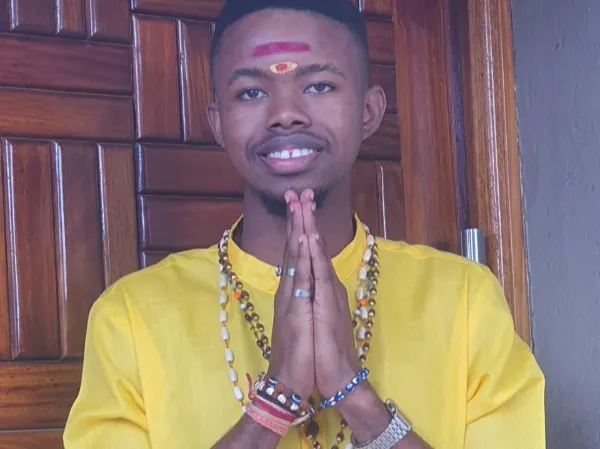
Thandolwethu Zungu, known as 'Guru Raj'.
Image: Supplied
At just 23 years old, Thandolwethu Zungu has taken an extraordinary spiritual path that has transformed him from a boy raised in a Christian household into a practising Hindu, and now a self-taught priest known to many on social media as Guru Raj.
Zungu, who grew up in Newcastle, traces his spiritual awakening back to his childhood at Suryaville Primary School, a predominantly Indian school where daily assemblies included the Indian national anthem and the chanting of the Gayatri Mantra.
“I was around 9 years old when I found interest in Hinduism and the devotion increased by age 13, which was when I started learning poojas (prayer) and mantras (reciting sanskrit). I attended a diverse school where everyone was allowed to practise their faith. But what drew me to Hinduism were the festivals, the dancing, the food and the music.”
He became captivated by Bollywood films and devotional music, collecting DVDs and CDs as a child.
“When you watch those movies and see prayers being answered, or someone saved through faith, it makes you curious. I wanted to know more,” he said.
Television broadcasts of Diwali celebrations on SABC deepened that curiosity.
“They would talk about Ganesha and Lakshmi. I kept asking myself, ‘What is happening here?’ I had so many questions.”
Born into a Christian family that also observed African traditional practices, Zungu’s early interest in Hindu imagery puzzled his teachers and family.
He remembers cutting out newspaper pictures of deities such as Ganesha and Lakshmi and placing them on his desk at school.
“At home, they thought it was just a phase because I was watching too many Indian movies. But it became serious when I started buying murthis (statues).”
He purchased statues of Shiva, Durga and Ganesha from a local prayer store near his school. Without a guru or formal instruction, Zungu turned to YouTube and online resources to teach himself mantras, pujas and rituals.
“I did not know anything at first - no mantras nor procedures. I researched everything. I learned from Hindi, Tamil, and Telugu traditions. I wrote the mantras down in my own way, so I could pronounce them properly.”
His family’s reaction was not always supportive, he said.
At one point, priests were called to pray over him amid fears he was “possessed”.
“It was very painful. But even when they prayed, I found myself chanting Shiva’s name in my head.”
Despite the tension, Zungu remained steadfast.
“There was always something inside me telling me I am on the right path.”
Today, Zungu embraces Hinduism as a way of life rather than a break from his heritage.
“What is beautiful about Dharma (a foundational concept in Indian religions) is that it does not stop me from respecting my ancestors. In African tradition, we light sage and offer fruit. In Hinduism, we light agarbatti and offer fruit. There are similarities. It is just different forms.”
He has also chosen to refrain from eating beef, a decision respected by his family. While they remain Christian, they now join him during certain rituals, including hawans (fire offerings).
“My mother and grandmother participate and that makes me happy.”
Known online as Guru Raj, a name he says classmates gave him years ago, Zungu has built a following on TikTok, where he shares devotional songs, mantras and tutorials on rituals such as cleaning and preparing prayer lamps.
“My intention was to inspire the youth. Sometimes families tell children what to do, but they do not explain why. When I post mantras, I include the meaning. If I can chant it as a black person, you can chant it too.”
He says social media unexpectedly elevated his profile within Hindu communities beyond Newcastle, including in Johannesburg and Lenasia. While he has faced occasional criticism online, he says most Hindus have welcomed him warmly.
“They never make you feel different. When I sit with them, I forget I’m the only black person there. They treat me like family.”
Zungu describes a profound emotional connection to the deities he worships, particularly Shiva and forms of the Divine Mother. During devotional singing, he says, he sometimes feels overwhelmed.
“There are moments when a bhajan is so powerful I feel like I could cry. It feels like a miracle. Most of what I know, no one taught me. I feel called.”
He recently challenged himself to memorise complex Yajurveda mantras in just three days ahead of Maha Shivaratri.
“If you want to learn a mantra, write it down. Play the audio, repeat it, understand it.”
Though he has never formally studied in India, he hopes to travel there one day to deepen his knowledge.
“For those curious about Hinduism, Dharma needs someone open-minded. You keep learning every day. There is no end to it.”
He emphasises that Hinduism, in his view, recognises one supreme reality expressed in many forms.
“There are many ways to reach God,” he says. “God is called by different names.”
Looking back on his journey, Zungu said he could not imagine returning to Christianity, though he respected other faiths.
“When my family prays, I join them. When I do puja, they join me. There is mutual respect now.”
“From a curious schoolboy enchanted by Bollywood to a self-taught priest guiding others online, I hope my journey shows the possibilities of faith across cultural lines. I never planned to be called a guru. But people kept saying it. So I accepted it. If someone else can do it, you can too,” said Zungu.