

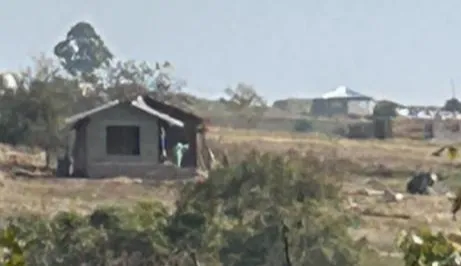
Houses that have allegedly been illegally built on privately-owned land in Emona, Tongaat.
Image: Supplied
THE eThekwini Municipality plans to enhance its land invasion unit's security in preparation for the 2026 Local Government Elections but the short-term capacity intervention requires R3 million for a tactical training budget.
The municipality’s security management services directorate presented its land invasion strategy and implementation plan to the eThekwini Executive Committee (Exco) on Tuesday.
Bhekinkosi Mkhize, the operations director of the security management services, explained that the anticipated land invasion risks during the upcoming election period necessitated immediate interim capacity support.
He said the current staff complement of 70 personnel was critically insufficient to monitor, prevent, and respond to land invasion activities occurring on an almost hourly basis across all regions of the eThekwini Municipality.
Through the learnership programme, the unit employed 88 learners to augment operational capacity. He said the learners have completed the Private Security Industry Regulatory Authority (PSIRA) accredited training. The unit members also have the National Qualifications Framework (NQF) Level 3 - basic security services skills programme.
"Additional tactical training is required to enable learners to effectively support land invasion operations under supervision. There is a proposal to engage learners on a two-year fixed-term contract at a cost of R25 million per annum for business continuity,” Mkhize said.
The land invasion control unit responds to threats and early-warning alerts from user departments and the community. Mkhize explained that most land invasion incidents occured outside normal business hours, requiring sustained after-hours operations and heightened readiness.
“Escalating land invasions erode property values, disrupt planned developments, and result in unlawful and unsafe use of water and electricity infrastructure. Incursions directly undermine approved spatial development and service-delivery programmes."
He reported that land invasions were intensifying across the city, affecting urban spaces, state-owned, and private properties.
“Informal structures can be erected in 60 minutes; monitoring is limited, so structures are often occupied before discovery. The unit currently addresses only two primary responsibilities, leaving monitoring largely unaddressed.'
Mkhize said he wanted to implement a strategic shift and move from reactive enforcement to early intervention, coordination and prevention.
He said the strategy was anchored on three core pillars, supporting the prevention of new informal settlements within the existing legal framework.
The three core pillars are:
1. Strengthening relations with traditional leadership and key landowners
2. Establishment of ward committees and community forums
3. Engagement with affected stakeholders and illegal occupants
“We are strengthening in-house security capacity and the deployment of 24/7 rapid response units to intervene during the construction phase of illegal structures. We will utilise court interdicts to halt or slow land invasions,” he said.