

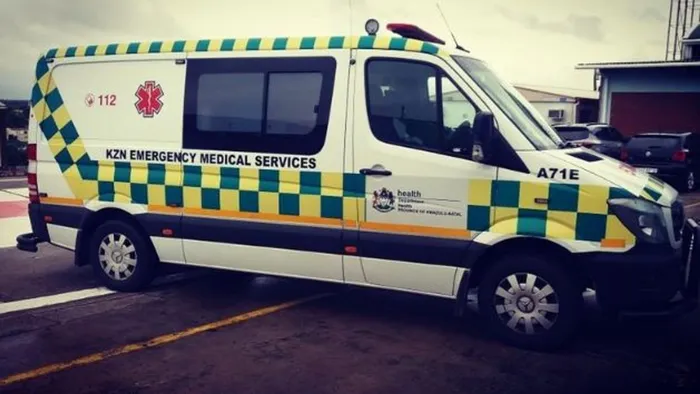
Communities report waiting times from two to 24 hours for ambulances in urban and peri-urban areas, and six to 48 hours or longer in townships and rural communities.
Image: File
THERE are urgent calls for the government to prioritise funding for emergency medical services, as alarming state ambulance shortages lead to dangerously long response times, risking lives in critical situations.
Amid the shortages, recent findings have also shown that state ambulances were operating without the required certification from traffic authorities.
It has been reported that the shortage of ambulances affects those in life and death situations, as response times for ambulances have reached between two to 24 hours in urban and peri-urban areas; and six to 48 hours or longer in townships and rural communities.
Dr Imran Keeka, the chief whip for the DA in the KwaZulu-Natal Legislature, said the province had about 460 ambulances.
He said that following sustained oversight, including interventions by the standing committee on public accounts (Scopa) and engagement with the National Treasury and fleet authorisers, the number of operating vehicles had improved somewhat.
“We are still far from having the full fleet operational. On a good day, between 120 and 180 vehicles may be active across the province. That figure fluctuates depending on vehicle availability and staffing levels. However, it is far from what we really need.
“The situation remains distant from the at least 1 200 ambulances which are needed. Since 2024, the portfolio committee on health has treated Emergency Medical Services (EMS) as a focal point for turnaround.
“But this will not be resolved overnight. It depends heavily on disciplined financial management within the KZN Department of Health.
“A rapid or large-scale overhaul would require a significant cash injection from the National Treasury, and, regrettably, that is unlikely to happen in the current fiscal climate,” Keeka added.
He said it had been reported that ambulances had arrived three or more hours later, and in some cases, eight hours after a distress call.
He said there had been cases where the ambulances never showed up at all.
“This is indeed a bitter pill to swallow. The core challenge is funding. The state cannot cope alone. We need more ambulances, more support vehicles, more personnel, and properly maintained equipment. Instead, we are dealing with an ageing and often decrepit fleet, with vehicles spending months in workshops before being returned to service, which does not bode well. Sometimes the ambulances are in the workshop for simple things like tyres, wiper blades or a fan belt problem,” he added.
Last month, Tim Brauteseth, the DA KZN spokesperson on Scopa, said through the intervention of the National Treasury’s sustained exposure by Scopa, and the DA’s determination to pursue accountability, had led to an improvement in the province’s ambulance fleet.
“Without these interventions, the crisis would have continued unchecked, with devastating consequences for healthcare delivery. To date, pressure on relevant stakeholders has resulted in 70 ambulances being returned to service during the past two months.
“As of September 2025, 60% of KZN ambulances and more than 50% of KZN EMS vehicles were out of service, with some retained by dealerships for months. These failures directly undermined emergency response capacity and patient safety.
“Issues identified include delayed inspections, poor workmanship, excessive retention of vehicles, price discrepancies, and even allegations of collusion and fraud,” Brauteseth said.
IFP councillor Jonathan Annippen said families were forced to transport patients themselves to hospital to try to save their lives.
“Communities report waiting times from two to 24 hours for ambulances in urban and peri-urban areas, and six to 48 hours or longer in townships and rural communities.
“In some cases, ambulances never arrive at all. Emergency calls are often logged, escalated and re-escalated, yet patients are left unattended for dangerously long periods.
“This disconnect between reported performance and lived experience raises serious concerns about data integrity, accountability, and transparency. There are numerous reported cases that illustrate the gravity of the crisis:
“Patients suffering strokes or heart attacks wait hours, resulting in permanent disability or death. Accident victims left on roadsides while families are told that there are no ambulances available.
“Women in labour are forced to use private vehicles, taxis or bakkies to reach hospitals. Families transport critically-ill relatives themselves because repeated calls to EMS yielded no response.
“These are not isolated incidents. They reflect a pattern of systemic collapse, not sporadic operational failure. From a governance perspective, the effectiveness of state ambulance services in our area is severely compromised,” he added.
Annippen said that while the mandate of the public EMS is to provide timely, lifesaving interventions, the reality on the ground falls far short of this obligation.
He said the system was under-resourced, overstretched, and poorly managed.
“Ambulances are too few, staff morale is low, and operational readiness is inconsistent. In many instances, communities report that calling an ambulance has become an act of hope rather than a guarantee of help.
“This is not a reflection on front-line paramedics, many of whom work under extreme pressure with limited support. Rather, it points to systemic failures at policy, budgeting, fleet management, and leadership levels.
“The impact on communities is profound and deeply unjust. First, there is a loss of life that is entirely preventable. Delayed emergency care directly translates into deaths that should never have occurred in a functioning health system.
“Second, communities are experiencing psychological trauma and loss of trust in the state. When people realise that emergency services cannot be relied upon, it erodes confidence in the government as a whole,” he added.
Annippen said the crisis exacerbated inequality.
“Poor and working-class communities suffer the most, while those with financial means are able to access private emergency care. In effect, emergency health care has become class-based, which is morally and constitutionally indefensible.
“Private ambulance services fill the gap, but only for those who can afford it. Private EMS providers are often quicker, better equipped, and more responsive. However, they operate on a fee-for-service basis, making them inaccessible to the majority of residents.
“The state appears to be outsourcing its constitutional responsibility by default, not by design, allowing private services to compensate for public failure without addressing the root causes.
Emergency medical care is not a luxury, it is a public good. Reliance on private ambulances as a safety net normalises state failure and entrenches inequality.
“This is not merely a health issue. It is a governance and accountability crisis. The shortage of ambulances and unacceptable response times reflect poor planning and budgeting, weak fleet and asset management, inadequate oversight and consequence management, and a failure to prioritise emergency health care as a matter of urgency.
“How many lives must be lost before emergency medical services are treated as non-negotiable? Communities deserve better. Front-line workers deserve support. The state must be held accountable,” Annippen added.