

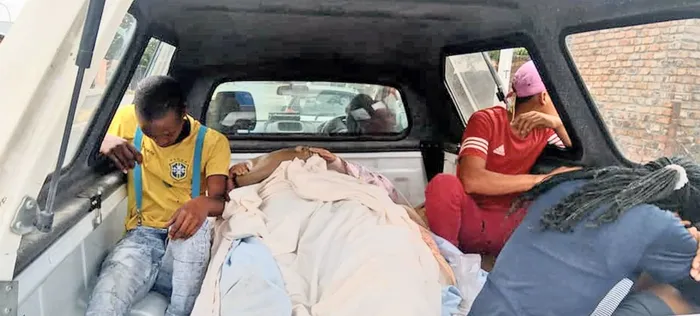
Residents claimed they were forced to transport patients in private vehicles and taxis with no medical equipment or trained personnel.
Image: SUPPLIED
COMMUNITY leaders in Phoenix and Chatsworth are urging the KwaZulu-Natal Department of Health to address critical ambulance shortages, highlighting the dire consequences faced by residents who are forced to transport patients without medical assistance
Residents claimed they were forced to transport patients in private vehicles and taxis with no medical equipment or trained personnel.
“The ambulance crisis in Phoenix, has reached dangerous and unacceptable levels. This is no longer just a service delivery concern, but a matter of life and death.
“We raised red flags early last year when the delays in the ambulance response times became critical. However, the situation has continued to deteriorate. We are dealing with repeated incidents where ambulances take hours to arrive for medical emergencies that require immediate attention,” said Val Pillay, interim chairperson for the Phoenix Community Police Forum (CPF).
She claimed state ambulances had failed at responding on time to patients with heart attacks, serious injuries, and those who collapsed at home or in public spaces.
“In some cases, ambulances simply do not arrive at all. Families are left waiting and watching their loved ones suffer. In some tragic cases, the outcomes are far worse because help did not arrive on time.
“In some cases, desperate residents transport critically-ill patients in private vehicles or taxis, without medical equipment or trained personnel. No community should be pushed into making these choices,” Pillay said.
She said on Valentine’s Day, a stabbing victim waited almost two hours for a state ambulance.
“The emergency call was logged at 10.51pm. Despite the seriousness of the incident, the ambulance s only made contact again at 1.22am. They called to request directions to the scene. After waiting for a prolonged period with no medical assistance, the family was left with no option but to privately transport the critically-injured person to hospital. This delay of more than two and a half hours in a severe trauma case is deeply concerning and highlights the severity of the crisis facing our community.
“The emotional and psychological impact on families has been devastating. People feel abandoned in their most vulnerable moments. Trust in emergency medical services has been severely eroded, and frustration is growing because these delays are happening repeatedly, not occasionally.
“While private ambulance services sometimes step in, this is not a solution. Many residents simply cannot afford private emergency care, and access to lifesaving services should never depend on financial means. The growing reliance on private services only highlights the deepening crisis,” Pillay said.
She said they hoped that the KZN Department of Health took immediate and decisive action.
“They need to urgently increase the number of operational ambulances in high-density areas like Phoenix, addressing critical staff shortages, and ensuring that response-time targets are met and monitored. Communities cannot continue to raise the same concerns year after year while lives are lost,” Pillay said.
Rocky Naidoo, from the Bayview CPF and Havenside Civic Association, claimed in Bayview last week, a resident had to wait over three hours for a state ambulance, and he eventually died.
“The elderly man had breathing problems. Every effort was made for assistance but sadly he passed on. Sometimes it takes hours for services to arrive. We understand there are only 12 ambulances available. The paramedics are competent and are very helpful, but the poor service is unacceptable,” Naidoo said.
Previn Vedan, a community leader in Shallcross and human rights activist, said in Chatsworth and Shallcross , there were multiple reports of ambulances arriving several hours after being called, or in some instances only after repeat follow-ups by family members or community leaders.
“State ambulance personnel work under extremely difficult conditions and often with limited resources. However, the service is currently under significant strain. The shortage of ambulances and staff means that, while there are committed professionals in the system, overall effectiveness is compromised by capacity constraints,” said Vedan.
“Out of desperation, people have transported critically-ill patients in private vehicles. Unfortunately, transporting patients without proper medical support can worsen injuries or medical conditions. At the same time, some residents are reluctant to use their own vehicles out of fear of legal or medical complications, and these delays can tragically result in preventable fatalities.
“The psychological impact is significant. Communities feel vulnerable when emergency medical care is not reliably accessible. Beyond health risks, this erodes public confidence in essential services. Families are placed in impossible positions, forced to choose between waiting for assistance or taking medical risks themselves.
“The burden falls disproportionately on poorer communities, particularly informal settlements, where infrastructure challenges compound the shortage of resources. Private ambulance services do assist those who can afford them or who have medical aid coverage. However, they are not a sustainable solution to a systemic public health challenge.
“Emergency medical services are a constitutional and public health imperative. While private services provide relief in some cases, the majority of residents rely solely on the state,” he added.
Vedan said long-term solutions required increased fleet capacity, improved staffing levels, better deployment strategies and focused investment in underserved communities.