

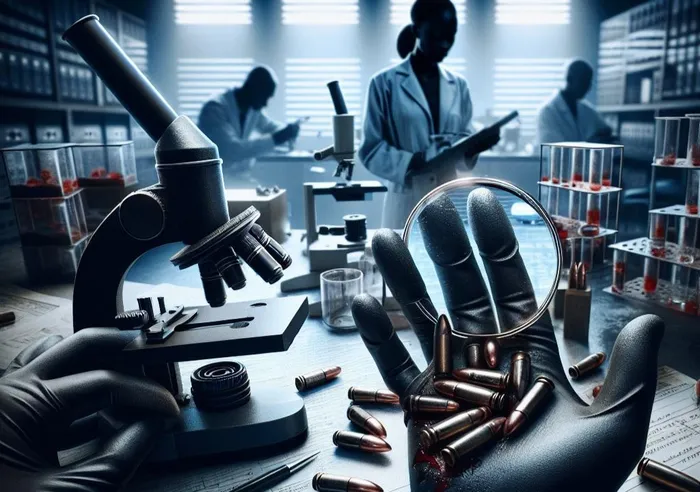
Under-resourced forensic labs in South Africa face a critical crisis, jeopardising the integrity of evidence and delaying justice for victims of violent crime.
Image: IOL / RON AI
The South African Police Service's Forensic Science Laboratory (FSL) is facing severe resource shortages and systemic issues, leading to a dangerous compromise between speed and accuracy in criminal investigations.
In these laboratories, a resource gap, backlogs, and systemic failures are forcing analysts to choose speed over science, a trade-off of “quantity over quality” that is eroding the foundation of the country's criminal justice system.
This reality was laid bare during the recent testimony of SAPS ballistics expert Captain Laurance Makgotloe before the Madlanga Commission of Inquiry into criminality, political interference, and corruption.
“Errors will arise from time to time as long as there is pressure at the lab. We push quantity, not quality,” Captain Makgotloe admitted.
Mike Bolhuis, founder of Specialised Security Services (SSS) and a veteran specialist in violent and organised crime, said the numbers emerging from the Madlanga Commission paint a picture of a system stretched past its breaking point.
He said the Ballistics Section was currently grappling with a staggering backlog exceeding 41,000 cases.
This is not just a number; it represents thousands of murder, rape, and violent crime investigations languishing, their outcomes hanging precariously on a piece of microscopic evidence that has yet to be examined.
To function effectively and service the country’s high crime rate, the Ballistics Section requires a national complement of 66 analysts, said Bolhuis, adding that it currently operated with a mere fraction.
He said the situation was dire even in crucial hubs like the Pretoria laboratory, which was a central facility requiring roughly 30 analysts, but currently had only 16 on staff.
Bolhuis warned that this crisis fundamentally reflected a failure in governance.
“The crisis in the Ballistics Section is not just about slow reports; it’s about a direct failure of the state to protect its citizens.”
According to Bolhuis, analysts could only process about 2,000 cases per month, while new submissions continued to flow in at an equal or higher rate.
This unsustainable environment means the backlog is never truly cleared.
“When analysts are drowning in backlogs, they are forced to cut corners,” Bolhuis continued.
“The sheer volume of cases means the focus shifts from comprehensive scientific examination to simply getting a report out the door, and that is a direct threat to the integrity of our court evidence,” he said.
Independent firearm examiner Jannie van der Westhuizen, also known as Wes, the owner and CEO of Wesco Forensic Services and a former SAPS crime lab analyst, echoed this concern.
He highlighted that the sustained workload pressure on Forensic Firearm and Toolmark Examiners had resulted in a heightened risk of recurring mistakes.
“Several mistakes have been noted with their forensic results when it comes to firearms and microscopic results,” said Van der Westhuizen.
He stressed that such errors are simply unacceptable in a laboratory context.
"If you have everything in place and Standard Operating Procedures (SOPs) to prevent mistakes, these things should not happen.”
The integrity of forensic work is compromised by systemic failures that extend beyond mere staffing issues.
The experts stated that the Ballistics Section's issues stem significantly from obsolete equipment and administrative failures.
Bolhuis said experts estimated that over R50 million was required just to replace old, outdated equipment, some of which was no longer supported by manufacturers.
Budgetary inadequacies prevent compliance with mandatory service, maintenance, and calibration schedules, said Van der Westhuizen.
He said this lack of investment, combined with inadequate care for current assets, was a key factor driving the backlog’s increase.
“The state doesn't have the funding to maintain the existing instruments," Van der Westhuizen observed, detailing the intense pressure this creates.
“The lack of resources and equipment, and equipment being old and not serviced regularly or calibrated, puts a lot of pressure on the experts.”
Bolhuis warned that this lack of compliance alone was enough to undermine the scientific validity of forensic results in court.
Compromised evidence integrity due to poor storage, contamination, or the use of obsolete equipment weakens cases, allowing violent criminals to evade conviction even when a report is finally submitted.
The highly skilled analysts, who are already in critically short supply, are routinely diverted from their core scientific duties, said Bolhuis, further explaining that due to critical shortages in support staff, forensic scientists are forced to perform administrative work, including procurement, tender administration, and even basic report typing.
“We have highly qualified forensic scientists, who should be on the bench solving murders and rapes, being forced to act as typists and procurement officers,” Bolhuis stated.
He said this was a catastrophic misallocation of specialised resources.
“The system is designed to fail.”
Every hour a forensic scientist spends on administrative tasks is an hour stolen from a desperate case, an hour that prolongs the backlog, and an hour that delays justice for victims.
Bolhuis said the consequences of this quantity-over-quality mentality are chilling and devastating for justice.
“Thousands of cases are delayed or abandoned because forensic evidence is unavailable.”
Van der Westhuizen lamented that these long delays place “people's lives on hold”, with some victims and accused waiting several years for essential reports.
He said the inevitable result was that courts dismissed cases.
Professor Stephen Tuson, from the Wits Law Clinic, pointed out the legal jeopardy this created, particularly for indigent accused.
While defence teams can challenge forensic evidence on the grounds of flawed methodology, such as reports being “rushed” or procedures being omitted, this requires expensive, independent expert witnesses.
“Poor or indigent accused will not have the ability to credibly challenge the police forensic report due to lack of expert knowledge, and this could result in wrong convictions of potentially innocent accused,” Tuson explained.
Conversely, skillful cross-examination by well-resourced defence counsel could raise doubt in the mind of a judge if the police expert is forced to admit to “cutting corners or omitting important tests/safeguards”, leading to acquittals based on evidence integrity issues.
This legal vulnerability is compounded by the accused person's right to a speedy trial.
As Tuson noted, if the State constantly asks for postponements due to outstanding forensic reports, the accused's rights are prejudiced.
While the State can provisionally withdraw charges and later summon the accused back to court, Tuson highlights a critical societal risk: “If the accused is charged with very serious, violent crimes like murder or rape, the courts will be reluctant to release a potentially dangerous accused back into society, pending his delayed trial. This poses a risk to society and affects all of us.”
Bolhuis said the bottom line of the Ballistics Section’s collapse was a catastrophic increase in impunity for violent criminals.
“The failure of the Ballistics Laboratory is a failure to match the bullet to the gun, meaning a failure to put the killer behind bars. It erodes public trust and gives criminals a free pass.”
The crisis is deep-seated and systemic, requiring more than mere budgetary adjustments. To regain credibility and address the crushing backlog, independent experts are urging collaboration.
“I think if SAPS wanted to gain any kind of credibility from the public, they really should take hands with independent crime labs to assist them in working towards a goal, to bring down the national backlog,” Van der Westhuizen insisted.
He stressed that independent labs are “not working against the South African Police Service labs. We would like to join them and take hands and say, listen, we all live in South Africa. We're all here. We want to make things right”.
Without such urgent intervention, Van der Westhuizen offered a dire prediction: “I think we as a country are going to lose all credibility when it comes to forensic investigations... we're going to go down a dark rabbit hole, and we're going to find ourselves unworthy of any kind of credibility and accreditation worldwide.”