

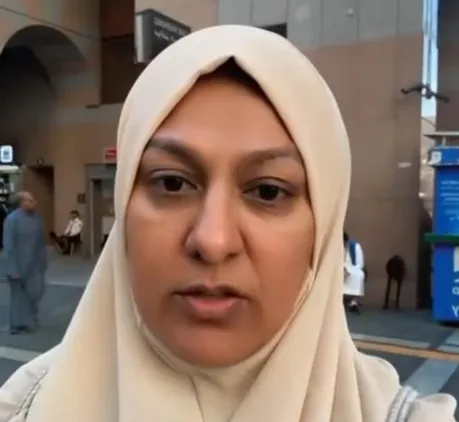
Dr Naseeba Kathrada, who was unable to return to South Africa, after flights were cancelled due to the airstrikes.
Image: Supplied
SOUTH AFRICANS living and travelling in the Middle East have shared their experience following a series of airstrikes reportedly originating from Iran, damaging the Dubai International Airport and its landmark Burj Al Arab hotel at the weekend.
Dr Naseeba Kathrada said she was unable to return to South Africa and had to seek alternate accommodation due to her flight being cancelled.
She was expected to return on a flight scheduled for this morning (Sunday).
“My sister and I had gone for Umrah in Medina and were meant to return home today. However, our flight with Qatar Airways was one of those that were cancelled. Many South Africans are currently stranded in Medina. We are now waiting for the airline to issue us new tickets, but we are also trying to book other airlines to return home. I also have friends that were coming to Medina who are stuck in Dubai. We are all keeping in touch to support each other and stay updated.”
Kathrada said while they did not feel threatened or in harm's way, there was uncertainty.
“We want to go home, but we would like some direction on what to do. We are hoping to get assistance from the South African government. For example, if all the South Africans stranded in Saudi Arabia can gather at an airport, we might be able to get on one flight that is still operating, and return home.”
Kathrada said those who were stranded now had to look for interim accommodation.
“Our flight was meant to be at 4:35am, and we had to check out of our hotel at midnight to get to the airport. Due to the flight cancellation, many stranded people were looking for accommodation, with many places being booked quite fast. Thankfully, I was able to find accommodation, but we cannot stay for too long, as we need to get home.”
Halima Patel, who resides in Dubai, said she felt “calm and reassured”.
“The United Arab Emirates (UAE) authorities are always proactive and fully in control of the situation. The leadership consistently puts safety first, which gives me complete confidence that we are well protected.”
She, together with her husband and three children relocated to Dubai 15 years ago.
Patel said while the events may sound concerning from the outside, daily life continues normally in Dubai.
“I am not in immediate proximity to any attacks, and there has been no direct impact on my surroundings. Of course, whenever you hear about these kinds of events, you naturally think about safety, but I truly believe the UAE has everything under control and is doing everything necessary to keep everyone safe, which gives me complete peace of mind.
“My only concern is making sure I stay informed and act responsibly. We are listening carefully to the authorities, following all official updates, and strictly adhering to their protocols and procedures,” she said.
Patel added that they are able to leave their homes, as there is no immediate danger.
“However, we are choosing to follow the guidance provided by the authorities such as staying indoors when advised, keeping away from glass areas as a precaution, and remaining alert.”
Patel said she does not feel the need to return to South Africa.
“This is an isolated incident, and it was something that had been anticipated for some time. We have been following the news closely for weeks, and there has been clear communication throughout.
I feel secure here and completely trust that the UAE continues to protect everyone living in the country.”
A South African living in Doha, Qatar since 2009, who declined to be named, said in recent days, the country has been affected by regional tensions stemming from ongoing conflicts involving Iran, the United States, and Israel.
“According to media reports, Iran has targeted US military bases in the Gulf Cooperation Council region. In response, Qatari authorities have issued regular public updates and emergency alerts to residents.”
She said an emergency alert was sent to all mobile phones in the country yesterday (Saturday).
“Shortly afterwards, we heard a series of explosions, which were later confirmed to be missiles intercepted by Qatar’s defence systems. At the time, my family and I were attending a church meeting. We remained as calm as possible and exited the venue once it was deemed safe to do so.
“Like many others, we have experienced moments of anxiety over the situation. However, we have confidence in the Qatari government’s ability to protect the community. Schools in Doha have shifted to online learning, and many companies, including my husband’s workplace, have advised staff to work from home. My husband is currently working remotely and we are staying closely informed through official channels.
“Although it is technically possible to leave our home as our neighbourhood is currently calm, we have chosen to remain at home in accordance with local guidance. We remain hopeful and trust that the authorities will continue to act in the best interests of public safety.”
Meanwhile, in a statement, President Cyril Ramaphosa and the South African government expressed “deep concern” regarding the escalation of tensions in the Middle East.
It said these developments pose a serious threat to regional and international peace and security, with far-reaching humanitarian, diplomatic and economic consequences.
President Ramaphosa called on all parties to exercise maximum restraint and to act in a manner consistent with international law, international humanitarian law and the principles of the United Nations Charter.
“Article 51 of the UN Charter provides for self-defence only when a state has been subjected to an armed invasion. Anticipatory self-defence is not permitted under international law and self-defence cannot be based on assumption or anticipation.
“Experience has repeatedly demonstrated that there can be no military solution to fundamentally political problems that can and should be resolved diplomatically. Military confrontation has never delivered sustainable peace, nor has it addressed the legitimate grievances that underlie conflict. Long-term peace and stability can only be achieved through inclusive dialogue and a genuine commitment to justice and coexistence,” read the statement.
President Ramaphosa also called for intensified diplomatic efforts to de-escalate tensions and create space for continued meaningful negotiations.
“We urge the international community, including multilateral institutions and regional partners, to redouble efforts aimed at promoting mediation and peaceful resolution. As a nation that has emerged from conflict through dialogue and reconciliation, South Africa remains steadfast in its belief that peace is not only possible, but imperative for the shared future of the Middle East and the world.”