

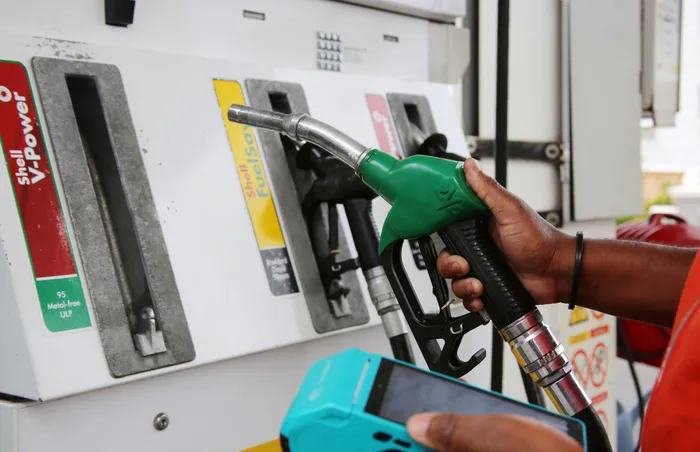
FUEL prices in South Africa are at four-year lows, but upcoming increases in March and April, driven by international oil prices and tax adjustments, could put additional financial strain on households.
Image: Tumi Pakkies / Independent Newspapers
FUEL prices in South Africa are at four-year lows, but upcoming increases in March and April, driven by international oil prices and tax adjustments, could put additional financial strain on households.
Month-end data from the Central Energy Fund (CEF) is pointing to petrol price hikes of 21 cents for 95 Unleaded and 18 cents for 93 Unleaded, while diesel is looking set to rise by between 62 cents, in the case of 500ppm, and 65 cents for 50ppm.
This will see the price of a litre of 95 Unleaded rising to around R19.48 at the coast and R20.31 in Gauteng, where the cheaper 93 Unleaded will retail for around R20.17. Expect the wholesale price of 50ppm diesel to reach to around R17.84 at the coast and R19.17 inland.
The price increases will take effect on Wednesday, March 4, keeping in mind that the above predictions are based on unaudited data. The final price adjustments will be announced by the Department of Mineral and Petroleum Resources early this week.
The anticipated fuel price hikes stem largely from elevated international product prices recorded during February. A firmer South African rand has, however, helped soften the blow, preventing increases that could otherwise have amounted to around 35 cents a litre for petrol and close to 80 cents for diesel.
More fuel price pain in April
Looking ahead, April is likely to bring further upward pressure at the pumps, not only because of the war in the Middle East, which has sent international oil prices spiking in early March, but fuel taxes are set to rise too. This follows the 2026 Budget Speech delivered on Wednesday by Finance Minister Enoch Godongwana, which confirmed adjustments to both the General Fuel Levy (GFL) and the Road Accident Fund (RAF) levy.
Under the proposed changes, the GFL will rise by 9 cents per litre for petrol and 8 cents for diesel. The carbon fuel levy will also increase — by 5 cents for petrol and 6 cents for diesel — while the RAF levy is set to climb by a further 7 cents. In total, motorists are facing an additional 21 cents per litre across both fuel types.
Once these tax adjustments take effect on April 1, drivers will be contributing R2.25 per litre to the RAF, while the GFL component on petrol will increase to R4.10 per litre.
Bobby Ramagwede, CEO of the Automobile Association, warned that across-the-board inflation-linked increases would add further strain to households already under financial pressure.
He said the Minister had an opportunity to offer meaningful relief to consumers by lowering mobility costs in order to stimulate economic activity.
“While inflationary tax adjustments may be defensible in principle, simply allocating more funding to the RAF does little to address its deep-rooted inefficiencies,” Ramagwede said.