

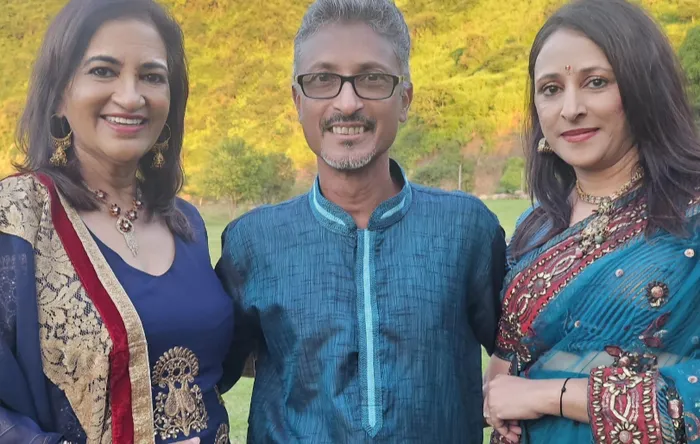
Zakia Ahmed Siddiqi, Tansen Nepaul and Umita Kalyan.
Image: Facebook
THE Indian music community in South Africa is mourning the sudden passing of singer and music teacher Umita Kalyan, who died at the age of 50, leaving behind a grieving family, a devoted circle of students, and a cultural fraternity struggling to come to terms with yet another profound loss.
Kalyan's death comes barely three months after the passing of her close friend and fellow music enthusiast Zakia Ahmed Siddiqi, compounding the sorrow within a close-knit network of artists and supporters who had only recently gathered to honour Siddiqi's memory.
News of Kalyan’s passing was first shared in a message posted to a social media group created to remember Siddiqi. In the message, Kalyan's husband, Tansen Nepaul, wrote: “It is with a heavy heart and deep shock that I have to share the devastating news of the tragic and sudden passing of my beloved life partner, Umita Kalyan. I am sorry that I will not be able to take your calls, and I sincerely appreciate your love and concern. Funeral arrangements will be advised soon.”
The simplicity of the message carried the weight of immense grief. Within minutes, tributes began flooding social media platforms as former students, fellow musicians and admirers expressed disbelief and sorrow.
Kalyan's funeral took place on Sunday, drawing family members, friends, students and colleagues from across the country who gathered to pay their final respects.
Born Umita Kishore Ramjee in 1975 in Louis Trichardt – now known as Makhado in Limpopo – she grew up in a small, but culturally vibrant community where music formed an integral part of religious and social life. It was therefore almost fait accompli that when she met accomplished young musician and composer Nepaul that the two would form a decades-long bond to promote their first love – sharing music and singing with others.
The couple complemented each other artistically and personally. Their shared dedication to preserving classical traditions and nurturing young talent became the foundation of their marriage and their careers. Together, they raised two children: Bihaag, a data analyst with Discovery Bank, and Himani, a second-year BCom student.
As lead female vocalist in the band led by her husband, Kalyan became a familiar presence at cultural events, weddings, religious gatherings and community celebrations across South Africa. On stage, she was expressive and commanding. Her voice effortlessly navigating complex classical compositions as well as popular favourites. Off stage, however, she was known for her quiet demeanour and humility – a performer who never allowed applause to alter her grounded nature.
Her influence extended far beyond public performances. As an instructor at the Drisha School of Music, Kalyan trained numerous students in Indian classical music, the foundational genre from which many contemporary forms, including Bollywood music, derived their structure and style. Former pupils recalled lessons held at her home. Her commitment to her students was particularly evident in November last year. Just a week after Siddiqi’s passing on November 23, Kalyan proceeded with a planned student showcase at Kendra Hall in Durban.
Despite her own grief, she ensured that her students had the opportunity to perform and demonstrate their progress. Kalyan had a special affinity to devotional singing, particularly bhajans.
Singing doctor Bhadrish Vallabh recalled: “Umita was a truly special soul. We will always remember her fondly, especially for her beautiful singing talent. It was a joy and a privilege to have her perform our bhajan, Bhajan Gaawoh Re, for the Lotus song writing competition. That memory is a testament to her spirit and her gift, and it will remain with us forever.”
One of Kalyan’s many students, Bhavana Harilal, posted: “You have had a profound influence on me as a human being and from a musical perspective. I will never forget those singing lessons held at your home, and the wonderful memories shared and knowledge gained. You were the epitome of grace and humility. Always smiling, and every encounter with you was so full of love and warmth.”
These were just two of the hundreds of condolence messages posted on social media by Kalyan's fans and friends.
On a personal note, my condolences not only to the family, and also to Kalyan's father, Kishore. I doubt that he might remember this, but I recall that in the late 1970s, when I was working for the erstwhile magazine Fiat Lux, I had the privilege of being a guest in their home in Louis Trichardt when I was doing features on every Indian township that had been started in the old Transvaal under the Group Areas Act. Eltivillas was one of them.
There was a toddler in the room watching a children’s programme on TV, and Kishore apologised to me as he gently chided her to turn the volume down. I could never have thought then that the child was likely Kalyan, who would also become so much a part of my life decades later.
Kalyan emotionally sang a favourite song of Siddiqi's as we celebrated the latter’s life with a show and book launch at Suncoast CineCentre last month. Barely a month later, I am writing this tribute to Kalyan – legendary singer, teacher, mother and wife.
May her soul rest in peace, and the Almighty grant you and the family the strength to continue her legacy which will remain eternal from her body of work.
The Indian music fraternity has lost not only a gifted vocalist, but a dedicated custodian of tradition. At a time when classical forms compete with rapidly changing musical tastes, Kalyan remained steadfast in her commitment to preserving and teaching the foundational structures of Indian music. Though her voice has fallen silent, its echo continues – in classrooms, on stages and in devotional halls where her music once soared.