

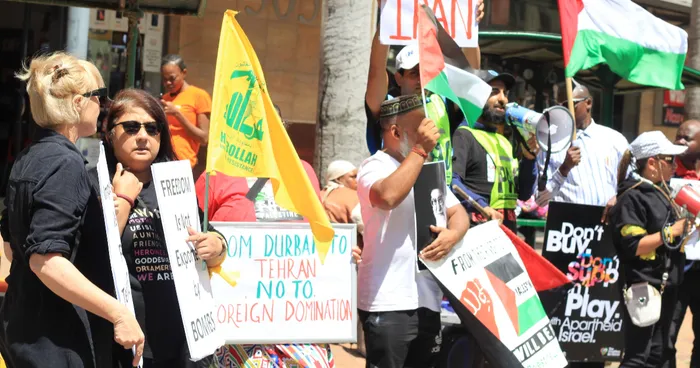
Solidarity organisations joined the protest outside the offices of the US Consulate in Durban on Tuesday.
Image: Chumani Mazwi
RELIGIOUS leaders in South Africa have expressed deep concern over the escalating conflict in the Middle East following the death of Iran's Supreme Leader, Ayatollah Ali Khamenei, urging for dialogue and humanitarian efforts.
The South African Hindu Maha Sabha (SAHMS) expressed “profound concern and sorrow over the escalating military conflict across the Middle East region and the immense suffering endured by innocent civilians".
“The sanctity of life is central to our Dharma, and the continued loss of innocent lives stands in painful contrast to the Hindu teachings of ahimsa (non-violence), compassion and reverence for all beings,” the organisation said.
Appealing to all parties involved, the SAHMS urged leaders to prioritise dialogue and diplomacy over armed confrontation.
“We earnestly appeal to all parties involved to embrace dialogue, diplomacy and non-violent pathways as a matter of urgent priority. Lasting peace can emerge only from a foundation of mutual respect, justice and a sincere commitment to the well-being and security of all communities affected by the conflict.”
The statement further called on the international community and humanitarian organisations to intensify peacebuilding efforts and deliver critical relief to affected populations.
“In times of suffering, our scriptures encourage us to act with compassion and to uphold the dignity of every person, recognising the divinity that resides within all,” the SAHMS said.
Faisal Suliman, from South African Muslim Network (Samnet), who arrived in Johannesburg after flights from the Middle East were rerouted through Istanbul, described the attack as long anticipated.
“In its 5,000-year history, Iran has never attacked any sovereign nation. In modern history, it has been subjected to US orchestrated attacks from Iraq, punishing sanctions for the past 30 years. There have been multiple attempts at regime change, overthrowing the government, and destabilisation of the government.
“Iran has clearly stated for many years and complied with the atomic agency regulations. It has been inspected and cleared. As we know, been warned, in President Donald Trump's words, obliterated its nuclear programme last year, and was willing to talk and have inspections. I think it is a common cause of the attacks. On behalf of Israel were foregone conclusions for months now, after Israel attacked it last year, and its ability to strike back was clear with ballistic missiles.
“There was never any doubt that Iran was going to be attacked so that Israel could continue its expansionist programme in the Middle East. Iran was probably the only deterrent to Israel. Every other justification from Israel and America is another hogwash, and should be seen, as that it is an unjustified, illegal attack on a sovereign nation and sovereign people, which should not come as a surprise, given Israel's, in particular, history for the past 70 years, and America's history since World War II,” said Suliman.
The KwaZulu-Natal Jamiatul Ulama urged Muslims to react with principle rather than emotion.
While acknowledging the long-standing hostility between Iran and the Israeli-American alliance, the council stressed that Iran’s own regional conduct should not be overlooked.
“While the Israeli-American coalition has long been immensely hostile towards the Muslim world, this does not erase the reality that Iran, too, has caused tremendous harm. One enemy opposing another does not transform either into a friend. Khamenei was the spiritual head of the Twelver Shia sect.
“Beyond theological differences; his leadership was tied to an ideological project that sought to expand Iranian influence across the region. A central aim of the Iranian revolution was to revive the legacy of the Safavid era by spreading Shi'ism and consolidating regional dominance,” the Jamiatul Ulama said in a statement.
“This vision materialised in the pursuit of a so-called 'Shia Crescent' stretching from Lebanon and Syria through Iraq and Iran, to Bahrain and Yemen. Despite its public slogans of 'death to America' and "death to Israel', Iran's history reveals instances of quiet co-operation with global powers when it suited its own interests and agenda. The Iran-Contra scandal remains one well-known such example. Iran also assisted in key regional conflicts, including the US invasion of Iraq and the removal of the Taliban in Afghanistan. Political rhetoric often masked strategic calculation.
“In its drive for regional control, Iran became deeply involved in conflicts across Lebanon, Syria, Iraq and Yemen. Its unwavering support for the deposed Syrian president Bashar al-Assad, stands out. Under Khamenei's leadership, backing Assad was framed as a religious duty. Militias were mobilised, and the Syrian conflict resulted in catastrophic loss of life, displacement and destruction. Masaajid were altered, communities torn apart and countless families left grieving,” said the statement.
The organisation also pointed to Iran’s historical involvement in regional conflicts, including its support for Assad during the Syrian civil war, which it said resulted in catastrophic loss of life, displacement and destruction.
“For many Syrians who endured these atrocities first-hand, the news of Khamene's death was met not with sorrow but with relief, even celebration. Supporting the Palestinian cause remains a moral obligation on the Ummah. However, allegiance in Islam cannot be reduced to a single political issue. No stance, however correct, erases a record of oppression elsewhere. History reminds us that good in one matter does not cancel wrongdoing in another. Justice in Islam is consistent and principled.
“At the same time, the foreign policies of the United States and Israel have also resulted in devastating humanitarian consequences, including civilian casualties, displacement and destruction. All oppression must be condemned unequivocally, regardless of who commits it. Accountability cannot be selective. The fact that Khamenei was killed by an adversary of the Muslim world does not elevate him to the status of a hero or martyr. Allah Ta'ala, in His wisdom, sometimes allows one oppressor to overcome another,” read the statement.