


Rushna Minnaar Lipsey with her husband, Sean Lipsey, and their two daughters, Melody Story and Jazzy Luna.
Image: Supplied
SOUTH African expats in the Middle East shared their experiences and concerns following Iranian airstrikes since Saturday, targeting US military bases in the Gulf Cooperation Council (GCC) region.
The GCC region comprises Bahrain, Kuwait, Oman, Qatar, Saudi Arabia, and the United Arab Emirates (UAE).
While the expats continue to keep their guard up, they remain positive as the airstrikes continue.
Over the weekend, several landmarks including the Dubai International Airport, a luxury hotel and residential buildings were damaged by debris when missiles were intercepted. Several people were also injured.
Rushna Minnaar Lipsey, 36, said she lived about 15 minutes away from the Dubai International Airport.
She moved from Cape Town 12 years ago to work as a singer at a hotel in Dubai.
Lipsey, a freelance make-up artist, said she was “completely horrified” when the bombings started.
“I always had so much faith in our safety in Dubai. But my world felt shaken because the sound of jets and explosions was so overwhelming. It was also extremely difficult to console my children while staying calm and focused. It has been one of the hardest things I have had to process over the last few days.”
She said they received warnings to remain indoors for their safety after the airstrikes.
“Many of the hundreds of missiles that were launched from Iran were intercepted by the UAE military. However, we were advised to stay home due to falling debris, which could be dangerous or even fatal if it comes into direct contact with people.”
Lipsey said the situation had since become relaxed.
“However, due to the reported deaths and injuries, I have chosen to remain indoors until the bombings are completely over. We have enough supplies to sustain us until we receive official confirmation that the situation has fully stabilised.
“I have done everything I can to protect us such as reinforced my bedroom windows, placed a fire extinguisher beside my bed, and prepared emergency bags with shoes, medication, first-aid kits, canned food and water. We have also stocked up on food and water to sustain us for an extended period if necessary,” she said.
Lipsey said her greatest concern was the safety of her daughters, Jazzy Luna, 7, and Melody Story, 3, and husband, Sean, 40.
She said her husband was stranded in Australia after flights were cancelled at the weekend.
“My girls have their whole lives ahead of them, and I just want to ensure they are safe. Another concern is reuniting with my husband. He is in a terrible emotional state because he is not here to protect his family during this crucial time. However, he has rebooked his flight for March 9, which gives me hope and optimism that we will get through this – not only by the grace of God, but also through the efforts of the UAE authorities who have worked tirelessly to protect the people.
“We have also been provided with a 24-hour trauma hotline for emotional support, which has been helpful. Overall, things are looking more hopeful for us.”
Miksha Ramlall, 31, who lives in Abu Dhabi, UAE, said she was trying to remain positive and trust in the systems that are in place to keep residents safe.
She moved from Durban together with her sons, Ethan Govender, 11, and Akario Govender, 4, about seven months ago.
Ramlall, a teacher at a private school, said she had seen and heard missiles being intercepted in the sky.
“I currently live in a more remote area about two hours away from the city, so my experience has not been as intense as what some people closer have reported. However, we have seen a few missiles being intercepted in the sky and heard the loud sounds.
“We have also occasionally heard fighter jets. Thankfully, our area has remained relatively calm compared to the main city. However, we receive emergency alerts from time to time advising residents to stay indoors, and keep away from windows and doors,” she said.
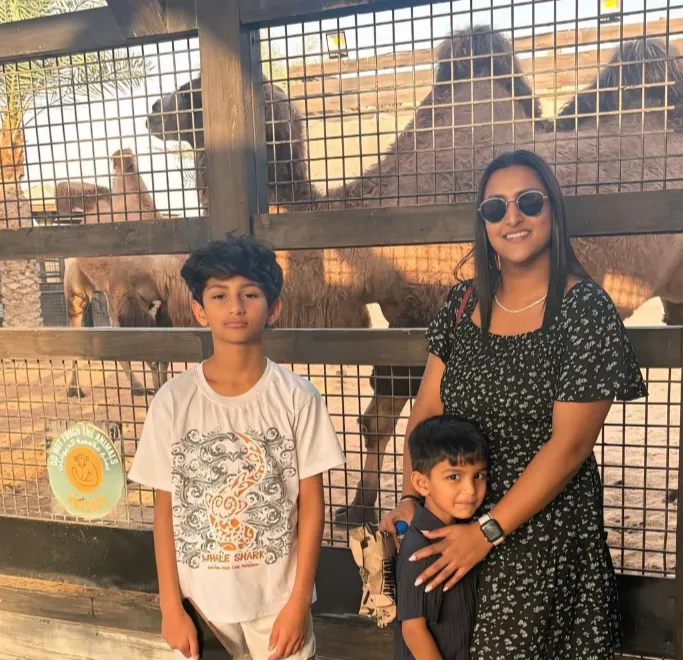
Miksha Ramlall, with sons Ethan Govender, left, and Akario Govender.
Image: Supplied
Ramlall said they had received constant reassurance from the UAE authorities.
“They reassured us that they had everything under control and that strong safety measures were in place, which did bring some comfort and calm. Of course, there are moments when the uncertainty can feel stressful, particularly when alerts come late at night or early in the morning. But I try to stay focused on remaining calm and keeping things as normal as possible for my children. We follow the guidance given to us, such as staying indoors when alerts are issued, and keeping away from windows and doors when advised.
“I am trying to remain positive and trust in the systems in place to keep residents safe. The support from the community and the clear communication from authorities have also helped reassure us,” she said.
Ramlall said she did not feel the need to return to South Africa at this stage.
“While the situation can be concerning at times, we have been reassured by the authorities that everything is under control, and that there are strong safety and security measures in place. That reassurance has helped me feel more at ease. Of course, being far from family can make moments like this feel a bit more emotional, but for now I feel safe where I am.”
A South African living in Doha, Qatar, since 2009, who declined to be named, said in recent days, the country had been affected by regional tensions stemming from ongoing conflicts involving Iran, the US and Israel.
“According to media reports, Iran has targeted US military bases in the GCC region. In response, Qatari authorities have issued regular public updates and emergency alerts to residents.”
She said an emergency alert was sent to all mobile phones in the country on Saturday.
“Shortly afterwards, we heard a series of explosions, which were later confirmed to be missiles intercepted by Qatar’s defence systems. At the time, my family and I were attending a church meeting. We remained as calm as possible and exited the venue once it was deemed safe to do so.
“Like many others, we have experienced moments of anxiety over the situation. However, we have confidence in the Qatari government’s ability to protect the community. Schools in Doha have shifted to online learning, and many companies, including my husband’s, have advised staff to work from home. My husband is currently working remotely and we are staying closely informed through official channels.
“Although it is technically possible to leave our home as our neighbourhood is currently calm, we have chosen to remain at home in accordance with local guidance. We remain hopeful and trust that the authorities will continue to act in the best interests of public safety.”