
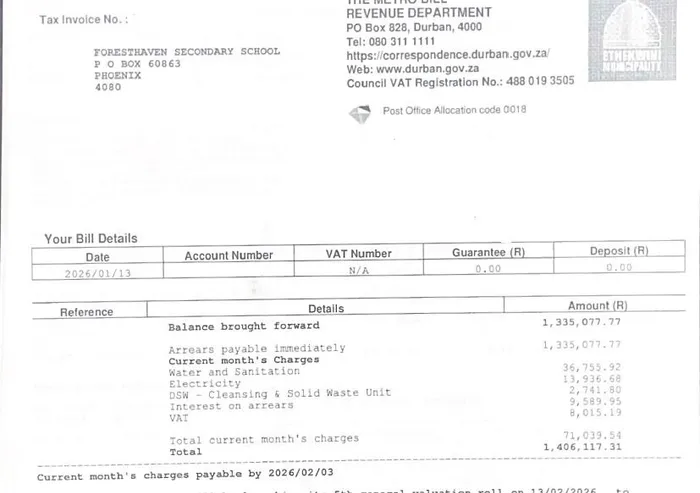
Foresthaven Secondary School in Phoenix is struggling with a R1.4 million municipal utility bill, prompting calls for a moratorium on disconnections.
Image: Supplied
Foresthaven Secondary School in Phoenix is struggling with a R1.4 million municipal utility bill, prompting calls for a moratorium on disconnections.
Several schools in the eThekwini Municipality had their water and electricity services disconnected due to unpaid bills.
The KwaZulu-Natal Department of Education's Section 20 schools and offices owed eThekwini R537 million, while Section 21 schools owed R336 million.
The Foresthaven school’s water and electricity supply was reconnected on Tuesday.
Jay Singh, an eThekwini councillor representing the United Independent Movement (UIM), said the disconnections were against the Constitution.
“By cutting these services, the municipality is engaging in a constitutional crime against the youth of Phoenix. We will not allow the administrative failures of the state to be solved on the backs of indigent learners,” he said.
Singh said that despite the best efforts of the school’s administration, they face the following challenges:
“What is a principal supposed to do?" asks Singh. “How do you run a computer room, or even a basic toilet block for hundreds of children, when the municipality treats a place of learning as a delinquent commercial business?”
Singh called for a moratorium on all school utility disconnections in Phoenix and for debt write-off subsidies.
“The eThekwini Municipality and the KZN Department of Education must sit down to write off historical debt for schools with high indigent populations. There should be a review of the 'quintile' system that labels these schools as fee-paying when the community is clearly unable to contribute,” Singh said.
During the February 2026 municipal council meeting, eThekwini Mayor Cyril Xaba said schools have approached them to settle outstanding amounts or enter into payment plans.
Xaba advised those who cannot pay their debt, not only schools, to come forward and make a payment plan.
“All roleplayers must work together to reduce the municipal debt,” he said.
Muzi Mahlambi, the KZN DoE spokesperson, said the department was aware of these disconnections.
“They happen despite our engagements with the municipalities for payment arrangements. We also have two head offices that were disconnected,” he said.
According to a municipality debt collection report, the city is owed R43 billion. Government departments owe the city R2 billion, while the bulk of the debt is owed by provincial government departments at R1.6 billion.
Dr Jonathan Annipen, an IFP councillor in eThekwini, said the disconnections at schools brought learning to a grinding halt.
In correspondence with Annipen, eThekwini City Manager Musa Mbhele said the DoE was informed before the disconnection was carried out in line with municipal credit control and debt collection by-law and policy.
“In the absence of any existing payment plan, the municipality first disconnects the regional offices of the department, and should there be no response to the disconnection, the municipality has no other alternative but to disconnect all services that are not paid for,” Mbhele explained.