

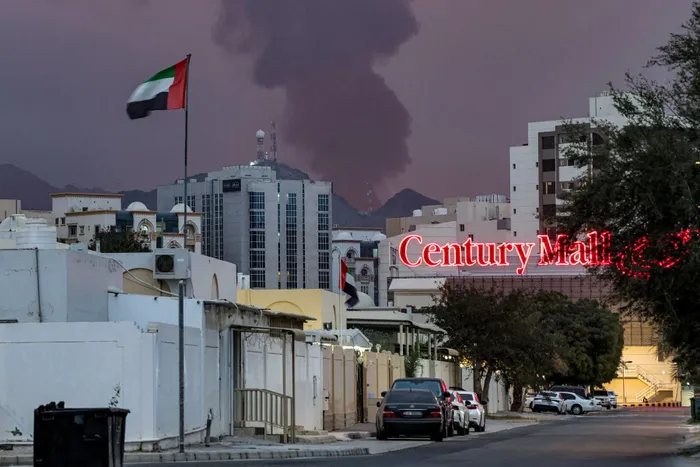
A plume of black smoke rises from the port of Fujairah in the gulf emirate of Fujairah. Iran's strikes on Gulf neighbours since February 28, following the US-Israeli attack, forced the UAE to shut its airspace, blindsiding travellers who thought they were headed to one of the region's safest holiday destinations.
Image: FADEL SENNA / AFP
ALTHOUGH the recent airstrikes in the Middle East have taken an emotional toll, two South African expats say they are safe and will continue living there.
Demi George, 28, an English teacher working in Kuwait, said being far from her family during this time “makes everything feel heavier”.
“There have been airstrikes in the region. Although I have not physically witnessed a site being bombed, I have been hearing sirens and missiles being intercepted. That sound is something you don’t forget. It shakes you, not just physically, but emotionally.”
She said Kuwait's interception systems were working, which brought reassurance.
“But the reality is, when you hear sirens at night and feel the tension in the air, sleep becomes difficult. You lie awake listening, praying, checking your phone for updates, and messaging family back home to tell them you are okay. It is a strange feeling being physically safe, but emotionally alert all the time.”
George said her biggest concern remained an escalation in attacks.
“When you are in the Middle East during regional tension, you are aware that things can change quickly. However, Kuwait authorities have been organised and prepared, which gives us comfort. The defense systems are active, and that has prevented worse outcomes. I am grateful for that. Movement is still possible, but caution is advised.”
When things are uncertain, she said she longed for home.
“But I have so many people checking on me, and reminding me that I am not alone. However, if the situation escalates significantly, I would absolutely consider returning home. For now, I am not thinking about going home. I am safe, and I am staying vigilant, grounded, and prayerful.
“This experience has reminded me how fragile life is and how powerful faith is. Even in the tension of sirens and intercepted missiles, I choose to trust that God is still sovereign,” she said.
A 34-year-old teacher, who declined to be named, said she saw missiles, although she was not close to the affected areas.
She moved from Durban to Abu Dhabi, the capital city of the United Arab Emirates (UAE), in 2022, and lives with her husband, 35, and their one-year-old daughter.
“At first, I was a little scared, but I have full faith in the UAE government. They are doing their best to keep citizens safe by intercepting all incoming missiles. Due to these interceptions, debris is falling in and around the city, causing minimal damage in some areas.
“The UAE government has given us procedures to follow, but knowing that missiles or debris can hit anywhere at any time is concerning. We were urged to stay away from windows and doors and to avoid driving unless necessary. Whenever there is a possible missile strike, the UAE government sends notifications to all cellphones informing us of the situation and advising us to take precautions,” she said.
The woman said she was able to move around freely.
“However, those in the impact zones are not allowed to leave due to safety concerns.”
She said she was not considering returning to South Africa as she felt "much safer here even with everything that is happening”.
“The government protects its citizens. I am actually happier here.”
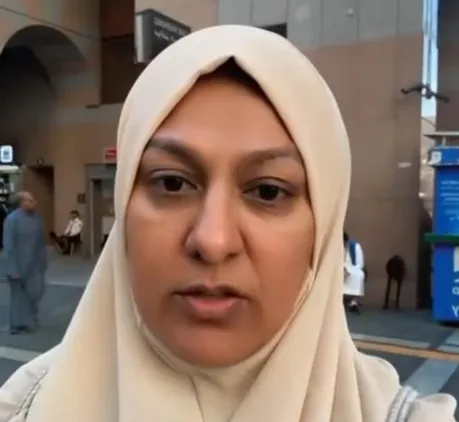
Dr Naseeba Kathrada returned to South Africa on Tuesday.
Image: Supplied
Meanwhile, a South African doctor, who was stranded in the Middle East after Iranian airstrikes cancelled flights, is glad to be home.
Dr Naseeba Kathrada and her sister who went for Umrah in Madinah in the Kingdom of Saudi Arabia had planned to return home on Sunday.
Shortly after checking out of their hotel around midnight, they learned their Qatar Airways flight was cancelled and they needed to find alternate accommodation.
“We eventually had to take a train from Madinah to Jeddah. From there we boarded a Saudi Airlines flight to Nairobi, then took another flight to Livingstone in Zambia, and then to Cape Town. It is really good to be home.
“I have heard that Emirates has opened a few flights, and that my friends who were stuck in Dubai managed to get a flight to Jeddah and will be able to perform their Umrah. However, they had to wait a long time due to a backlog,” she said.
Kathrada, who is formerly from Durban, said while she did not feel threatened or in harm's way, there was uncertainty.
“All we wanted was to be able to return home, but did not know when we would be able to.”
Iran has indicated it is willing to assist with evacuating South African citizens stranded in parts of the Middle East as fighting intensifies in the region.
Mansour Shakib Mehr, Iran’s Ambassador to South Africa, said on Wednesday night that Iranian authorities stood ready to support evacuation efforts if required.
The airstrikes reportedly followed the US and Israel launching a series of aerial attacks across Iran, killing the Islamic Republic’s Supreme Leader Ayaotollah Ali Khamenei and several senior regime officials.
In response, Iran launched missiles and drones at US allies across the Gulf, in Saudi Arabia, Bahrain, Qatar, the UAE, Kuwait, Jordan, Cyprus and Iraq.