
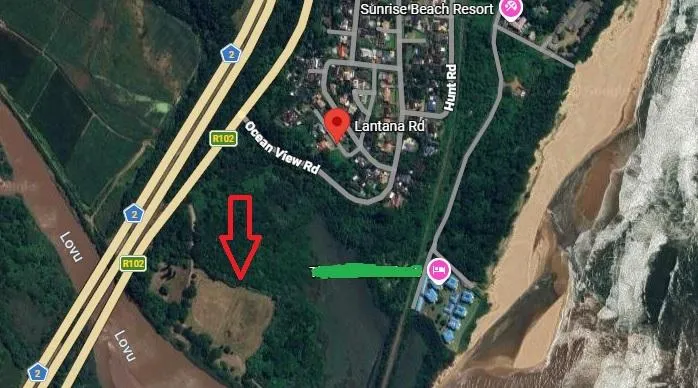
This vacant plot of land is the proposed site of an artificial intelligence (AI) Data Centre in Amanzimtoti, south of Durban.
Image: Google Maps
THE eThekwini Municipality's plans for a new AI Data Centre in Amanzimtoti are under scrutiny as local councillor raises concerns about the project's transparency, environmental impact, and local economic participation.
Andre Beetge, DA eThekwini Exco member and Ward 97 councillor, questioned the Memorandum of Agreement (MOA) the municipality will sign with the Korea South Power Consortium’s development of the artificial intelligence (AI) Data Centre on the KZN South Coast.
Beetge said that municipal councillors only became aware of the MOA when it appeared on the committee agenda two days before the February 26, 2026 council meeting.
“At first glance, the proposal sounds almost too good to be true. The capital investment, jobs, and a global technology footprint for eThekwini. But beyond the headline figures, the details are conspicuously absent. There is no clarity on who precisely will benefit from the employment opportunities,” he said.
Beetge said that Asian-owned technology entities historically rely heavily on imported specialist labour, often limiting meaningful local economic participation.
“The report further fails to contextualise that the Korea South consortium has reportedly set out to establish 76 such facilities globally by 2028. Nor does it adequately address the energy demand trajectory associated with AI data centres — projected to escalate dramatically over the next few years, with global AI-related power consumption rising from approximately 415 terawatt hours in 2024 to an estimated 945 terawatt hours by 2030.”
Beetge added that the municipality was grappling with an unstable electricity supply and significant water losses of over 50%.
“You have just reprioritised funding away from the Kingsburgh substation upgrade. How can we responsibly commit to a project of this magnitude without first stabilising core infrastructure? The proposed site itself raises further concerns. It is located within a D’MOSS sensitive environmental area, in proximity to the ocean,” Beetge warned.
Beetge also sought clarity on:
He was also concerned about:
The municipality stated that the centre is expected to cost the consortium between $3 million and $10 million.
It will provide the land and infrastructure for development, while the developer is expected to cover the costs of the building and operations.
“The municipality's Economic Development and Planning Committee report stated that a development of this nature would complement and strengthen existing local smart city initiatives, including traffic optimisation, transport analytics, energy management, and data-driven municipal planning,” he said.
However, the municipality stated that the MOA creates a structured framework for engagement with the prospective investor to assess the feasibility of the proposal.
“Such agreements are standard practice at the early stages of large-scale projects, enabling information exchange and preliminary assessments. A collective of Korean energy and technology entities that have expressed interest in exploring the proposed investment.”
The municipality added that no final decisions have been made regarding the electricity requirements of the proposed facility or how electricity may be supplied.
Also, that any figures currently circulating publicly, including specific megawatt estimates, should not be regarded as confirmed project specifications.
“Water demand, sourcing, and associated infrastructure needs have not been determined. These matters fall within the scope of technical, environmental, and feasibility assessments that would take place should the engagement progress,” the municipality added.
Should the engagement progress beyond the exploratory phase, the municipality explained that all proposed development activities would be subject to the full suite of legislative and regulatory requirements, including environmental authorisations and water use approvals where applicable.
According to the municipality, the MOA is for exploratory and feasibility purposes and this approval does not constitute: