

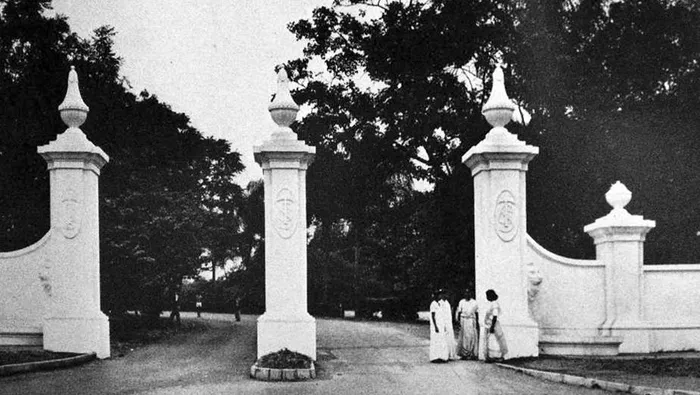
TONGAAT Sugar Estate workers outside the grand entrance: 1960s.
Image: Tongaati by RGT Watson
THE 21st century has proven to be an unforgiving era for giant corporations. Traditional corporate powerhouses have been filing for high-profile bankruptcies and liquidation, ending, in some instances, a century of existence. Key factors for the collapses include poor management or mismanagement, false financial reporting, failing to innovate or adapt, corrupt punitive government taxation that benefits an elite circle, and the rise of oligarch economic control.
In most instances, working-class employees bear the brunt of financial meltdowns, with corporate executives often getting away by virtue of their obscenely-amassed wealth reserves.
In 2001, false accounting practices contributed to the spectacular collapse of Enron, an American energy company based in Houston, Texas, where 5,000 workers were fired the day after Enron declared financial bankruptcy. Closer to home, the Steinhoff debacle of 2017 qualified as the biggest case of fraud committed in South African corporate history.
Globally, an industry that teeters on the brink of collapse, the once stable sugar industry, has experienced a significant downturn, with raw sugar prices dropping nearly 35% over the past year to a five-year low in early 2026. This crisis is driven by a massive oversupply, particularly from record production in Brazil, Thailand and India. This, combined with slowing demand due to rising costs of living, slowed economies and reduced purchasing power, and health-conscious consumer trends have caused a massive decline in global sugar consumption.
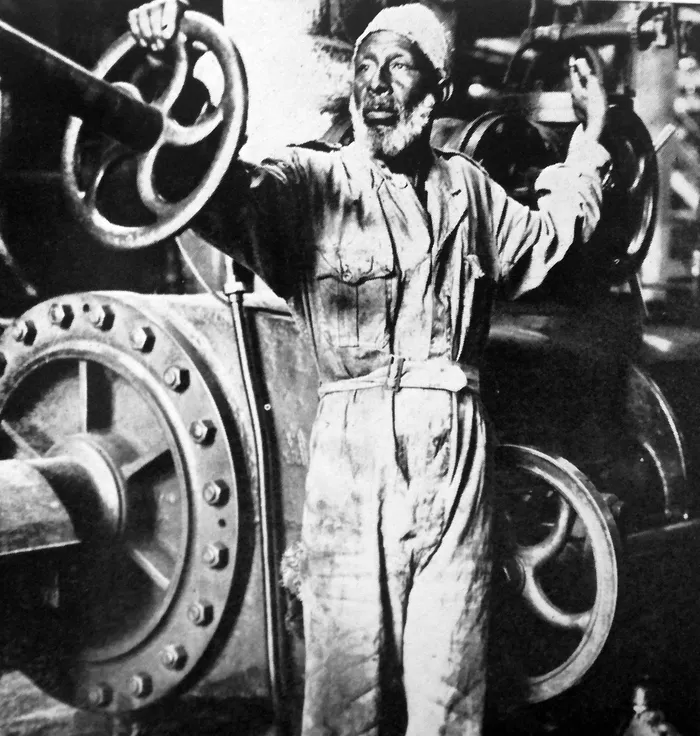
SAAIDI, a mill engine driver working at the Tongaat Mill.
Image: Tongaati by RTG Watson.
Global production is exceeding consumption. In South Africa, the industry is on the brink of collapse due to an influx of cheaper imports, with a 25% decline in production over the past 20 years. In the news, Tongaat Hulett’s filing for provisional liquidation on February 12 this year marks the end of an era for the 134-year-old giant of the South African sugar industry.
The hope of the Vision Group’s business rescue plan that began in October 2022 has turned into a legal and financial crisis, which is not merely a corporate failure but potentially, a socio-economic disaster. Before the business rescue, Tongaat Hulett’s books showed serious financial discrepancies with false profit reporting to the tune of R3 billion to R4 billion. The company acknowledged the growing scandal and admitted that its financial statements had to be restated. The board requested that the Johannesburg and London stock exchanges to suspend their listing. The company’s response to the huge escalation in its debt has been to retrench more than 5,000 workers. The bulk of whom are employed in sugar production industries.
Given the historical significance of this company in growing the economy of KwaZulu-Natal and its relationship to indentured ancestry, the imminent collapse of Tongaat Hulett’s sugar-related operations conjures up a multitude of bitter-sweet reflections. One reflection will most certainly be centred on the romantic spirit of the pioneering colonial settlers who developed colonial Natal, while the other will be centered on an anger that sees yet another generation of the privileged elite being exonerated for crimes committed against the working class.
To contextualise the current crises, it is important to look at the history of the company from its origins. The company that now manages some 120,000 hectares of land for sugar cane production, was formed through the merger of two sugar companies that are each almost 130 years old.
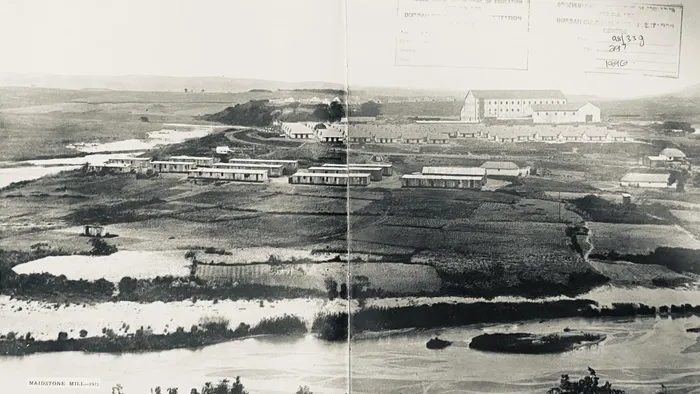
Maidstone Mill, Tongaat: 1923.
Image: 1860 Heritage Centre
Today, Tongaat Hulett is an agricultural and agri-processing business that includes integrated components of land management and property development. In recent years, Tongaat Hulett’s property development has certainly yielded better profit dividends, given the successful commercial and property development boom to the north of Durban. Contrastingly, sugar production and its associated business entities that once formed Tongaat Hulett’s core business have taken a step in the opposite direction.
The present company was formed in 1962 as a result of a "merger" between the Tongaat Sugar Company, founded by Edward Renault Saunders, and Hulett Sugar, founded by Sir Liege Hulett. At this time of the renaming, the Hulett family claimed that the merger was nothing more than a hostile takeover. They had no controlling interest in the company, with Guy Hulett being told to step down as chairman after a consortium of seven businessmen gained more than a 50% share control of Sir J L Hulett & Sons Ltd. In the years that followed, the only legacy that enshrined the Liege Hulett’s legacy was found in just the second name of Tongaat Hulett.
Sir Liege Hulett, knighted for his contributions to the colony of Natal, arrived in Durban as a 19-year-old lad with just 5 pounds in his pocket, on board the ship Lady Shelbourne in 1857. Two years later, he borrowed money to purchase a farm near Compensation, Ballito, where he made steady progress to eventually purchase 600 acres of land that he named Kearsney, which grew a host of crops from cotton to tea. By 1882, Hulett consolidated his interests by floating JL Hulett & Sons Ltd with a capital of 50,000 pounds. In 1903, Hulett operated his first sugar mill at Tinley Manor, and by 1908 controlled a sizable portion of the sugar-dominated production of Natal.
The genesis of the Tongaat Sugar Estate that eventually contributed to the name of Tongaat Hulett was formed through a generous grant of land of 6,000 acres in 1848 to E Chiappini, a Cape Town merchant. By 1860, James Renault Saunders, who gained vast experience of sugar cane farming in Mauritius, acquired a portion of Tongaat’s company holdings. Both Saunders and Hulett were noted for their strong advocacy of the importation of indentured Indian labour to grow the economy of an undeveloped colonial Natal.
On closer inspection, the advocacy of Indian labour was a carefully constructed plan concocted by colonial farmers to bring in cheap labour from India to maximise profits. By 1855, Edmund Morewood, the founding father of sugar cane cultivation in Natal, argued that despite African labour being readily available, colonial farmers wanted the cheapest form of labour from India.
Given the strong advocacy for Indian labour by both Saunders and Hulett, it is not surprising to note that much of this advocacy was done with sinister intent. In highlighting the powerful stature of the Huletts, the case of Dr HW Jones of the Stanger Medical Circle is worth highlighting. In a letter to the Huletts, Jones lambasted them for their treatment of indentured labour by stating the following:
“Well, I happened to ride the corner of the old factory – when lo and behold, there were five Indians who were very ill. One woman had her womb right out. Now, were these people hiding there? During the summer months, you make your Indians toil in the blazing sun. You may say perhaps that the industry would not thrive unless the coolies were sweated. Very well then, let the industry go to the devil. It benefits no one, but yourselves.”
Given the political and economic clout of the Huletts within the colonial administration circles, it was no surprise that Jones was summarily dismissed from his position as medical officer. Clearly, if colonial officials could not challenge the power of the Huletts, how then could the indentured labourers challenge the atrocities they endured?
The Tongaat Sugar Company, run by the Saunders of Tongaat, were also not exempt from meting out abuse.
From 1875 to 1911, the Tongaat Sugar Company was rated second only to the Reynolds Brothers Estates (now Ilovo Sugar) for the highest incidence of suicides committed by indentured labourers on the plantations of Natal. The high prevalence of abuse on the sugar plantations of Natal prompted Hendry Polak, a journalist who followed Gandhi during his stay in South Africa, to say this in 1903:
“The Indian labourer is often regarded by his employer as of less account than a good beast, for the latter costs money to replace, whereas the former is a cheap commodity.”
Given the evidence that validates the colonial planter’s intent to manipulate the workforce to yield maximum profits, it was not surprising to note that when India had finally stopped indenturing Indians to Natal in 1911, the defensive position of the planters that once advocated for Indian labour would then deliver anti-Indian sentiments in wanting to remove "the alien menace":
“I do not go so far as to say that you must take the Asiatic by the throat and throw him out of the country. They are here, but we can put them in their own areas.”
Clearly, the troubles that have afflicted the Tongaat Hulett group from their formative years through to their current financial woes have taught them little about working in the best interests of their working-class employees. Much like their colonial-era predecessors, the former chief executive and his team at Tongaat Hulett, responsible for the current financial irregularities, have yet to face criminal charges. The implicated former CEO, who retired after 16 years as chief executive, received R94 million in bonuses and incentives over the past 10 years.
Beyond the miraculous financial spreadsheets, the catastrophic collapse, at the cost of utter greed, must now prioritise the human cost of generations of families who toiled for the benefit of Tongaat Hulett.
"Before the industry goes to a 21st century devil", government engagements with all stakeholders, including labour, growers, financiers, investors and affected communities, must explore every possible solution to ensure the survival of the company and the long-term sustainability of the sugar sector to move beyond this crisis that spells disaster, not just the industry, but for all of us.
Selvan Naidoo is the great-grandson of Camachee, indentured number 3297, and director of the 1860 Heritage Centre.