
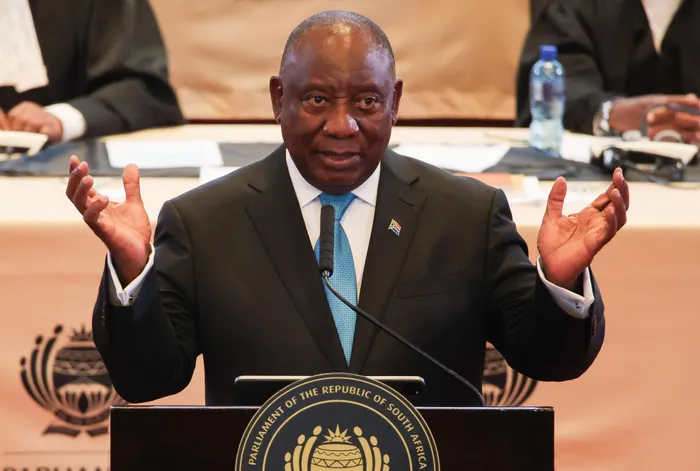
PRESIDENT Cyril Ramaphosa has emphasised the importance of local government elections as an opportunity to address longstanding municipal failures and improve governance.
Image: IOL
PRESIDENT Cyril Ramaphosa has emphasised the importance of local government elections as an opportunity to address longstanding municipal failures and improve governance.
He expressed concern that financial stability remained a major challenge for many municipalities, and warned that without stronger revenue management and financial discipline, service delivery challenges will persist and infrastructure backlogs will worsen.
Ramaphosa said the upcoming local government elections should be a chance for all stakeholders to work together to improve municipalities, rather than focusing only on campaigning.
In his weekly newsletter on Monday, Ramaphosa said cooperation between government, business, and communities is key to fixing struggling municipalities and improving service delivery across the country.
The highly anticipated 2026 local government elections are expected to be held later this year, with many political parties already campaigning and announcing mayoral candidates for key municipalities across the country.
He said progress made by the eThekwini metro towards stabilisation demonstrates how effective leadership, coordinated action and strong societal partnerships can help struggling municipalities regain their footing.
Last week, Ramaphosa met with stakeholders in the Presidential eThekwini Working Group, which includes representatives from national, provincial and local government, as well as business, community-based organisations and organised labour.
The working group was established in 2024 in response to concerns from businesses and residents about the city’s decline.
“At the time, the metro was beset by service delivery failures, deteriorating infrastructure and declining business and investor confidence,” Ramaphosa wrote.
“Two years later, the interventions undertaken to tackle poor service delivery and failing infrastructure are driving an effective and sustained recovery in the metro.”
According to Ramaphosa, the Durban Business Confidence Index is now at its highest level since its establishment.
“In the manufacturing sector, confidence has risen by nearly 16% quarter-on-quarter, a significant development for a city with a major port and a strong industrial base,” he said.
He said touristm has also rebounded strongly, with more than 1.2 million visitors to the metro during the recent festive season.
In addition, key infrastructure projects are underway and improvements are being seen in safety and security coordination across the metro.
Ramaphosa said that while stabilisation is not the same as a complete turnaround and the metro still faces significant challenges, the experience of eThekwini provides a viable model for coordination and partnership that can be replicated in other municipalities.
“The working group approach is based on the District Development Model, which we launched in 2019 to improve service delivery by fostering collaboration across all three spheres of government,” he wrote.
He said the model has proven effective in addressing challenges in government and has encouraged stakeholders to work together.
It is designed to bring together government, business, labour and civil society to accelerate turnaround strategies.
Last year, the eThekwini metro also approved a Partnerships Framework to strengthen public-private cooperation, particularly on infrastructure and catalytic projects.
“For business, supporting local government turnaround has a direct economic benefit because improved service delivery strengthens the economic environment in which companies operate,” Ramaphosa said.
He said drawing on lessons from the eThekwini Working Group, the government established the Presidential Johannesburg Working Group in March last year.
The group focuses on governance, service delivery, infrastructure, urban renewal and safety.
It was established after Ramaphosa expressed deep concern about the deteriorating state of Johannesburg during a meeting with the city council.
The city faces a range of challenges, including hijacked buildings, a water shortage crisis, frequent power outages, pothole-riddled roads, non-functioning traffic and street lights, rampant crime and widespread corruption in various departments.
These issues have persisted for years, with residents across the city expressing concern about poor service delivery.
Ramaphosa said that while working groups can help stabilise municipalities, sustained progress depends on strengthening institutional capacity across the entire local government system.
“Municipalities must be able to deliver on their constitutional mandates without the need for national intervention,” he said.
He said the review of the White Paper on Local Government currently underway is expected to result in a far-reaching overhaul of the system.
Ramaphosa said proposed reforms include a differentiated approach to municipal powers and responsibilities, improvements to the appointment processes for senior municipal officials, and stronger cooperation between municipalities and traditional leadership institutions.
He expressed concern that financial stability remains a major challenge for many municipalities.
“A number of municipalities are characterised by poor revenue management and rising municipal debt,” Ramaphosa said.
He said audit outcomes show that about two-thirds of municipalities are in financial distress.
According to him, without stronger revenue management and financial discipline, service delivery challenges will persist and infrastructure backlogs will worsen.
He said revenue collected from service provision is meant to be reinvested in maintaining and upgrading infrastructure to improve service delivery.
However, Ramaphosa said that in too many instances these resources are redirected to cover other costs.
He said to address this, R27.7 billion has been allocated over the next three years to encourage metros to reform water, sanitation, solid waste and electricity services.
The President added that the government is also reforming the municipal infrastructure grant to address persistent underspending, misuse of funds and capacity constraints.
Ramaphosa said the progress in eThekwini and other municipalities forms part of a broader reform programme aimed at boosting economic growth and improving business confidence.
“The reforms we are undertaking in the energy, water, telecommunications and logistics sectors are already making an impact on the efficiency and competitiveness of our economy,” he said.
“The progress being made in eThekwini to rebuild capacity and restore accountability shows how municipalities can achieve a turnaround with political will and the involvement of stakeholders and residents.”
“When local government fails, the impact is felt by communities, businesses and households. When local government works well, villages, towns and cities become engines of opportunity and growth.”
“With local government elections on the horizon, this is an opportunity for all stakeholders to work together – not to campaign for the ballot box, but to renew the promise of local government to uphold the dignity and improve the life of every citizen.”