

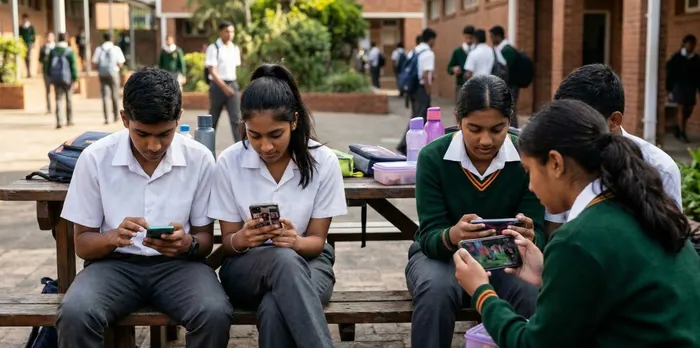
Should SA follow Australia and other countries in banning social media for children under 16?
Image: Gemini AI
THE debate surrounding the ban on social media for children under 16 has intensified globally, with legal experts and stakeholders weighing in on the implications for young users' safety and well-being.
At the recent Moot Court debate hosted by Moxii Africa, participants debated on whether should South Africa should follow Australia and other countries in banning social media for children under 16.
The discussion reflected on the increasing international anxiety over the risks digital platforms posed to children, including cyberbullying, mental health challenges, online grooming and the circulation of child sexual abuse material.
The team which argued in favour of a ban maintained that stronger legal protections was necessary to shield vulnerable young users from exploitation and psychological harm. They argued that children often lacked the maturity and knowledge required to navigate the risks associated with social media platforms.
The opposing counsel warned that a blanket ban might be too restrictive and difficult to enforce. Instead, they proposed solutions such as improved digital literacy education, greater parental involvement and stricter regulation of technology companies.
Australia became the first country to introduce a nationwide ban on social media for under-16s in December last year. The law blocks minors from platforms such as Facebook, Instagram, TikTok and YouTube, with the government citing mounting evidence that social media can harm young people’s mental health and well-being.
Since the ban took effect, millions of accounts belonging to minors have reportedly been removed.
Indonesia is set to introduce regulations from this month restricting social media use among the under-16s to protect children from cyberbullying, pornography, scams and excessive screen time. Similar legislation is also being discussed in Spain, France and Malaysia.
Companies that fail to prevent underage users from creating accounts can face heavy financial penalties.
Social media experts:
Legal experts say the risks for younger users are significant.
Unathi Dlamini, an associate at Shepstone and Wylie Attorneys who specialises in social media law, said children were particularly vulnerable because they often did not fully understand their rights or how to respond when those rights were violated online.
“This can lead to young users of social media feeling helpless and isolated, which in turn makes them even more vulnerable to the prevalent harms of social media.”
Dlamini noted that the rapid integration of technology into daily life had made young people increasingly digitally skilled, but this also presented challenges when attempting to enforce restrictions.
“Technology has woven itself into everyday life, and with it the use of social media has skyrocketed. This means that more and more youngsters are tech-savvy in a tech-forward world. The negative of youngsters being tech-savvy is the ease with which they can find a way around bans on social media platforms.”
She added that online safety remained one of the most pressing concerns.
“One of the biggest risks facing young users of social media relates to safety. Young users are at risk of becoming victims of paedophilia and human trafficking syndicates. It is prevalent particularly when the correct age-appropriate safeguards are not implemented on the social media platforms.
“In instances where a child is using a social media platform unsupervised, they are an easy target for those intending to cause harm.”
Dlamini pointed to Australia’s recent legislation as proof that bans could be implemented with the right legal framework.
“In December 2025, Australia introduced a ban on under-16-year-olds having access to certain social media platforms through the Online Safety Amendment (Social Media Minimum Age) Act 2024.
“The motivation for the legislation was the protection of mental health and well-being of Australian children and teens. The lesson from Australia is that it is possible to enforce a ban and have the legislative framework to support it.”
However, she warned that the issue remained complex.
“Just as perils exist within the social media world, there are positives such as access to information, which is important in countries such as ours where there is a wide digital divide.
“Ultimately the question becomes: would limiting the right of social media use for young users be justified? If so, what is the justification? The exercise of weighing up the pros and cons of social media use for youngsters would need to be done.”
She added that, in South Africa, the decision largely remained with parents or guardians.
“While there is no legislated ban in South Africa, the decision of how extensive a youngster’s use of social media can be ultimately lies with their parent or guardian,” Dlamini said.
Attorney Serisha Inderjeeth said children were increasingly becoming dependent on social media from an early age, which could contribute to addiction and mental health problems.
“Scrolling attracts unwanted algorithms and features,” she said, adding that stricter age enforcement could help reduce these risks.
Inderjeeth suggested that platforms could introduce stronger safety-by-design measures, including parental default settings, screen-time limits and features that prevented interaction with strangers.
However, she warned that enforcing a ban might not be straightforward.
“This may include bypassing the age restrictions by children through the inclusion of fake ages and VPNs. Enforcement may also empower curious children to find social media by other means and in worse places.”
She also pointed out that any blanket ban in South Africa would need to pass constitutional scrutiny.
“The constitutional right to freedom of expression and access to information would be at the forefront of the debate. To reduce these rights it must be subject to reasonably justifiable restrictions,” Inderjeeth said.
At the same time, children’s rights remained a key consideration, she said.
“Children’s rights are also constitutionally protected which is given precedence and is in their best interest in all matters affecting them through Section 28 of the Children’s Rights provisions,” she added.
Inderjeeth said another challenge was holding international social media companies accountable for local laws.
“Platform accountability may, however, pose a challenge, as numerous platforms such as Meta and TikTok are internationally owned. How do we hold these international platforms liable for a law that is passed in our country?” she asked.
She added that implementing strict age verification systems could also raise privacy concerns.
“To ensure proper enforcement there would be an online tool verification system requiring information such as facial recognition and biometric data. Paradoxically, to achieve the purpose of attempting to protect a child may require the divulging of more information than usually required.”
Such measures could potentially conflict with South Africa’s Protection of Personal Information Act, which regulates the handling of personal data.
Inderjeeth said policymakers must carefully balance safety, privacy and constitutional rights before introducing any restrictions.
Education:
Education stakeholders have also voiced support for stricter controls.
Matakanye Matakanye, general-secretary of the National Association of School Governing Bodies, argued that unregulated social media use could have serious consequences for young people’s development.
“I agree with a ban. If we do not use the ban to control them, their cognitive development will be affected. Social media destroys values and attitudes in families, and even in school and life generally. The ban will bring back those values and attitudes that build character.”
However, he emphasised that the goal was not to remove technology from young people entirely.
“We should be understood well. We do not push social media use out of school. We are saying let us have control over these kids and how they use social media responsibly. We need responsible leaders tomorrow.”