

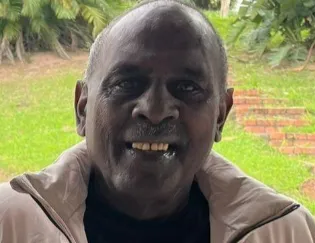
Ronnie Vadivel Kisten
Image: Supplied
THE family of "Karia Gang" leader, Ronnie Vadivel Kisten, said the news of his death on social media sparked a flurry of hateful comments from those who lost loved ones during the bloody drug turf war in the 1980s.
Kisten, 73, died of a heart attack on Sunday after a three-year battle with kidney cancer.
His daughter, Popsy Peters, 50, told the POST that while they understood that the pain and hatred of what happened in the 1980s during the drug turf wars, the hateful comments added to their grief.
At the time the drug turf war claimed "at least one life each week”.
“We, too, have felt the pain of losing our loved ones tragically. When someone dies, families should be given the respect and space they deserve to mourn. The hatred for my father is still there even though he is dead. When does it stop?” asked Peters.
“With this hate, my mind is foggy and I cannot mourn my father peacefully. We appeal to those who are being nasty to let us bury him and we can deal with allegations thereafter,” she appealed.
Peters said it was no secret that her father was a known gangster and drug dealer, and that he had served time in prison for the crimes that he committed.
She said many social media users had been “fed with the wrong information” over the years and were angry.
“They still believe that my father was responsible for most of the killings in the Bayview area in the 1980s.
“But he was not directly involved in the murders. If someone from his gang killed a person, people would say the Karia Gang killed the person. This made people believe that it was my dad who actually killed the person,” she said.
Peters said her father was charged for the murder of a man called "Tallman" in 1983.
“He was sentenced to eight years in prison. While he was in jail, in 1989, my father’s brother Roy was stabbed to death. When his other brother Reggie came home from working abroad and received the news of Roy’s passing, he suffered a fatal heart attack. My dad was not allowed to attend his brothers' funerals,” she said.
“He was also jailed many times after that for dealing in drugs. But my father was a wonderful dad who kept the family together, even our extended family.
“He took care of everyone, and he would pay the bond, lights, water and even buy groceries for relatives and people in the community who were struggling. We moved from Bayview to Hillary in the 1990s after the Karia Gang broke up.
“When my dad was arrested in 2010 for drug dealing, we lost our family home in Hillary. We then moved to Umhlatuzana. In 2023, he was diagnosed with cancer.
“We want to encourage families who have lost loved ones in the gang violence of the 1980s to let bygones be bygones. We had losses, too. But the hate should not go on for generations.
“My dad is dead now. Should we or our children pay for his mistakes? The backlash we are facing since his death has traumatised our family,” she added.
She said her mother, Fathima, 68, who also has cancer, has had anxiety attacks after stories about the violence and killings surfaced on social media this week.
Kisten's niece, who did not want to be named, said her uncle’s involvement in the drug trade started when he became an addict.
She said he left school in Class 2 (Grade 2) and when relatives sent him to the drug dealers to buy marijuana for them, he got “used to the idea of buying drugs”.
“It was not long before he was smoking marijuana. He then started smoking mandrax, which became more available in the late 1970s and 1980s.
“Ronnie never asked to be anyone’s leader. His father, Chinnapen Kisten, was a soldier who fought in World War II. Ronnie was born with a power in his punch. In the 1970s, when gambling was illegal, he ran what was referred to as a ‘gambling school’ that attracted hooligans and brought trouble to his doorstep.
“Karia was a name used to insult him by hecklers and he never liked the name. But he had come to accept it as there was no escaping it. He came from a family that objected to all forms of criminal behaviour and encouraged him to move out of the street life, but every time he tried a straight honest living, he was dragged back and held down.
“He was not proud of being a gangster. He was ashamed of it, but when you are in gangs, people do not allow you to leave that life.
“He was naturally strong and because he had fought off about 10 men at once, people started being around him and felt protected with him. That was how he became a ‘gang leader’.
“When his gang member and best friend, Raj, had decided to sell drugs on his own in the late 1970s, it sparked a violent and bloody war between them.
“Raj’s mother had brought in drugs from India and he wanted to have his own gang. But my uncle was known for being a defender and a protector who would unleash his wrath to protect his loved ones.
“That was when the drug turf war started and turned to bloodshed. At least one person was killed every week. When he got caught for crime, he did the time and spent long periods away incarcerated.
“He would say 'when I meet my Moses, I will answer because I did wrong things'. He was remorseful,” she said.
Deepak Panday, the author of Kings of Durban, a book about gangsterism in the Indian communities in the 1960s, said he was due to interview Kisten for his second book which would be released in July.
He said the book, Kings of Durban Part 2, was set to feature Kisten on his role in the underworld from the 1960s to the 1980s.
“Kisten was at the centre of a very dangerous and full contact gang war in the 1980s. His gang was notorious for clashing on the streets with rival gangs. They used bush knives, sickles and choppers, and the streets became a bloodbath.
“Research indicated that the gang members would go to people's houses, bust down the door, and chop rival gang members inside their homes.
“The war was over the sale of mandrax. Many people thought that he had died years ago. Few people knew he was alive,” Panday added.
Kisten leaves behind three children, eight grandchildren and one great-grandchild.
His funeral will be held on Wednesday.