
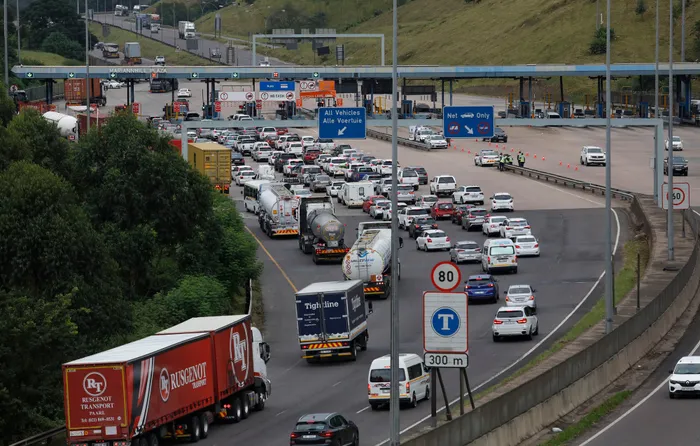
MOTORISTS face a 3.12% increase in toll fees from March 2026, impacting road trip budgets as motorists prepare for Easter travel.
Image: Supplied
MOTORISTS face a 3.12% increase in toll fees from March 2026, impacting road trip budgets as motorists prepare for Easter travel.
The South African National Roads Agency Limited (Sanral) increased all toll fees by 3.12%, which is marginally below 2025’s headline Consumer Price Index (CPI) figure of 3.2% as released by Statistics South Africa in February. This was also lower than 2025’s increase of 4.85%.
However, South Africans will still feel the pinch in their pockets, with some major toll gates commanding R100 or more following the 2026 increase. South Africans planning their Easter Weekend road trips should also budget around significant fuel price increases, which could even surpass R5 in the case of diesel.
The most expensive toll gate in South Africa is Machadodorp on the N4 in Mpumalanga between eMahleni and Mbombela, which costs R126 for ‘Class 1’ light vehicles. This is up from R122 in 2025. Heavy trucks with five or more axles will pay R729 at this plaza.
The second most expensive toll plaza for light vehicles in 2026, at R103, is the Swartruggens plaza on the N4 in North West. It is followed by two plazas on the N3 route between Johannesburg and Durban, with the Tugela Plaza near Ladysmith commanding R100.00, and the Wilge Plaza in Villiers costing R94.
See the full list of toll gate prices here
A one-way trip along the N3 highway between Johannesburg and Durban will cost R347.50 for light vehicles. This is R13.50 more than it cost before the March increase. Motorists should budget R695 for a return trip.
Expect to pass through five toll plazas: De Hoek (R67), Wilge (R94), Tugela (R100), Mooi (R70) and Marianhill (R16.60).
Those operating heavy vehicles, one way between the two cities, will pay R632 in the case of Class 2 vehicles with two axles, R912 for Class 3 (three to four axles) and R1,274 for Class 4 (five or more axles).
A one-way trip from Johannesburg to Cape Town along the N1 will see motorists pass four toll plazas - Huguenot (R54.50), Vaal (R91.50), Grasmere (R27.50) and Verkeerdevlei (R78.50).
A one-way trip will set you back by R252 in a light vehicle, R562 in a Class 2 truck, R775 in a Class 3 and R1,115 in a Class 4 heavy vehicle.
A one-way trip from Johannesburg to Polokwane on the N1 north will cost R232.50 in a light car, and R465 for a return trip. Expect to pass through four toll plazas here: Pumulani (R16.50), Carousel (R75), Kranskop (R61.50) and Nyl (R79.50).
A one-way trip from Johannesburg to Beit Bridge will cost R357.50.
Other popular routes
Driving from Durban to Cape Town, you’ll pay R41 for a light vehicle at the Oribi plaza near Port Shepstone in KZN and R73 at the Tsitsikamma plaza near the Western Cape border.
On the N4 highway between Pretoria and the Mozambique border, you’ll pass through Diamond Hill (R51), Middelburg (R84), Machadodorp (R126) and Nkomazi (R95). That’s a total of R356 in a light vehicle.
Roads agency Sanral manages 26,799km of South Africa’s national road network. 13% of these are toll roads that are directly managed, and privately owned, by Sanral.
The other 87% are non-toll roads that are still managed by Sanral, but funded by National Treasury grants.
According to the roads agency, toll fees allow for a continuous revenue stream, to ensure that there will always be funds to optimally maintain roads.
Sanral was established in 1998 to manage South Africa’s road network.
The entity has been involved in constructing some of the country’s most impressive road engineering projects, including the Huguenot Tunnel on the N1 in the Western Cape.
Its toll booths sometimes double as weather stations, which can monitor rainfall as well as temperature and wind. Data is fed to Sanral’s traffic and maintenance teams.
The entity also has a special ‘night crew’ that can repair critical roads overnight to minimise traffic disruption.