

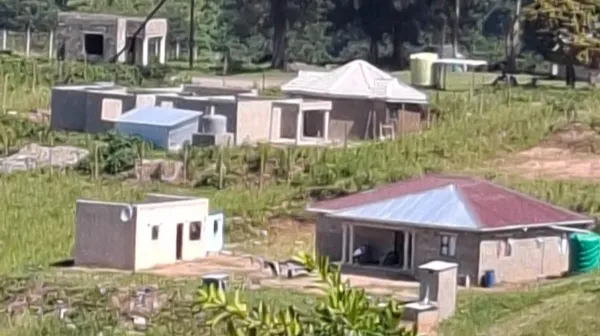
Land grab: Several houses were built allegedly on private land after plots were sold.
Image: Supplied
SMALL-SCALE farmers in Tea Estate Inanda, north of Durban, are facing unlawful land grabs, leaving them desperate for justice and compensation.
The farmers said that for more than a decade, they had watched helplessly as their land was seized and sold off.
Despite holding title deeds, they struggle against intimidation and violence while seeking legal recourse.
A 60-year-old third-generation sugar cane farmer, who declined to be named, said after allegedly failing to get help from the local police, they formed the Tea Estate Farming Organisation and approached the Durban High Court for assistance.
The organisation represented both farmers and landowners.
“In 2019, we were granted an interim and then final order, in which the judge ordered that the chief and several others including his indunas (high-ranking advisors) refrain from selling or attempting to sell any plots, as well as to take the necessary steps to remove all structures or fencing they had erected. They were also ordered to not directly or indirectly damage crops growing on the property.
“We put up the order at the local police station and in the community, only for it to be ripped down the very same day. The situation thereafter just escalated. Even though we have met with high-ranking SAPS members, from district to provincial level over the years, we are still suffering. The farmers do not know what more to do, and are being greatly impacted, mentally and financially,” he said.
The farmer said over the years, they opened nearly 200 police cases covering various allegations, including malicious damage to property, intimidation, arson and assault.
Yet frustration mounted as they reported little to no action taken by authorities, he said.
The farmer added they paid agriculture rates to the eThekwini Municipality.
“Why are we still paying this when we are not using our land? Also, how are they able to build? Did they submit their building plans to the municipality or follow the necessary protocols? This is also farmland, not a residential area, but they have electricity and piped water connected to their homes. Even roads are built. We want to know if the area was rezoned to residential. If so, why are we paying rates?”
Another third-generation sugar cane farmer, 66, said he had not been able to farm since 2023.
The man, who has been farming for the past three decades, said his 10 hectares of land had been invaded.
He said he had been kidnapped and threatened after structures erected on the land were demolished in 2023.
He has not returned to the area since then.
“I first noticed pegs being put around sections of my land in 2023. I went to the police to report it, and then we went to the farm to find out what was happening. We were informed by some men on my farm that they were given instructions from the chief to peg the land, and cut plots.
“They then questioned me about my title deeds. I told them I did not walk around with them, and they could see the land was used for farming. They continued with this, and soon after structures started popping up.
“I went to the district police offices, and a senior member had given instructions that structures be demolished. So together with the police, I went back to the farm and hired a TLB to remove them. However, the next day when I went back to the farm to do an inspection, I was surrounded by four vehicles. They pulled me out of my van, threw me on the floor, and repeatedly kicked me.
“I was pushed into the centre seat of my van, while one of them drove, and the other sat in the passenger seat. I was taken to the tribal court, but the chief was not there. So, they made me sign an affidavit and said I must come back the following Monday. I went to the police,” he said.
The man said one of the men was arrested for kidnapping and assault.
“However, soon after I started receiving threats on my life. It took a toll on my health and I had to take medication for depression. I eventually withdrew that case as my life was worth more. But as the land grabs continued, I opened more cases, but there has not been any progress.
"Right now, I am struggling financially. The last crop was harvested in 2022, and since then I have started doing vegetable farming from my home to try and make ends meet. I have lost my livelihood. What is more sad is that there are mansions on our land, but we are barely putting food on the table,” he said.
A 69-year-old third-generation sugar cane farmer, said his two farms, totalling 25 hectares, had been invaded since 2016.
“I have opened more than 10 cases in the past year alone, and nothing has come of it. I also last went to the area about two years ago. It is pointless going there, with fears of being assaulted or killed.
“I remember a few years ago, one of the buyers was building on my land, and I questioned him. But he showed me a 'permission to occupy' slip he was given after paying R70,000. Another woman told me she paid R50,000 for a plot. I told her that the land was mine and she was shocked. I told her we should go to the police, but the next day, she told me to leave her alone. I opened a case for fraud, but nothing has happened to date,” he said.
A 71-year-old landowner, said he purchased about seven hectares of land in 2009 for his retirement.
“I was considering farming, as I loved to grow my own vegetables. It would also keep me busy once I retired. However, a few years ago, people took over the house on one of my farms.
“After some time, structures were being built on the land. Every day a new structure pops up. I think I have made almost 70 calls to the police in the last year for assistance. Every time we go there, we are surrounded by groups of people demanding my title deeds. I leave out of fear. I don’t believe I will ever get my land back, but we should be rightfully compensated,” he said.
Colonel Robert Netshiunda, a provincial police spokesperson, said the matter had been escalated to the SAPS eThekwini District and was receiving attention.
“A meeting has been planned between the legal representatives of the farmers, SAPS’s legal representatives, the prosecutor and magistrate to look at all the cases holistically and find a way forward. The date of the meeting is yet to be agreed upon, pending the availability of all stakeholders.”
Gugu Sisilana, the eThekwini Municipality’s deputy head of marketing and communications, said the city was aware of reports concerning land use activities and private land sales in the area.
“The matter has been monitored by municipal directorates responsible for informal settlements. Preliminary indications suggest that the situation relates to what appears to be a land invasion allegedly led by traditional leadership structures. Historically, much of the Tea Estate area has consisted of privately owned farming land.”
She said the municipality was not formally notified of the installation of electricity or piped water in the newly-established settlements.
“Notwithstanding this, the city remains committed to ensuring that all residents have equitable access to essential socio-economic services such as clean water, adequate shelter and electricity.”
Sisilana said while the municipality had previously offered support to private landowners, there are legal considerations that govern municipal involvement on privately-owned land.
“The municipality is guided by existing directives and a court order applicable to the Tea Estate area, which identifies the SAPS as the authority mandated to assist landowners in managing matters related to land invasions.
“The municipality continues to monitor the situation and remains available to work collaboratively with all stakeholders within the confines of applicable legislation,” she said.