

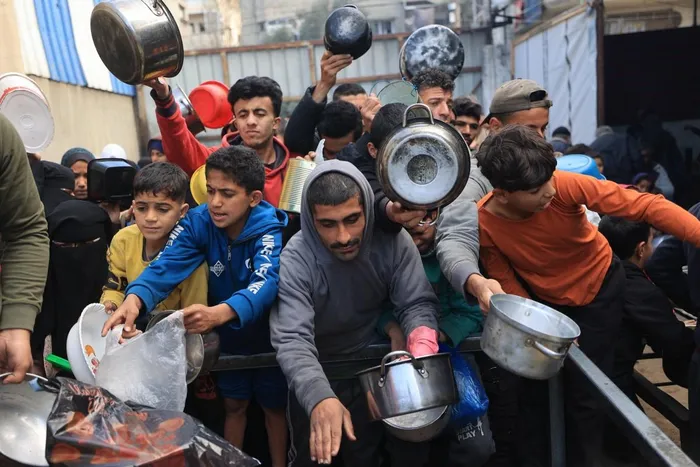
Displaced Palestinians jostle for food at a food bank in Nuseirat, in the central Gaza Strip. The majority of Gaza's 2.4 million people have been displaced, often multiple times, by the war that began with Hamas's attack on southern Israel on October 7, 2023. With displaced families living in tented camps, with serious concerns raised about their living conditions
Image: EYAD BABA / AFP
Israel has submitted its response to South Africa's genocide case at the International Court of Justice, following Pretoria's detailed written arguments submitted over a year ago.
Vincent Magwenya, Presidency spokesperson, said Israel filed its response on Thursday.
"Government has noted the filing of Israel's response to SA’s written pleadings in the case," he said.
The case was brought by SA before the ICJ in 2023 after the conflict in Gaza escalated to such an extent that it led to widespread destruction across the territory. SA argues that Israel’s military operations in the Gaza Strip amount to acts of genocide against Palestinians.
More than 72,000 Palestinians have been killed, according to health authorities in Gaza, while large parts of the enclave’s infrastructure have been damaged or destroyed.
Much of the population has also been displaced and faces severe shortages of food, water, medical care, and other basic services.
Pretoria filed its full written arguments, known as a memorial, on October 28, 2024. A memorial is a detailed legal document in which a country sets out its case, including evidence and legal arguments.
The ICJ had originally ordered Israel to respond by July 28, 2025. However, Israel requested extensions to the deadline on two occasions, which the court granted.
Magwenya said SA would now study Israel’s response.
"(We will) decide whether to request the court’s permission to make further written submissions in reply, or to proceed directly to the oral phase of proceedings," he said.
According to his statement, Palestinians in Gaza continued to face ongoing bombardment from Israeli strikes, with continued loss of life, damage to critical infrastructure, and increasingly difficult living conditions.
He said this was happening despite a ceasefire that was announced in 2025 and three binding provisional orders issued by the ICJ since the case began.
Those orders directed Israel to prevent acts that could fall under the Genocide Convention and to ensure the delivery of humanitarian aid and basic services to people in Gaza.
United Nations Secretary-General António Guterres last week warned that the situation in Gaza “remains dire”.
The government also said the situation in Gaza had been worsened by rising tensions in the Gulf and Israeli attacks on Lebanon.
President Cyril Ramaphosa said the crisis highlighted the importance of international law and global institutions.
“At a time of growing global division and the systematic undermining of the multilateral system, the United Nations in particular, the crisis in Gaza represents an opportunity to unite humanity and remind us all of our shared values,” Ramaphosa said.
“We must all answer to the call to defend the principles of international law and to reassert the vital role played by the UN and international dispute settlement mechanisms like the ICJ.”
He said SA remained committed to working with other countries to uphold the Genocide Convention and the United Nations Charter.
Meanwhile, the United States has filed a declaration of intervention in SA’s case.
It said Israel had not committed genocide in Gaza.
The Netherlands and Iceland have also filed declarations to intervene in the proceedings.
Both countries relied on their status as parties to the Convention on the Prevention and Punishment of the Crime of Genocide, adopted in 1948.