

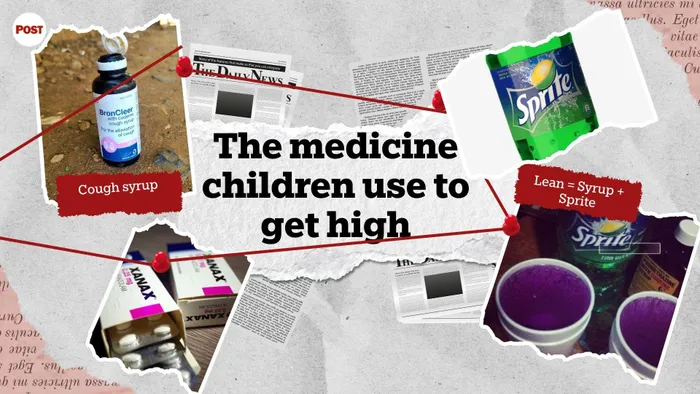
This bottle of Bron Cleer cough syrup, pictured top left, was found in possession of a child in the community. Some schoolchildren are misusing prescription medications and cough syrups to get high.
Image: Graphic: Chumani Mazwi
COMMUNITY leaders in Chatsworth, Phoenix and Verulam are sounding the alarm over the alarming rise in schoolchildren misusing prescription medications and cough syrups to get high.
This concerning trend poses serious risks to the health and safety of young people, prompting calls for collective action from parents, schools and community organisations.
In Chatsworth, community leaders said that schoolchildren were able to access medicines – including over-the-counter to prescription medication – at schools, local tuckshops and the local Bangladesh Market.
Xanax, an antidepressant, and "Lean" – a concoction of a cough mixture and fizzy drinks – had many schoolchildren addicted, the community leaders said.
Pranashen Pillay, director of Child Welfare Chatsworth, said the increase in such cases was concerning.
“We are dealing with the troubling trend emerging in our schools, where pupils are using prescription medication and cough mixtures to get high. Substances such as Xanax, codeine-based cough syrups mixed, and/or pain syrups, with fizzy drinks, marijuana and other tablets are being used by pupils before school or even during the day.
“What makes this trend particularly worrying is that many of these substances are perceived as ‘safe’ because they are medicines. In reality, when used without medical supervision or mixed with other substances, they can be extremely harmful,” he added.
Pillay said in a school environment, the effects on pupils were visible.
He said pupils under the influence of prescription drugs often struggled with concentration, memory and motivation.
“Teachers report increased absenteeism, disruptive behaviour and declining academic performance. More concerning is the growing risk of these substances being sold or shared among pupils, normalising drug use within peer groups and creating safety risks on school grounds.
“Through our work as a child protection organisation in Chatsworth, we have also encountered situations where the use of these substances have contributed to violent outbursts among pupils. In some cases, these incidents have resulted in serious injuries, disciplinary action by schools and even criminal charges against children who might otherwise have had very different futures,” added Pillay.
He said several social factors contributed to this problem.
“Peer pressure, easy access to certain medications and exposure through social media all play a role. For some young people, substance abuse had become a way of coping with stress or emotional difficulties.
“Addressing this issue requires a collective response from parents, schools and community organisations. Protecting our children means working together to ensure schools remain safe spaces for learning and healthy development,” Pillay added.
Rocky Naidoo, a community leader in Chatsworth, said prescription medication and cough syrups were easily accessible to pupils, leading to a rapid increase in cases of abuse.
He said tuckshops, drug dens, and stalls at the Bangladesh Market in Westcliff were selling the medication.
He said he was convinced that the medication sold was either illegal, fake or expired.
“Cough mixture, antidepressants, and Stilpain can all be easily found on the streets of Chatsworth. At Bangladesh Market, you can get all of these medicines. How is that possible?
“We are calling on law enforcement to clamp down on these dealers. These types of addictions are leading to children displaying bad behaviour at school.
“Regrettably, it is very difficult to control as schoolchildren are not searched, and these medicines are easily accessible even at home,” he added.
Naidoo said the first step to eradicating the problem would be to eradicate the dealers.
Brandon Pillay, chairperson of the Bayview Community Police Forum (CPF), said "Lean" was accessible at drug dens and tuckshops, and children were taking the concoction at school.
“There are many schoolchildren who are addicted to ‘Lean’. We have found that the schoolchildren are mixing cough mixture or other pain syrups that are diluted with cool drinks and sometimes apple juice.
“This is of serious concern as young people are getting addicted to it, and it seems to give them a high. They are also taking it in school. We have raised alarm bells before when we realised that it is getting out of hand,” Pillay added.
He said parents and guardians should monitor their children’s behaviour.
“The addiction and abuse of substances especially with children in school are contributing largely to the behavioural problems we experience daily. Some of them are also dealing in school,” he added.
In Phoenix, schoolchildren were allegedly “runners” who were selling the medicines and other drugs at school.
Aroona Chetty, director of Phoenix Child Welfare, said: “Children are accessing Xanax, cough syrups and cannabis to get a high, from 'runners' in schools.
“We have had many cases where children were addicted to these substances and we had to send him to Narcotics Anonymous for assistance. We have also had instances of children smoking marijuana in school, mixed with these medicines, and we referred them to the South African National Council on Alcoholism and Drug Dependence,” she added.
Chetty said the situation was so bad that some children who are addicted and did not want to go for treatment, had left the home and their parents did not know where they were.
Verulam CPF spokesperson Rachel Wilkin said they had also noticed an increase in cases.
“We are aware of a troubling trend among some young people experimenting with over-the-counter cough mixtures and prescription medications to create intoxicating effects. In several instances, children have reportedly been mixing cough syrups with cool drinks, or misusing medications such as antidepressants, painkillers and nerve relaxants to experience a narcotic-like effect.
“This behaviour is extremely concerning as it can quickly lead to dependency, addiction and serious health consequences, including withdrawal symptoms, agitation, depression and impaired judgement,” she said.
Pillay said from a community safety perspective, these patterns also highlighted deeper issues.
She said many young people were struggling to cope with emotional pressures and were not always finding healthy ways to manage stress, anxiety or feelings of isolation.
“Young people today face significant pressures, which range from academic demands and social expectations, to identity challenges and the need to feel accepted by their peers.
“At the same time, many parents and caregivers are under intense economic and social strain, particularly with the rising cost of living. While parents are working hard to provide for their families, young people also need consistent emotional support, attention and open communication at home.
“We encourage parents, teachers and community members to be vigilant. Monitoring changes in behaviour, safeguarding access to medication in the home, and reporting concerns early are critical steps. Where young people are struggling, families should consider constructive support systems such as counselling, mentorship programmes, sports, arts and other healthy recreational activities that allow children to express themselves positively,” she added.
Pillay said the issue required collective awareness and early intervention to ensure that young people received the support they needed before risky behaviours became harmful patterns.