

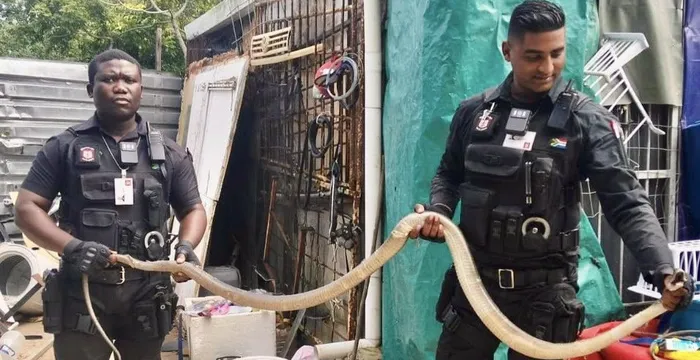
Reaction Unit South Africa's officers with the 3.2-metre-long black mamba - one of Africa’s most venomous snakes.
Image: Supplied
A father and daughter from Verulam were stunned on Saturday when what appeared to be a discarded bicycle tyre turned out to be a 3.2-metre-long black mamba - one of Africa’s most venomous snakes.
The dramatic discovery occurred at a home on Ebony Link Road in Trenance Park, while the father and daughter were cleaning out a shed on their property.
According to Reaction Unit South Africa (Rusa), officers were called to the scene after the pair realised the “tyre” had suddenly come to life.
Prem Balram, of Rusa, explained that the situation unfolded within seconds.
“The homeowner was conducting a cleanup in the shed when his daughter picked up what she believed to be a bicycle tyre lying among items in the structure. The object suddenly moved and slithered deeper into the shed. At that point they realised it was in fact a large snake and immediately requested assistance.”
A Rusa response officer, Bryson Bisnath, rushed to the property and began searching the cluttered structure where the snake had disappeared.
Bisnath located the black mamba inside the shed.
“The snake was safely captured and removed from the premises. Officers also noted that the highly venomous snake was in the process of shedding its skin at the time it was captured.”
Despite the frightening encounter, experts say the situation highlights a common misunderstanding about black mambas.
Local snake rescuer Nick Evans says the species has developed an exaggerated reputation for aggression.
“Black mambas have a very exaggerated and misunderstood reputation. They are often described as extremely aggressive. But after working with them for more than 10 years, I have learned that this simply is not the case. Even when I have done enough to aggravate them during captures, they almost always try to escape rather than attack.”
Evans stressed that most snake encounters occurred when people unknowingly disturbed them or attempted to kill them.
“All a mamba, and any snake, wants to get away from people. That is exactly what happened in this encounter. Black mamba bites are extremely rare throughout the greater Durban area, despite the large human and healthy mamba populations.”
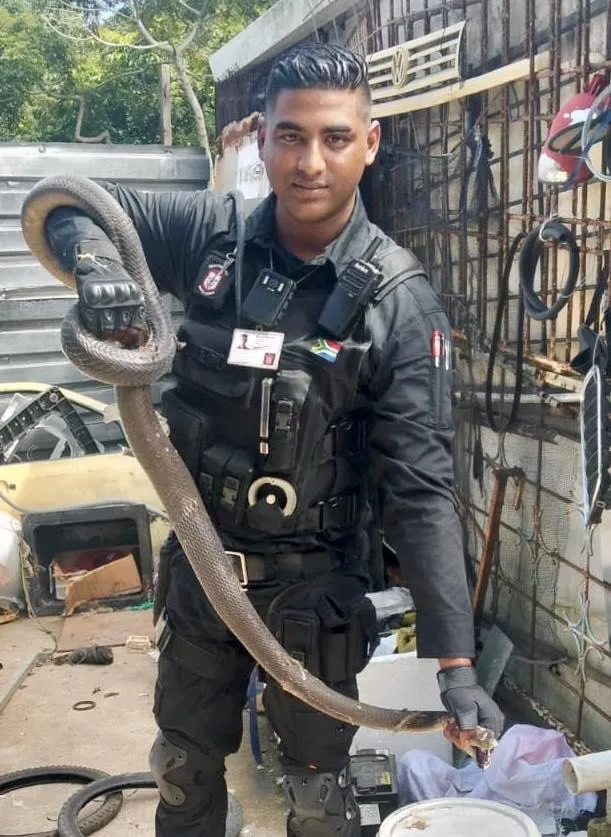
Reaction Unit South Africa's officer with the 3.2-metre-long black mamba - one of Africa’s most venomous snakes.
Image: Supplied
He estimated that only a handful of bites occurred in the region annually.
“I record about two to three bites annually, and often it involves someone trying to kill or capture the snake. That is something people should never attempt.”
While the venom of a black mamba can be lethal, Evans said medical treatment in the region was well-equipped to handle emergencies.
“Of course, the bite can be deadly, but Durban has many hospitals that can stabilise a patient and administer antivenom if required. In some cases the snake does not inject venom at all. That is called a ‘dry bite’, essentially a warning. The problem is you cannot know that immediately, so anyone bitten by a snake should always go straight to hospital.”
Evans added that black mambas are commonly found in valley areas around Durban, where human settlements often overlap with their natural habitat.
“These snakes are frequently drawn to properties with rat populations, messy storerooms, abandoned cars, piles of rubbish or wood. Those places offer both food and shelter.”
His message to residents encountering a snake is simple.
“The number one rule with snake safety is to leave it alone. Do not try to kill it and do not attempt to catch it. Step away slowly and phone a professional snake remover. If possible, keep an eye on where the snake goes from a safe distance because we do not have machines to track them if they disappear.”
He also cautioned pet owners to keep dogs away from snakes.
“Dogs often attack snakes, including mambas, but they usually get bitten in the process and often die."
Ultimately, Evans emphasised that snakes play an important role in the ecosystem.
“Snakes are not here to kill us. They are part of the food chain. They eat rodents and are themselves eaten by animals like monitor lizards, birds, genets and mongooses. In many ways, they are your free pest controllers.”