

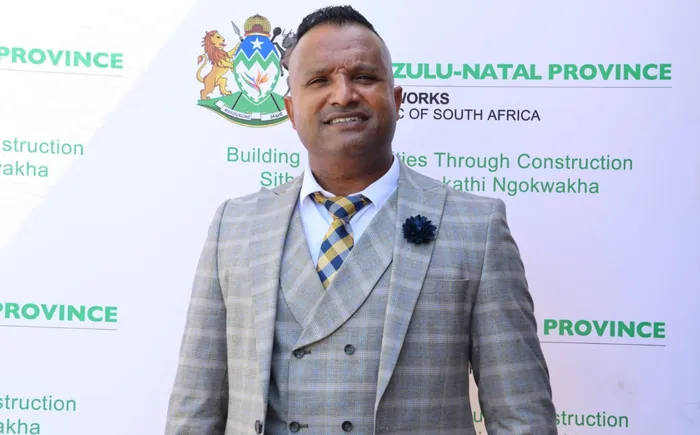
Dr Vish Govender.
Image: Supplied
The newly appointed head of department (HOD) for the KwaZulu-Natal Department of Public Works and Infrastructure, Dr Vish Govender, aims to enhance service delivery and address the persistent challenges of corruption and inefficiency in public service.
Govender, 46, of uMhlanga, held the position as the acting HOD for 18 months and is also the department’s accounting officer.
He said he was humbled and elated about the appointment, noting that it carried a huge responsibility.
“This appointment is not only about career advancement, but it also reflects my personal growth, commitment to public service, and desire to make a positive contribution to the community. It motivates me to continue improving my skills and to perform my duties with integrity, accountability, and professionalism.”
Govender said while growing up in the “dusty streets” of Phoenix, he became aware of the challenges many communities faced regarding basic services such as water, electricity, and housing.
“Seeing these issues made me interested in how government institutions operate and how they can better serve the public. As I grew older I developed a strong interest in public sector management because I wanted to contribute to improving service delivery and ensuring that communities received the support they needed.
“In addition, my dream has always been to work in the public sector where I can help develop policies and management practices that promote efficiency, accountability, and better living conditions for citizens.”
Govender, who has a Master’s degree in public administration and a PhD in public management and governance, added that he had been working in the public sector for the past 25 years.
“My career journey has been one of perseverance, growth, and determination. I started my working life as a student horticulturist, performing basic duties that supported the daily operations of the organisation. At that time, my responsibilities were mainly manual tasks and assisting other employees where needed.
“Although the position was entry-level, it gave me an opportunity to learn about the workplace environment and understand how different departments contribute to the organisation's functioning.”
He said that during his time as a student, he began to observe how the organisation managed its operations, especially the financial and administrative processes.
“I became interested in how decisions were made, how budgets were managed, and how resources were allocated to ensure that services were delivered to the community. These observations inspired me to think about improving myself and aiming for a position where I could contribute more meaningfully to the organisation.
“As I gained more knowledge and experience, I started taking on additional responsibilities in the workplace and pursued post graduate studies. I learned more about financial procedures, record keeping, budgeting, and the importance of accountability when dealing with public resources. Each step in my journey helped me build confidence and develop a deeper understanding of how sound financial management supports effective service delivery,” he said.
Govender added that he previously held the position of the department’s chief director.
“I was responsible for immovable asset management in KZN, managing a portfolio of R20 billion.”
The married father of two said apart from his family, his greatest accomplishment in the public sector was progressing from a student to an accounting officer.
“This achievement is significant to me because it represents years of hard work, determination, and personal growth. When I first started working as a student, I never imagined that I would one day hold a position with such important financial responsibilities. However, through dedication and a strong desire to improve myself, I worked towards developing the skills and knowledge needed to grow within the public sector.”
Govender added that as the HOD, he was responsible for strategic leadership, financial management, infrastructure development, policy implementation, and ensuring accountability within the department to support effective service delivery in the province.
He said his main goal was to ensure the department meaningfully contributed to improving the quality of life for KwaZulu-Natal's citizens.
“I believe that public infrastructure plays a vital role in enabling effective service delivery and supporting social and economic development.”
He said one of my key priorities was to improve infrastructure development and maintenance across the province.
“Many public facilities such as schools, hospitals, and government buildings require regular maintenance and upgrading. By ensuring that infrastructure projects are completed on time and maintained properly, the department can create safe and functional environments that support education, healthcare, and other public services.
“Another important goal is to promote job creation through public works programmes. Infrastructure projects have the potential to create employment opportunities for local communities. I would focus on expanding labour-intensive projects that allow local people to participate in construction, maintenance, and other development activities. This approach would not only improve infrastructure but also help reduce unemployment and poverty,” he said.
Govender said he was also prioritising good governance and accountability in the management of public resources.
“I will ensure that the department complies with the Public Finance Management Act and other government regulations to prevent corruption, wasteful expenditure, and mismanagement of funds. Transparent financial management is essential for building public trust and ensuring that resources are used for the benefit of citizens.
“Another goal is to support small businesses and emerging contractors. By creating opportunities for small and medium enterprises to participate in government infrastructure projects, the department can contribute to local economic development and empower previously disadvantaged groups.
“I am also focusing on strengthening collaboration with other government departments and communities to ensure that infrastructure development responds to the real needs of the people. Engaging with communities would help the department understand local challenges and ensure that projects are designed to improve access to services and promote sustainable development,” he said.