
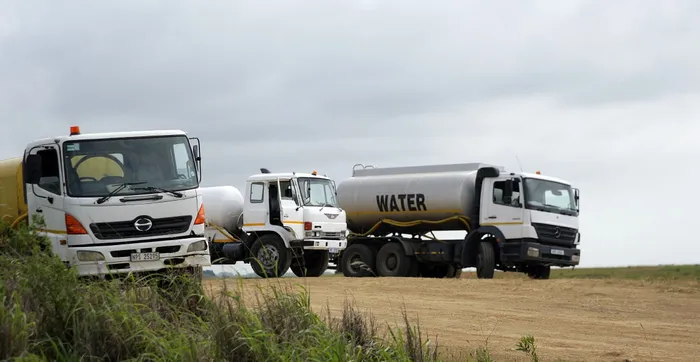
The SAPS has launched dedicated teams to investigate the growing issue of water tanker mafias, which exploit municipal water supply disruptions. Acting Police Minister Firoz Cachalia outlines the police's strategy to combat these networks and their corrupt ties to local authorities.
Image: Bongani Mbatha /African News Agency (ANA)
The SAPS has launched dedicated teams to investigate the growing issue of water tanker mafias, which exploit municipal water supply disruptions. Acting Police Minister Firoz Cachalia outlines the police's strategy to combat these networks and their corrupt ties to local authorities.
Cachalia detailed the police’s approach in tackling water mafias in response to a parliamentary question from EFF MP Carl Niehaus.
He said investigative capacity has been established in all provinces and that monthly meetings are conducted at a provincial level where feedback on investigations is provided.
“Whenever a case has been reported, an investing officer is appointed, and an investigation is conducted with aim to identify, arrest and successfully prosecute the perpetrator,” Cachalia explained.
He said the SAPS is aware of networks of so-called water mafias throughout the country, which control companies providing water tankers to municipalities during disruptions in water supply to communities.
He added that such networks are allegedly frequently linked to corrupt relationships with local authorities.
According to Cachalia, organised crime investigations with the SAPS detective and forensic services division have received some matters for investigations whereby municipalities appointed contractors to transport the water to the community for distribution.
Contractors are, however, prohibited to transfer water into the water tankers for transportation by the so-called water mafia, who demand money from them.
He said the contractors have, however, opted not to register any criminal cases and enquiry files have been registered and investigated. In other cases, companies awarded contracts to install the water pipes, are approached by members who identify themselves as ‘business forum’ and demand 30% of the project.
“The modus operandi identified is that contractors who are contracted to deliver the water to the communities, charge them for the water which they are supposed to deliver for free,” Cachalia added.
He said a priority committee on infrastructure has been established with six different legs to be addressed- water infrastructure is one the mentioned legs.
“This a multi-disciplinary team which includes external stakeholders such as municipalities, the National Prosecuting Authority, the Department Water and Sanitation etc.,” Cachalia stated.
The issue of water tanker costs has exacerbated the water crisis in municipalities and Metros across the country.
The City of Tshwane reportedly spent R777 million on water tankers in the 2024/25 financial year, according to the DA.
However, ActionSA maintains that R179m was paid in the 2024/25 financial year relating to unpaid invoices incurred in the previous financial year under DA former mayor Cilliers Brink’s tenure.
The party said the municipality has reduced expenditure from the levels seen during the DA’s administration and has begun a programme of procuring its own water tankers out of concern about what is clearly a water tanker mafia in municipalities.
These measures are already yielding savings of R12m a month, according to ActionSA.
The City of Johannesburg spent R130.5m on water tankers in the 2024/25 financial year in the midst of shortages due to infrastructure maintenance.
Johannesburg Water spent R130.5m on water tankers in 2024/25, which ended in June last year, and this includes both tanker provision for day-to-day water delivery to informal settlements, as well as emergency water tanker provision.
The municipality said the costs related to the supply of water to informal settlements for R116.3m in 2024/25 to 198 informal settlements, which comprised of about 166,000 households.