

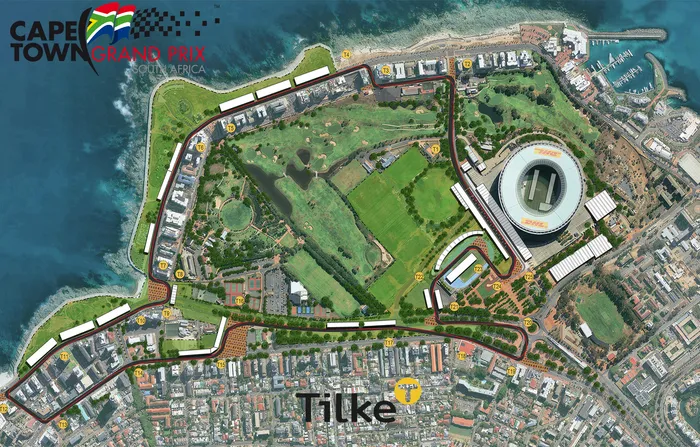
Cape Town Street Circuit Map
Image: Supplied by Cape Grand Prix and Tilke ™
AS SOUTH Africa pushes for a Formula One Grand Prix in Cape Town, advocates share their vision for a street circuit that could transform the city and inspire a new generation of motorsport enthusiasts.
The championship began last weekend with the Australian Grand Prix at the Albert Park Circuit in Melbourne, signalling the start of another year of technological innovation, fierce rivalries, and global attention, IOL reported.
Yet despite Formula One’s international reach, Africa has been absent from the championship calendar for more than three decades.
The last race on the continent was the 1993 South African Grand Prix at the Kyalami Grand Prix Circuit near Johannesburg.
Now, a group of South African advocates believes the sport could return -not on a traditional racetrack, but on a street circuit winding through Cape Town.
The driving force behind the proposal is Igshaan Amlay, an activist and chief executive of Cape Town Grand Prix South Africa (CTGPSA).
Amlay says the idea first came to him while working on Robben Island between 1998 and 2001.
From the Alpha 1 security outpost, he would watch the lights of cars moving along the Atlantic Seaboard at night.
Studying detailed maps of the area, he began imagining how a racing circuit might weave through the streets near Green Point.
“I thought this would make a beautiful Formula One street circuit,” he tells IOL.
Building the Team
Among those involved in shaping the project is communications strategist Esther Henderson, who has worked alongside Amlay and project collaborator Bjorn Buyst to develop the proposal.
Their vision centres on a street circuit winding through the Green Point precinct, framed by the Atlantic Ocean, Cape Town Stadium and the backdrop of Table Mountain.
Speaking to IOL, Henderson says the concept immediately resonated with her.
“When Igshaan first pitched the idea during one of our casual chats, it was a resounding and immediate yes,” she says.
“Both of us had lived and worked on Robben Island, so the idea simply made sense.”
By 2005, Henderson had begun transforming the vision into a formal proposal using Amlay’s early research.
This included hand-drawn circuit maps, technical notes, and correspondence with government departments.
She compiled a comprehensive business concept for the race and soon expanded her role to include stakeholder engagement and partnership development.
“I started mapping stakeholder engagements and presenting the proposal to potential partners,” she explains.
These discussions included meetings with former F1 boss Bernie Ecclestone, the longtime head of Formula One’s commercial operations, as well as government leaders such as former Western Cape Premier Ebrahim Rasool and officials from the City of Cape Town.
From the beginning, Henderson says the proposal had to be grounded in practical considerations.
“It could not simply be an exciting idea,” she says.
“It had to make practical sense.”
Early discussions focused on whether a Cape Town street circuit could meet the stringent standards set by the Fédération Internationale de l'Automobile (FIA), the governing body of international motorsport.
For Henderson, Amlay and their team, the project represents more than a single race weekend.
The proposal also includes plans for a karting academy and a South African School of Motorsport Excellence aimed at developing local talent in engineering, racing and motorsport technology.
“It’s about creating opportunities and leaving a legacy,” she says.
After more than two decades of involvement, Henderson says her commitment to the project remains strong.
“This year marks 21 years for me on this project,” she says.
“I believe in it, and I won’t stop until it happens.”
If the race ultimately becomes reality, it would also hold personal significance.
“My son, Lazar Henderson, lives for Formula One and is now part of the team as a researcher and web developer,” she says.
“For me, it would be a dream come true — but more importantly it would be about leaving a legacy for the next generation.”
Technical Blueprint: The Green Point Street Circuit
The proposed Cape Town Grand Prix centres on a 5.2-kilometre street circuit designed by the renowned firm Tilke Engineers & Architects.
The layout integrates into the Green Point Sport Tourism Precinct and makes use of existing infrastructure around the Cape Town Stadium.
Key features of the circuit include:
The track’s character combines high-speed coastal straights with technical city sections, with a combination of high-speed coastal straights alongside the Atlantic Ocean and technical sections through the surrounding city streets.
The proposal also emphasises the use of existing infrastructure.
The pitch at Cape Town Stadium would serve as the team paddock, while the pit lane and garages would be integrated into the stadium’s western parking structure.
Hospitality facilities, including the Paddock Club, would be built above the pit area to give guests a clear view of the race.
According to organisers, using existing facilities reduces the need for temporary construction and aligns with modern sustainability goals.
Cape Town's Formula One Bid
South Africa’s renewed push to host a Formula One race forms part of a broader national initiative.
The Department of Sport, Arts and Culture established a bid steering committee to evaluate proposals for hosting a future race, with bids submitted in 2025 and discussions ongoing about the possibility of staging an event later in the decade.
Cape Town’s proposal differs from traditional circuit bids.
Instead of building a permanent racetrack, CTGPSA and its partners propose a street circuit centred around the Green Point Sport Tourism Precinct.
“We believe a street circuit would be phenomenal for Cape Town,” Amlay says.
“It would showcase the city, bring people together, and the infrastructure is already there.”
He points to famous city races such as the Monaco Grand Prix and the Singapore Grand Prix as examples of how street circuits can become iconic destinations on the Formula One calendar.
However, the proposal also faces significant challenges.
Hosting a Formula One race requires meeting strict FIA Grade 1 safety standards and covering substantial licensing fees.
Amlay acknowledges these obstacles but believes the economic impact could justify the investment.
“Our funding model is based on external income,” he says.
“We cannot afford the licence fee ourselves, but the ripple effects — tourism, jobs, and opportunities — would be enormous.” For context, hosting fees for a Formula One Grand Prix typically range from $40 million to $60 million annually, highlighting the financial scale of such an undertaking.
Racing the Clock
Cape Town’s bid exists alongside an interest in reviving racing at the historic Kyalami Grand Prix Circuit.
While Kyalami offers a permanent facility with strong motorsport heritage, Cape Town advocates argue that a street circuit could deliver wider tourism and economic benefits.
“There is genuine enthusiasm for this in Cape Town,” Amlay says.
“But you have to work with authorities and stakeholders to ensure the vision aligns with what is possible.”
The bid steering committee has emphasised that all proposals will be evaluated on their merits, to select the option that delivers the greatest benefit for South Africa.
For Amlay, the project carries symbolic significance as well.
He points to the achievements of drivers such as Lewis Hamilton as inspiration for young people around the world.
“History is a lesson you cannot kill,” he says.
“Our story is still being written.”
Amlay believes the project could help inspire a new generation while positioning South Africa on the global stage.
“It’s about showing that South Africa can host world-class events, educate its youth, and claim its place in the global sporting landscape,” he says.
“That’s what Formula One can do for us.”
For now, the dream remains a work in progress.
But for those involved in the Cape Town bid, the vision has remained remarkably consistent for more than two decades.
“Anything can happen,” Amlay says.
“But once it happens, Cape Town, South Africa, and the people win. That’s the dream — that’s the race we’re running.”
The track ahead
The Cape Town Grand Prix represents more than high-speed racing. It embodies ambition, innovation, and the resilience of a city ready to reclaim its place on the global stage. Should the bid succeed, it will mark the continent’s long-awaited return to Formula One, proving that with determination, collaboration, and foresight, even the boldest dreams can become reality.
The bid progress is mapped across several key phases, with a target for race operations to begin in the late 2020s: The timeline follows: