

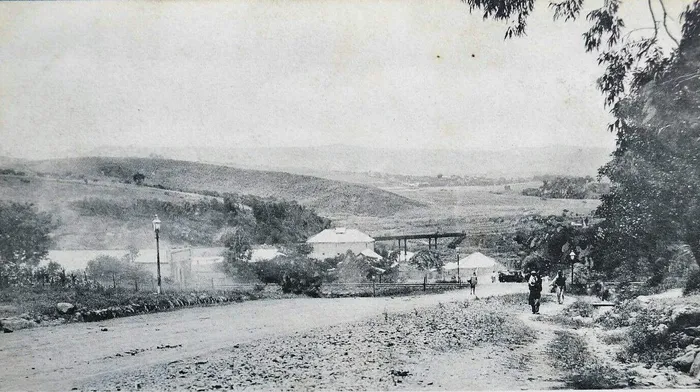
View near the river, Verulam.
Image: Supplied
Verulam, a town rich in history, commemorates 176 years of existence. From the Wesleyan Settler movement to becoming the seat for the Magistracy, hospital and gaol - including the settlement of indentured workers - Verulam became the capital of Victoria County. Today it remains a thriving community that caters to a diverse population, writes Amber Ramdass
THE town of Verulam, situated some 30km to the north of Durban, was the third settlement after Durban and Pietermaritzburg to be established in the former British Colony of Natal.
The following is a history of the town from the time of its founding in 1850 to the year 1996, when it was absorbed into the new local government structures being set up as part of the new democratic order in South Africa, and finally became part of the eThekwini (Durban) Municipality.
Verulam is derived from Verulamium, the name of an ancient Roman settlement some 30km north of London. The Roman name Verulamium came from Verlemion, a Celtic Iron Age settlement whose name means "the settlement above the marsh".
After the Roman conquest of Britain in AD 43, it developed as Verulamium and became one of the largest towns in Roman Britain. About 600 – 700 AD, Verulamium was attacked and destroyed by the Saxons. Later, the town of St Albans was built upon the ruins of Verulamium.
The founder of Natal’s Verulam, William Josiah Irons, was a native of St Albans. When he set about planning a settlement in Natal for his Christian Emigration and Colonisation Society, he decided that the town would be named Verulam. He had initially gained the patronage of the Earl of Verulam (whose father had at one time been MP for St Albans).
When the site of the new town was fixed in March 1850, it was on a hill overlooking what in those days was probably a marsh, much like the site of Iron Age Verlemion. John Swales Moreland, the Natal agent for the emigration promoter Joseph Charles Byrne, described this marsh as a "beautiful lake abounding in fish".
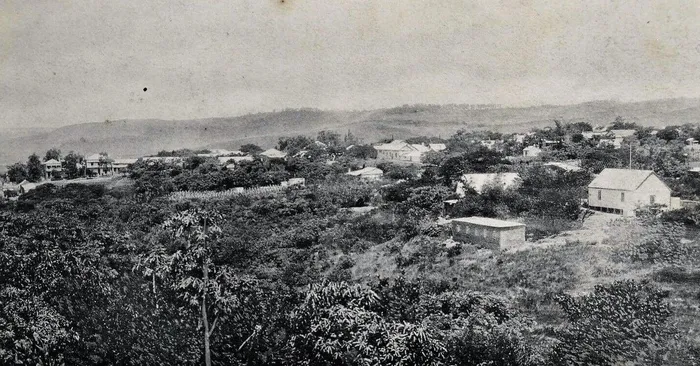
A general view of Verulam, looking east.
Image: Supplied
Britain had annexed Natal as a district of the Cape Colony in 1845, by which time one or two cotton-growing experiments were already under way.
It was found that Natal cotton was suitable for use in British cotton mills. Various Cape merchants in 1847 formed the Natal Cotton Co. and arranged to buy some 22,500 acres of land from the government for cotton production in and around the future site of Verulam. The company was never able to fulfill the conditions of sale, not one ounce of cotton was ever produced, and the grant lapsed.
It was, however, proved that cotton would grow well in Natal, but there were the problems of labour, and also of harvesting, as the bolls did not all ripen at the same time. After the failure of cotton, settlers went on to experiment with arrowroot, tobacco, tea and coffee before sugar cane proved its worth.
William Irons initiated a co-operative scheme whereby non-conformists (mainly Wesleyans) would emigrate to Natal. In May 1849, Irons sent out his brother, Theophilus, to act as his agent in Natal and to prepare for the arrival of the settlers.
A month or two later, having had difficulties in arranging terms with ship owners, he called a meeting in London of his prospective emigrants. Byrne, who had already introduced a number of British emigrants to the Colony, attended, and suggested that Irons co-operate with him, using his ships, as well as the services of his Natal agent, JS Moreland, in allocating the immigrants their land and settling them on it.
Byrne & Co eventually acquired the 22,500 acres of the defunct Cotton Company’s land, and it was on part of this that the Christian Emigration and Colonisation Society’s emigrants were settled.
On January 23, 1850, the first ship carrying Irons’s settlers, the King William, arrived at Port Natal (Durban) with 275 people on board, of whom 48 were Wesleyans. Irons had selected a committee from among the King William emigrants, with Thomas Champion as leader, to assist Theophilus in "inspecting and locating" the site. The plan was that, on arrival, the committee was to be augmented with two or three Natal residents with local experience, one being Durban’s Wesleyan minister, Reverend WC Holden.
Initially the new immigrants camped near the harbour in tents provided by Irons, and because of the government’s protracted dealings with the Natal Cotton Co in connection with repossessing their land, it was only on March 6 that the first inspection of the proposed site was made by Theophilus and committee members.
The town site was chosen on the south bank of the Umdloti River. It was all that Irons could have desired, taking into account his desiderata in a letter to Theophilus dated June 25, 1849 – "an eligible situation, not far from the sea-port of D’Urban, but contiguous to a high road (in this case to Zululand), and near a river with facilities for the construction of dwellings, etc".
A week later, on March 13, 1850, led by Thomas Champion, the first party arrived at the site in ox-wagons and set up camp. Where the town was to be, Champion raised a dark blue flag (again provided by Irons), with "VERULAM" printed in large gold letters across it.
This event marked the founding of the town. The Verulam settlement, 12,000 acres in all, was reserved exclusively for the Irons's immigrants, thus retaining their identity as a co-operative emigration scheme. Other Byrne & Co immigrants were also located on the Cotton Lands (as this 22,500-acre block came to be known), their villages being Mount Moreland to the east, and New Glasgow to the north of Verulam. Unlike Verulam, neither developed into a town.
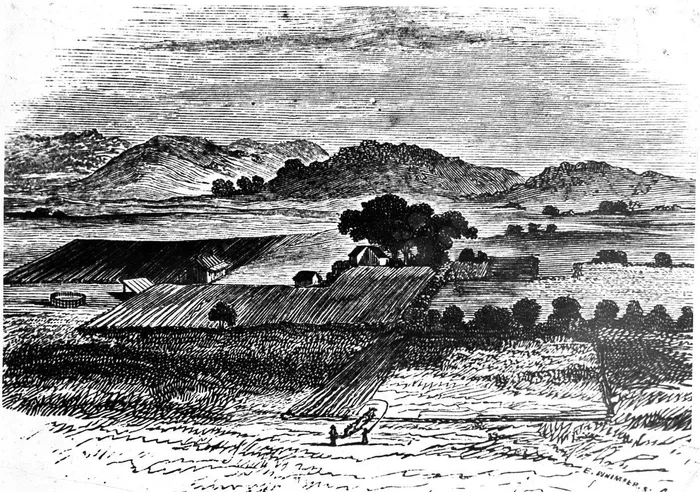
Sketch of Mr Morewood's Estate, near Verulam.
Image: Supplied
Just over a year after the settlers arrived, Verulam’s first chapel (wattle-and-daub under thatch) was built*, being the first erected "beyond the bounds of D’Urban and Pietermaritzburg".
It drew its congregation from the 52 families comprising 152 individuals who occupied 23 houses in the township. Within the first year, the town’s 50 allotments of one acre each had been brought more or less under cultivation. Besides a variety of vegetables and maize, the settlers owned 200 cattle and 80 pigs, all thriving.
The first public school, the Verulam Day School in Chapel Street, was opened in 1853 under the superintendence of Champion. The following year there were 40 pupils, including 14 or 15 African children belonging to the Verulam Native Christian Society. Only in 1859 did it become a school exclusively for white children, with the founding of a school at the Verulam Native Mission.
The Verulam Day School ceased to exist when a government school was established.
Irons was eager that a library be established in the town, and during 1850 sent out books to the value of £6. Eventually a library was opened in November 1856, and in 1858 a lecture and reading room was built for what had by then become known as the Verulam Library and Literary Institute.
Because there was a heavy flow of traffic through Verulam to and from Durban and areas to the north, Verulam prospered, and by 1857 it was the third largest town in the Colony. The first Indians came to Verulam in 1861 and went to work for white farmers. By 1890, the population of Verulam was 451 whites, 273 Indians and 349 Africans.
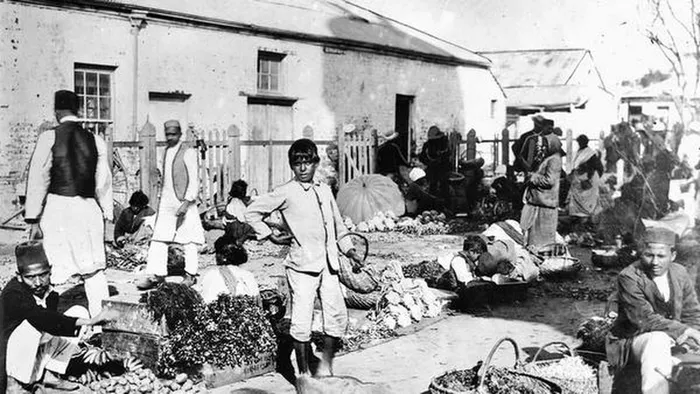
Verulam Market in the 1900s.
Image: Supplied
By 1882, Verulam had officially acquired the status of a town with Thomas Groom as the first chairman of the newly-constituted town board, which held its inaugural meeting on September 7, 1882. Verulam was then run by an all-white town board until 1967.
On December 4, 1964, Verulam was proclaimed an Indian area in terms of the then government’s group area policies. In preparation for the impending change, a local affairs committee comprising three Indian members was elected in October 1961 to advise the town board on matters affecting the Indian residents.
In September 1967, the first all-Indian town board was appointed by the administrator of Natal. In 1969, town board members were elected by popular vote, and a town clerk, Dick Naicker, was appointed. So phenomenal was the town’s growth that in less than 10 years it had acquired borough status.
In the same year, the first borough council elections were held according to the ward system, and a council of 12 members elected YS Chinsamy as mayor.
As a result of internal divisions among the councillors and bitter in-fighting, the Natal Provincial Administration dissolved the council in 1980. The borough was down-graded to town board status, and a caretaker board of three members was appointed by the administrator to run Verulam’s affairs until a new council was elected.
Members of the Development and Services Board were seconded on to this body in a bid to restore good governance to the all-Indian town. The caretaker board consisted of RW Whiteley as chairman, Mr Slatter (deputy chairman), and ER Maasch together with local residents SR Joshua, GME Kajee and RR Singh.
The new board was assisted by the following officials: town clerk Dick Naicker, deputy secretary (DSB) HL Scheffer, acting town treasurer RI Atcheson, town engineer VM Moodley and assistant town treasurer RV Delomoney.
Understandably, there was an outcry from Verulam’s residents prior to the proclamation, but the provincial administration was quick to assure them that this was a temporary measure and that the borough would return to full autonomy as soon as possible.
The administration of the town by the caretaker board lasted only eight months until fresh elections were held in August 1980. The Verulam municipal elections of August 1980 saw several new councillors being elected to the nine-man council, among them SGV Subban who was elected as mayor and held this office for the next eight years.
The weight of responsibility placed upon the new council to ensure good governance also manifested itself in the generally cordial relationships that existed among the councillors throughout 1981 to 1988.
The last 12 years of Verulam’s existence as a borough saw the council being headed by three mayors: Cllr L Palliam (1988–1990), Cllr R Munsamy (1990–1991) and Cllr R Rambaran (1991–1996).Up to 1988, while Subban was mayor, several projects had been initiated and completed, among them Verulam’s first swimming pool, the new Market Plaza, the development of Orient Park, a new tennis court, a low-cost housing scheme, extensions to and development of the Verulam Sports Grounds, a new library, extensions to the sewerage works, acquisition of border status for Verulam’s industrialists, conversion of Missionlands for industrial development, and the first phase of the Small Business Development Corporation’s factory project in the Missionlands Industrial area.
The pace of development continued during the mayoralty of Palliam with phase two of the Trenance Park housing scheme and a further R3 million extension of the sewerage works completed. Development slowed down during 1990 and 1991 as a host of new officials took office in the borough council. There was not only a new mayor in Munsamy but also a new town clerk, SR Naidoo, following upon the retirement of Verulam’s first town clerk, Naicker; and other officials appointed to the following positions: assistant town clerk (J Soojansingh), town treasurer (V Sewnarain), assistant town treasurer (Y Naidoo), acting borough engineer (E Naidoo) and a director of law enforcement (RM Moodley).
These changes resulted in a lull in activity during 1990 and 1991 as the new officials settled into their new posts.
The years between 1980 and 1991 saw stability being restored to the council. There were no changes to its composition in the October 1991 elections, and Rambaran who had served as a councillor from 1988 was elected as mayor, with Cllr VP Rattan as deputy mayor.
The stability during Rambaran’s lengthy term of office enabled the pace of development to pick up again, with the construction of phase four of the Trenance Park housing scheme being completed during this period. Sixty-four flats were also constructed alongside the Verulam Day Care Centre – an old-age facility – and the building of a frail-care facility was commissioned by the council also adjoining the day care centre.
A library and clinic complex was completed at Trenance Park and further development of Verulam’s sports grounds took place with the provision of change rooms and floodlights. The last couple years of Rambaran’s term of office were occupied with negotiations for the dissolution of the borough and its incorporation into the new local government structure for the northern Durban areas. These negotiations resulted in the amalgamation of Umhlanga, Verulam and Tongaat into (initially) the Durban Northern Transitional Local Government sub-structure, and later the North Local Council. With these developments, Verulam lost its borough status and became part of a much larger entity.
Verulam’s growth and development over the two decades following upon the transfer of the town board into Indian hands exceeded all expectations. The new town board got down seriously to developing the town’s infrastructure and attracting businessmen and industrialists. Roads in the CBD were tarred and a sewerage system installed.
A town planning scheme was adopted, and residential and industrial areas proclaimed. Several new suburbs mushroomed around the central business area as people from outside Verulam flocked in to establish residences on the many low-priced building plots on offer, some from the town board and others from private developers.
Packo, Verulam’s leading industry which produces canned foods for the local and overseas markets, relocated its factory premises to the new industrial area at Lotusville, and several new industries were established there. Others were to follow when the industrial area of Missionlands was opened a few years later.
All the activity caused an influx of Indians to Verulam which offered them the tranquility and security necessary for their own personal growth and development. The Indian population increased from 273 in 1890 to 22,801 in 1987. With the abolition of the Group Areas Act, the demographics of the population of Verulam is also changing with many more black people of the low- and middle-income brackets setting up homes in the suburbs where affordable housing is available.
It was predicted that with the opening of the Gateway Shopping Centre at nearby Umhlanga, the demand for housing in Verulam would increase, swelling the population even further. The development of the suburb of Waterloo on the edge of Verulam has added a substantial number of black people to Verulam’s existing population.
Waterloo is, however, a more recent development. With the initial expansion of the town after the takeover of 1967, the new town board saw the need for a government-funded township for the lower income groups, and the first phase of Mountview Township consisting of 100 sub-economic and 165 economic homes was built at a cost of R883,000.
Phase II of the township was completed in the early 1980s and Oaklands soon after. With the growth in population, more schools had to be built. For many years, the Verulam Government-Aided Indian School at Missionlands and the Umhloti Government-Aided Indian School at Coniston were the only schools serving the pupils of Verulam.
In those days, the Indian community had to provide its own schools, and almost every school became a community project. The Verulam High School was funded by a community-based organisation which raised 50% of the cost of the school building, and the rest was provided by the provincial administration which took control of the school thereafter. In this way other primary schools were built in Verulam before the government decided to take on this responsibility.
Set in the midst of lush sugar cane fields, Verulam has always been a bustling town, and is even more so today. While it is a commercial centre for the outlying rural areas, its importance lies in its being the centre of the magisterial district of Inanda. The recent addition of a five-storey complex to the existing magistrate’s court shows how important the town is considered to be in judicial circles.
Verulam’s other attraction is its morning market. Farming operations around Verulam are not only concentrated on the growing of sugar cane. Many farmers and market gardeners also engage in producing cash crops which are sold at the morning market on Tuesdays, Thursdays and Saturdays when thousands of people, from Durban and surrounding areas, flock to the market attracted by the freshness of the produce and low prices.
The present Market Plaza built over 20 years ago replaced the old market in Groom Street. After standing empty for several years, the old market was demolished and the land used to extend the adjacent park, which had been developed to commemorate the 150th anniversary of the founding of Verulam.
The Verulam Historical Society held a commemorative function at the Verulam Day Care Centre on March 13, 2000, exactly 150 years to the day after the town was founded. This was followed by an exhibition of old photographs and a slide show organised by the Society at the Verulam Charity Fair over the Easter weekend.
Later in the year (October – November), the Durban North Local Council formed the Verulam Celebrations Committee which organised several events to celebrate this important milestone in the life of the town. The celebration opened with a well-attended street party on Saturday, November 21, 2000, followed by an arts and crafts exhibition organised by the Verulam Retired Teachers’ Society on behalf of the council from November 22 to 29.
The town’s senior citizens were treated to a dinner at the day care centre on Wednesday, November 8, 2000. On November 17, 2000, people and institutions which had given outstanding service to the people of Verulam were honoured at a community awards function.
The Anniversary Park was opened on November 23, 2000, and a float parade through the streets of the town on Saturday, November, 25, 2000, rounded off the celebrations.
Verulam had in a fitting manner celebrated its past, and was looking with optimism to a better future.
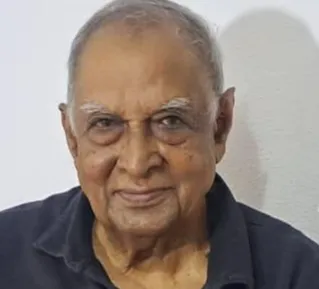
Amber Ramdass
Image: Nadia Khan
Amber Ramdass is a retired school principal. He is 90 years old and has spent most of his life in Verulam. He is presently bedridden.