

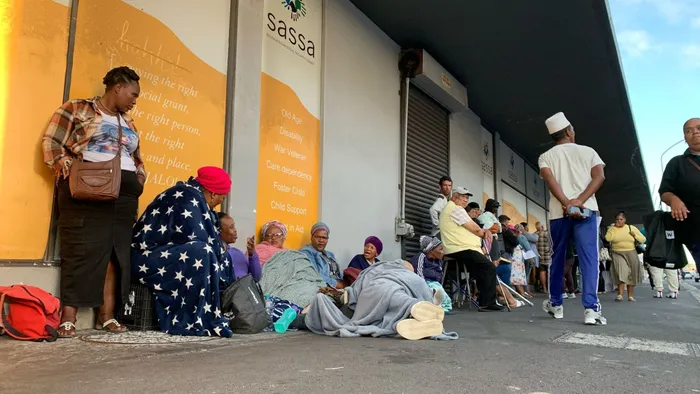
Overnight queuing at Sassa offices remains a significant challenge.
Image: Tracey Adams/IndependentNewspapers
Minister of Social Development Sisis Tolashe says the department is working to complete significant upgrades to the South African Social Security Agency (Sassa) systems by April 2026, to address ongoing issues that have forced people to sleep in queues outside local offices.
Tolashe was responding to a parliamentary question from Economic Freedom Fighters (EFF) Member of Parliament, Paulnita Marais, who asked the minister about the recent steps taken to rectify the system failures that have resulted in long waiting times and overnight queues at Sassa offices.
Tolashe explained that the department, working with Sassa, had implemented several measures aimed at improving the reliability of its systems and reducing the need for beneficiaries to visit offices in person.
One of the most important interventions had been the migration of the Online Grant Application System to a new, more resilient infrastructure.
This move, completed by the end of February 2026, addresses persistent performance issues, such as slow response times and system downtimes.
“This intervention is aimed at improving system stability and enabling more clients to complete applications remotely, thereby reducing pressure on local offices,” Tolashe said.
In addition to the infrastructure upgrades, Tolashe said Sassa had introduced a direct system-to-system integration with the Department of Home Affairs (DHA).
This new technical connection replaced previous indirect verification methods and was expected to improve the speed and reliability of identity verifications.
“This has significantly improved the reliability and speed of identity verification processes, reduced manual workarounds, and limited repeated client visits caused by failed or delayed verifications.”
Tolashe also highlighted the ongoing rollout of Electronic Queue Management Systems (QMS) across local Sassa offices.
The QMS aims to optimise client flow, prioritise vulnerable groups, and provide real-time monitoring of service demand.
According to the minister: “Sassa continues to roll out Electronic Queue Management Systems (QMS) across local offices to improve client flow, prioritise vulnerable groups, and enable real-time monitoring of service demand.”
She noted that the system would play a crucial role in managing peak periods and reducing congestion, which had contributed to the overnight queuing problem.
Despite these improvements, Tolashe acknowledged that overnight queuing remained a significant challenge.
The minister outlined several factors contributing to this persistent problem, including intermittent system instability that slowed down transaction processing and reduced the number of clients that could be assisted each day.
High demand during periods of grant reviews, reapplications, and verifications, as well as connectivity challenges in rural and high-volume offices, also exacerbated the situation.
Additionally, repeat visits caused by unsuccessful verifications or system timeouts have led many clients to arrive earlier in an effort to secure service, often resulting in them queuing overnight.
“Overnight queuing is mainly attributable to intermittent system instability, high demand, connectivity challenges, and repeat visits by clients who have been unsuccessful in their attempts to be verified."
To address these issues, the minister provided a detailed plan for stabilising and modernising Sassa’s systems.
The plan includes further improvements to the Online Grant Application System, continued integration with external partners like DHA, and the expansion of QMS usage across more offices.
In addition, the department is working on strengthening its business continuity measures, including implementing fallback procedures during system downtimes to ensure uninterrupted service delivery.
Tolashe confirmed that the final upgrades to the Online Grant Application System are scheduled to be completed by the end of April 2026, while the full rollout of QMS to the remaining offices was expected to be finished within the current financial year, depending on the operational readiness of local offices.
“These interventions are aligned with findings from Sassa’s broader technology assessments, which identified legacy system constraints, connectivity variability, and limited system agility as contributors to service delays,” Tolashe stated.
“We acknowledge the frustration experienced by beneficiaries,” Tolashe said.
''We remain committed to reducing waiting times, improving system reliability, and expanding digital service channels, while ensuring that no eligible beneficiary is denied access to essential social assistance services.''