

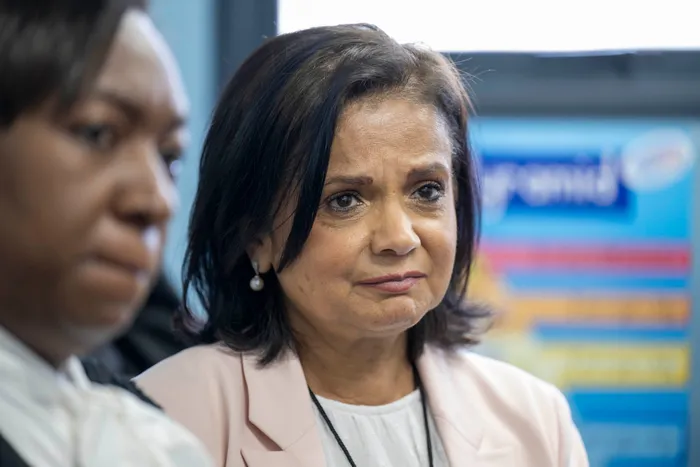
THE MK Party has filed an urgent application in the Gauteng High Court to block pension payments to former NDPP Shamila Batohi
Image: Henk Kruger/ Independent Newspapers
THE MK Party has filed an urgent application in the Gauteng High Court to block pension payments to former NDPP Shamila Batohi, citing concerns over her conduct during the Nkabinde Inquiry and the potential misuse of public funds
The application also seeks to reverse the decision to fund Batohi’s legal costs in the Nkabinde Inquiry, IOL reported.
The MK Party, led by former President Jacob Zuma, launched the court bid earlier this month.
“MK Party has approached the High Court in Pretoria on an urgent basis to stop what it believes may be the unlawful disbursement of public funds linked to NDPP Advocate Shamila Batohi,” said MK Party national spokesperson Nhlamulo Ndhlela.
“At the centre of the application are serious concerns about Advocate Batohi’s fitness to hold office, as well as whether she may improperly benefit from gratuity payments despite these concerns.”
“The MK Party is alarmed by the lack of transparency and accountability in the processes leading to these potential payments and the risk that public funds could be released before the legality of the situation is properly tested.”
Earlier this month, IOL News reported that the party warned the government against disbursing pension and post-tenure payments to Batohi, saying such payments would result in “irreversible” financial loss to the state.
The court papers cite Batohi’s conduct at the Nkabinde Inquiry, which was established by President Cyril Ramaphosa at Batohi’s formal request to investigate the fitness of Johannesburg prosecutions head Andrew Chauke to hold office. Batohi was a key witness at the inquiry.
However, her testimony took an unexpected turn when she walked out during cross-examination while still under oath.
Based on this walkout, the MK Party filed an urgent application to freeze Batohi’s pension and post-term gratuities, and to reverse the decision to fund her legal costs in the inquiry.
The party has accused Batohi of misconduct during her testimony, arguing that authorising and paying her pension, gratuity, and post-tenure benefits would vest public funds in her personal estate.
Once such benefits are vested, the court would be unable to grant effective preventative relief, leaving any subsequent challenge limited to recovery proceedings, which are procedurally complex, protracted, and uncertain.
“Recovery proceedings against an individual, particularly in respect of benefits lawfully received on their face, carry a materially heightened risk of non-recovery and significant litigation costs,” the papers state.
The party also alleged that Batohi made false or misleading statements under oath during the Nkabinde Inquiry and failed to safeguard sensitive prosecutorial matters, materially compromising governance.
The party described her walkout from the inquiry in December as unlawful and intended to evade accountability.
In the court papers, President Ramaphosa is referenced as the first respondent, Batohi as the second, the National Prosecuting Authority (NPA) as the third, and Minister of Justice and Constitutional Development Mmamoloko Kubayi as the fourth.
Ramaphosa’s spokesperson, Vincent Magwenya, said that there was nothing further to comment on.
NPA head of communications Bulelwa Makeke confirmed receipt of the application and said the authority would respond in line with “legally acceptable high court procedures”.
Department of Justice spokesperson Terrence Manase confirmed the department had received the court papers and intends to oppose the application.
“As the issues raised are now before the court, it would be inappropriate to comment further on the merits at this stage,” Manase said.
In his affidavit, Chief Whip Des van Rooyen acknowledged that, in line with established forfeiture jurisprudence in South Africa, the court has a duty to safeguard assets where there is a risk of dissipation, particularly when those assets constitute a financial interest tied to state funds.
Van Rooyen said the risk arises objectively from the nature of the payment and the absence of safeguards, not from any imputation of bad faith.
“If payment proceeds notwithstanding unresolved and material concerns, the principle of legality will be rendered hollow, as any subsequent engagement with those concerns will occur only after the irreversible transfer of public funds,” Van Rooyen said, adding that Batohi would suffer no irreparable prejudice if payment is temporarily withheld or lawfully conditioned.
“In circumstances such as these, the imposition of a security undertaking by the respondent is not merely discretionary but essential to protect the underlying asset and preserve the integrity of public funds,” he added.
Van Rooyen further stated that unresolved issues arising from the Nkabinde Inquiry, together with sworn material from senior NPA officials, constitute relevant information bearing directly on the rationality of any payment decision.
“Where credible, objectively verifiable material exists raising concerns about the conduct of a constitutional office-bearer, that material constitutes relevant information which cannot be ignored.”