

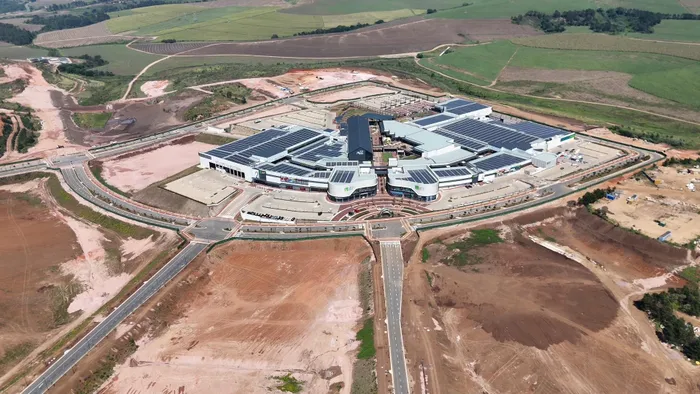
An aerial view of Westown in KwaZulu-Natal.
Image: Supplied
"In five years' time, KwaZulu-Natal will be unrecognisable. It will be at the same level the Western Cape has seen over the last four."
This bold prediction from Jan Jansen van Vuuren, development manager at Fundamentum Property Group, isn't just developer hyperbole but a high-stakes "hard news" challenge to the narrative of a failing KwaZulu-Natal.
And it is shared by many.
Stef Botha, director at Rainmaker Marketing, who has tirelessly been working at showcasing the developers and developments in KZN, agrees. He believes that KZN has pockets of excellence that can compete - and is already - with the likes of Cape Town.
While there are many new "pockets of excellence" in the region, in the west an injection of R15 billion is adding to the new narrative.
Standing amidst the red soil of the Westown development, fresh off the March 2025 opening of Westown Square and the recent March 2026 launch of the Kaleido residential precinct, the "Kwa-Silience" of the region is a visible, high-yield reality where property investment is showing fast returns.
Westown (often referred to as part of the Shongweni area) is the new 100ha sustainable mixed-use development located in Durban's Outer West region. Situated just off the N3 freeway near Hillcrest and Assagay, it is designed as a greenfields development featuring residential, commercial and retail spaces (Westown Square).
The shift toward Westown is a calculated "urban secession" from the crumbling 1960s city model. Jansen van Vuuren describes a "Catch 22" situation that has effectively paralysed traditional South African metros, particularly in Gauteng.
"There has been a general move away from the traditional CBDs of the '60s and '70s," Jansen van Vuuren says.
"The infrastructure is aged and hasn't been maintained in most CBDs.
"To refurbish those services is so expensive, cities can’t afford it, and they don’t get a return on it. Cities can't spend money to refurbish services that are so expensive and on which they don’t have a return. Maintenance is escalating at 4% to 6%, but the actual decay is moving faster."
Durban’s solution? Abandoning the refurb-heavy model for greenfield expansion.
"Durban has realised that to grow its rate base, it has to look at greenfield developments rather than massive capex projects and they are working closely with us to make it happen," says Jansen van Vuuren, adding that the region is poised for big economic growth.
A critical, often overlooked driver of this momentum is the restructuring of the region’s historical land ownership. The financial woes of Tongaat Hulett, once the monolithic gatekeeper of KZN development, have inadvertently triggered a "democratisation" of the landscape.
"... it forced them to sell," Jansen van Vuuren says. "What happened subsequently? Half the land was sold to developers with the right capital. Instead of one developer, you have four, five or six as big balance sheets drive development at a bigger pace. It’s actually a good thing in the longer run. It’s getting momentum."
The smart money has already moved. Growthpoint Properties, South Africa’s largest JSE-listed REIT, has pivoted a portion of its R157 billion portfolio toward KZN’s coastal and logistics hubs.
With an R8.6 billion provincial portfolio spanning 560,000m², Growthpoint's recent activity, including the R392 million Tecoma Park logistics hub and their retail presence at Hillcrest Corner and Watercrest Mall, just minutes from Westown, proves that institutional giants are betting on the "New West" to bypass municipal dysfunction elsewhere.
For Growthpoint’s leadership, the move to KZN is a strategic "flight to quality" in a region they believe is fundamentally misunderstood.
"Clearly the economy has started lifting and along with that they are starting to see some green shoots in KZN," says incoming group CEO Estienne de Klerk..
Their strategy mirrors the Westown model: Precinct-led investment. They are no longer looking at isolated buildings but at secure, managed environments where they can "influence the environment" to ensure long-term returns.
Stef Botha, director at Rainmaker Marketing, who has tirelessly bene working at showcasing the developers and developments in KZN, agrees. He believes that KZN has pockets of excellence that can compete with the likes of Cape Town.
The Westown team is systematically dismantling the three myths that have kept conservative investors at bay.
To ensure the long-term viability that the aging CBD could not provide, Westown operates as a managed precinct. This means private teams handle everything from street-scaping to security, taking the pressure off a constrained municipality while ensuring investor value doesn't erode, a model institutional giants like Growthpoint, Collins Residential and Devmco, are now replicating across their KZN "clusters"
"Municipalities can't do everything; they don't have the capacity to meet all servicing requirements," Wilkinson says. "Managed precincts are a useful model to add to what the municipality can do."
A glimpse at the progress:
Fundamentum and their institutional partners are not looking for a quick exit.
"We are not 'in-and-out' developers," Wilkinson emphasises. "We have the most to lose from value destruction. We own Westown Square and the private hospital; we are in it for the long haul."
As Jansen van Vuuren says: "Durban is open for business. Whether it’s the harbour being the engine of the country or the new partnership agreements, we have turned the corner."
For those still looking at the 2021 headlines, the R15 billion rising from the Shongweni cane fields is the reality check needed to see how the tide is turning.