

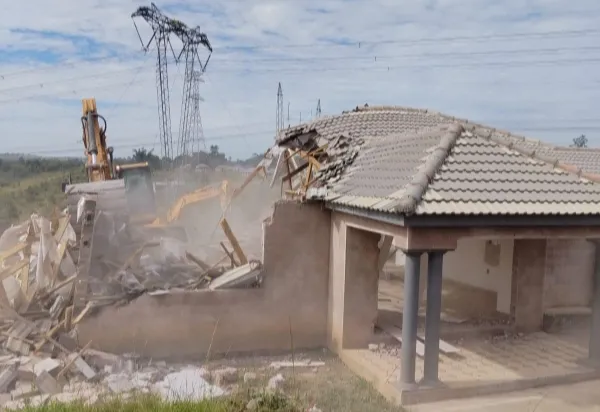
The owners of this house were left homeless after it was demolished on Eskom's invaded land.
Image: Bongani Hans
Residents of Thornville, Pietermaritzburg, expressed their outrage over their eviction by Eskom, claiming insufficient warnings and fraudulent land sales
They also blamed the people who illegally sold them the land, which is occupied by Eskom’s power station, for misleading them into believing that the sale was legitimate.
Some of these victims spoke out on Friday as a man, who was believed to be from the sheriff’s office, continued to lead the razing of illegally built houses.
Eskom’s subsidiary, National Transmission Company South Africa (NTCSA), which is responsible for the land, said it obtained three eviction orders from the Pietermaritzburg High Court last year.
Although tensions were still high and people were crying, the now homeless residents were not as angry as they were when the bulldozers started their work on Thursday.
Heavily armed police and Red Ant Security Relocation & Eviction Services officers followed as heavy-duty machines were moving from yard to yard, destroying houses worth a huge amount of money.
There were no attempts by the residents to disrupt the demolition, which was experienced on Thursday.
Mbali Mchunu, 64, whose house was demolished on Thursday, returned to her plot on Friday morning only to find that thieves had already helped themselves to some of her damaged building material and fencing wire.
It was believed that the thieves sold the zinc sheets and any metal items to scrap yards.
While some of the rubble seemed to be neglected by the homeowners, other residents were seen trying to retrieve whatever they could to rebuild their homes elsewhere.
“Criminals are heartless for stealing from people who have suffered by witnessing their houses being brought to the ground. I was told that these criminals worked the entire night stealing our stuff, leaving me with nothing to start afresh,” said Mchunu.
She insisted that Eskom did not do enough to warn unsuspecting land buyers that the land was off-limits to the members of the public.
“I did not know anything about the notice of eviction, which was only shown to me yesterday, just as were already starting to destroy my house. Eskom should have called a meeting or gone from plot to plot, warning us not to spend money building homes, and it should have also put up notice boards indicating that the land was private property, not for sale,” she said.
Mchunu did not believe that a man who sold her the land for R35,000 would refund her.
“Most of the land sellers have switched off their phones, and those who we managed to contact promised that they are dealing with the matter through court, and that we will get some compensation from Eskom,” she said.
The woman refused to provide the cell number of the man who sold her the land, even though he did not furnish her with any legal documentation to prove the sale agreement.
NTCSA said late last year that it would not compensate individuals for structures demolished on its property because such structures are unlawful and erected without consent.
“Compensation would contravene public finance and procurement laws, and it would undermine the rule of law and create inequitable precedents,” the NTCSA said.
Before approaching the court, after establishing that portions of its land had been unlawfully allocated and sold by certain individuals, NTCSA unsuccessfully made multiple attempts to address the matter without litigation.
“As the registered owner of the land, the NTCSA is legally obligated to secure its assets and ensure that servitudes remain clear for current operations and future expansion.
“While we empathise with the individuals affected, the NTCSA must prioritise public safety, the integrity of the transmission network, and the long‑term interests of all South Africans who depend on a stable electricity supply,” read NTCSA’s statement issued on Thursday afternoon.
Aron Zondi reported an expenditure of up to R2,5 million for a property development.
This total covered the initial R40,000 cost for the land, the construction of the main residence and several additional structures, the complete installation of all bathrooms, and the erection of a substantial concrete perimeter fence, along with other security enhancements.
“But my home is no more, as it was destroyed this morning, and my money is down the drain. My houses were completely developed and had state-of-the-art furniture, but I managed to remove roof tiles, and I worked the entire night relocating my stuff to a storeroom and to my other house in town.”
He said that after he bought the land, certain people, who claimed to be traditional leaders, gave him and his neighbours pieces of paper, which they called Permission to Occupy.
Another resident, who lived on a farm neighbouring Eskom’s land, said most of the demolition victims knew that there would come a time when they would be forcefully evicted.
“But they resisted and said they would fight the eviction, but others honestly did not know that this day would come.
“Right now, there are no actions to take further to continue fighting because you knew that this property is not yours.
“Other people inquired from us about this land, and we told them about its status, and that building on it would be a problem in the future, but they voluntarily continued building and said they would deal with the situation when it comes, as they have lawyers,” said the resident, who asked to remain anonymous for fear of intimidation.
He said those who bought land were victims of unscrupulous land sellers.
“You cannot pay R50,000 to buy land without getting a paper confirming that the land now belongs to you. They are land sellers who gave buyers fake papers,” he said.