

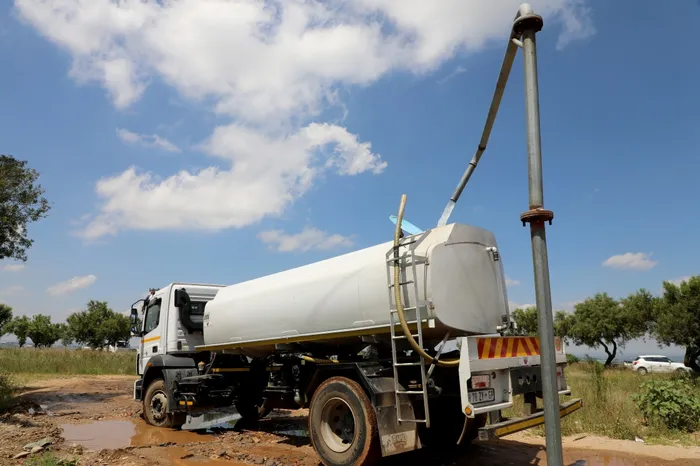
Community leaders are calling for urgent reforms to ensure water security and accountability.
Image: Timothy Bernard / Independent Newspapers.
Community leaders have expressed frustration over the government's delayed response to the water mafia crisis, which they warned about two years ago.
They are calling for urgent reforms to ensure water security and accountability.
Roshan Lil-Ruthan, spokesperson for the Verulam Water Crisis Committee (VWCC), said while any effort to combat criminality in the water sector was welcomed, this intervention arrived years too late for communities which have endured prolonged suffering, exploitation and systemic neglect.
He said the committee had warned the government years ago, and submitted a detailed correspondence and evidence to the National Director of Public Prosecutions (NDPP), SAPS and the presidency.
“Our submissions highlighted infrastructure sabotage, the deliberate damage to water systems, organised criminal networks controlling tanker distribution, and the collusion between officials, contractors and criminal syndicates.
“These warnings fell on deaf ears. No specialised unit was established. No urgent intervention was deployed. No accountability followed. Communities were left to fend for themselves while criminal networks flourished.
“The current initiative, while necessary, is not proactive governance, but is a belated reaction to a crisis that has already devastated households, schools, businesses and vulnerable residents,” he added.
Lil-Ruthan said communities had been forced to live in “survival mode”.
“Because of government inaction, the people of Verulam and surrounding areas have been forced to rely on water donations from non-government organisations, religious organisations, and private citizens.
“They have also had to rely on community-funded boreholes and a limited number of municipal tankers, often unreliable and insufficient. This is not sustainable service delivery. It is survivalism. The government is now applying a plaster to a festering abscess, instead of addressing the root causes: corruption, sabotage, mismanagement, and the collapse of critical infrastructure.
“We reiterate our long-standing call for the establishment of a specialised, multistakeholder oversight unit, including community organisations, to monitor the R25 billion Umkhomazi Dam project,” he added.
He said this project was central to water security for generations to come, yet it is also a prime target for large-scale corruption, procurement manipulation, infrastructure sabotage and criminal infiltration.
“Without transparent oversight and community involvement, the Umkhomazi Dam risks becoming another mega-project plagued by looting and delays. The people of KwaZulu-Natal cannot afford another failure.
“Communities must be partners, not after-thoughts. We call on the government to disclose the mandate, structure and reporting lines of the new SAPS teams, and include community organisations in oversight, intelligence-sharing and monitoring.
“We also need the police to protect whistle-blowers who expose tanker mafias and infrastructure sabotage, and develop a national water security strategy that addresses both criminality and infrastructure collapse.
“Communities are not passive recipients of government decisions. We are stakeholders with lived experience, evidence and solutions. The establishment of SAPS teams to combat water tanker mafias is a step in the right direction, but it is far too late for communities that have suffered for years, while the government ignored clear warnings,” added Lil-Ruthan.
He said the committee remained committed to constructive engagement, and they would continue to hold every sphere of government accountable.
“We will not allow our communities to be sacrificed to negligence, sabotage or looting,” he said.
Rachael Naidoo, secretary of the Tongaat Civic Association, said they demanded an immediate, transparent investigation into the sabotage and collusion between municipal officials and water mafia tanker operators in eThekwini.
“This should include replacing private tenders with in-house water tankers, repairing damaged infrastructure, and implementing security for utility assets. The municipality should immediately secure water valves and pump stations to prevent the documented trend of deliberate sabotage by syndicates.
“In Tongaat, we suffer frequent water outages, and during the 2022 floods experienced nine months without water from our taps. Water tankers are few and scarce, and the town relies on water delivery by private entities who undertake such an exercise at their own cost.
“While we welcome the announcement by the acting Police Minister Firoz Cachalia that a strategy is in place to combat the activities of the water tanker mafia, we note that it is largely reactive. What is needed is a more proactive intelligence-driven approach,” Naidoo added.
She said the water mafia syndicates were sophisticated and well-funded, with deep ties to government officials; and its members were often armed and willing to engage in violence to maintain their contracts.
“Water tanker mafias pose risks to South Africa’s security, economic and political stability. Mafias exacerbate issues of water quality by vandalising infrastructure, creating water contamination risks.
“We request the Special Investigating Unit and the newly-launched Water Sector Anti-corruption Forum to audit water tanker contracts, and investigate sabotage to ensure a secure water supply.
“We also call for the municipality to stop using external tanker tenders, and instead, repair existing infrastructure, using the savings to fund local, in-house, reliable water supply. We caution that water tankers should not be seen as the panacea to our current water crisis.
“As citizens, we should receive reliable water service from our taps. Providing water tankers should not compromise the repair of failing infrastructure.
“We propose a community-led monitoring system where residents can verify that water is sourced from safe, potable municipal points rather than unsafe dams or rivers used by illegal operators.
“We encourage residents to report suspicious activity around reservoirs or fire hydrants, to the municipality. We wish to remind the municipality that ongoing failures have already led to community calls for withholding utility payments, and as a last resort protest against poor service delivery,” Naidoo added.