

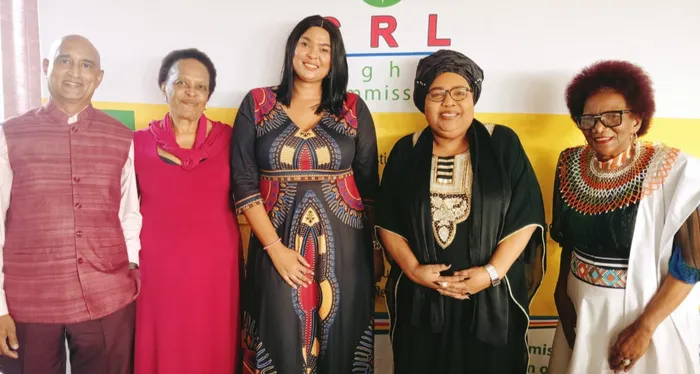
Representatives of the Commission for the Promotion and Protection of the Rights of Cultural, Religious and Linguistic Communities, from left, Dr Rajendran Govender (commissioner), Tsholofelo Mosala (commissioner), Donna Makoboka (commissioner), Tsakane Nkwe (commissioner), and Thoko Mkhwanazi-Xaluva (chairperson).
Image: Nadia Khan
The Commission for the Promotion and Protection of the Rights of Cultural, Religious and Linguistic Communities (CRL Rights Commission) held a consultative meeting with the Hindu community in Chatsworth to address concerns regarding the proposed Section 22 committee, emphasising the importance of dialogue and participation.
This meeting comes amid backlash about the commission’s intentions, as many fear it may be attempting to regulate the Hindu religious sector.
During the meeting, discussions focused on the purpose of the proposed committee, which the commission said was designed to act as a consultative body and a conduit for nation-building.
Thoko Xaluva Mkhwanazi, chairperson of the CRL Commission, said the committee formed part of a democratic and participatory process, grounded in the country’s Constitution.
“This path is not a procedure of imposition, but one of consultation. No community is being forced to participate. However, meaningful participation can only yield positive outcomes for the betterment of the diverse religious sector.”
Mkhwanazi said such structures were important for conducting consultations across the country, developing peer-review mechanisms and a code of conduct, thereby addressing challenges within the sector, including cases of exploitation and abuse, which require collective engagement and ethical leadership.
“It was clearly emphasised that this engagement represented the beginning of an ongoing consultative process. Once established, the Section 22 committee will continue engaging with organisations across the different provinces to ensure that the broader Hindu community is reached and included.”
Mkhwanazi added that neither the commission or the proposed committee had any mandate to regulate or prescribe religious practices.
“The role of the CRL Rights Commission is not to tell people how to worship, but to protect the space in which all can worship freely, with dignity and mutual respect.”
Mkhwanazi added similar Section 22 committees had already been established for the Christian sector and African traditional religion, respectively, with plans under way to extend this process to other religious communities.
Dr Rajendran Govender, a commissioner, added that the engagement was not about imposing structures, but about building trust.
“It is through consultation, participation and mutual respect that we strengthen both community identity and national unity. The Section 22 committee will serve as a bridge between the commission and the Hindu community – ensuring that no voice is left unheard.”
During the engagement, key concerns affecting the Hindu community were also raised, prompting calls for the commission to address them.
These included, among others, the urgent need to prioritise the promotion and teaching of Indian languages in schools and universities, funding opportunities for the promotion of Indian culture, and greater recognition and support for the Indian community which at times experienced marginalisation.
Meanwhile, Professor Brij Maharaj, the deputy president of the South African Hindu Maha Sabha (SAHMS), said last Wednesday, they wrote to President Cyril Ramaphosa expressing concern about the commission’s establishment of a Section 22 committee for the Hindu sector without prior consultation.
“The SAHMS, which is a nationally-recognised representative body of the Hindu community, noted that major Hindu organisations were similarly excluded, raising serious questions about procedural fairness, transparency and constitutional compliance.”
Maharaj said the SAHMS emphasised that public participation was a constitutional requirement.
“It is not a formality, and decisions taken without proper engagement risk undermining community trust, social cohesion and the legitimacy of institutions tasked with protecting cultural and religious rights.
“The organisation was also concerned that fragmented, faith‑specific committees may entrench divisions rather than support unity, social cohesion, and interfaith co-operation and harmony,” he said.
Maharaj said the SAHMS requested Ramaphosa’s intervention to ensure the commission provided clarity on the purpose and mandate of the Section 22 structure, and initiated a proper consultation process.
He said the SAHMS further called for a unified multifaith platform rather than siloed committees.
“It was pleasing that on March 26, the auspicious occasion of Ram Naumee (birth of Lord Ram), Parliament, through the Office of the Speaker, acknowledged the growing tensions between religious stakeholders and the CRL Rights Commission.
“The Speaker confirmed that Parliament had received several submissions alleging exclusionary processes and overreach by the commission. She reaffirmed Parliament’s commitment to safeguarding religious freedom, while ensuring that harmful practices are addressed within constitutional and legal frameworks.
“The Speaker has directed the portfolio committee on cooperative governance and traditional affairs to intensify engagements with all parties, including the commission and faith‑based organisations, to restore confidence, promote inclusivity, and ensure that all institutions operate within their constitutional mandates,” he said.