

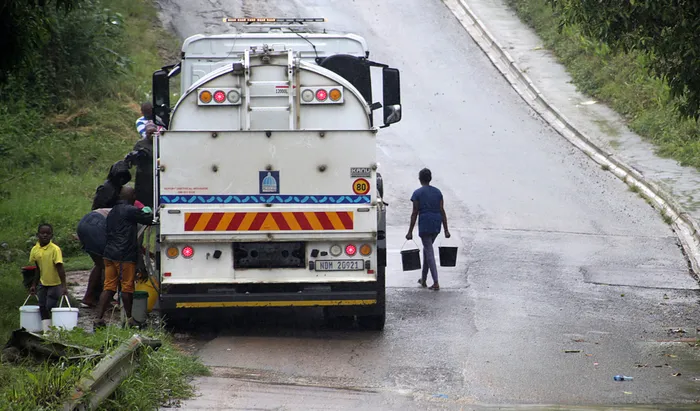
A water tanker in KwaZulu-Natal highlights the ongoing struggle for reliable water access in the province.
Image: Khaya Ngwenya/ Independent Newspapers
WATER services in KwaZulu-Natal face significant challenges despite full dam levels, with many areas lacking access to piped water and alarming rates of non-revenue water. Officials call for urgent interventions to ensure universal access by 2030.
Presentations by KZN Cooperative Governance and Traditional Affairs (Cogta) deputy director general, Barbara Mgutshini, and remarks by Premier Thamsanqa Ntuli highlight a multifaceted crisis centred on poor access to piped water in certain districts, alarmingly high levels of non-revenue water (NRW), and critical municipal technical capacity shortfalls, IOL reported.
Mgutshini said the major challenge is access in areas such as uMkhanyakude, uMzinyathi, Harry Gwala, Zululand, King Cetshwayo, Ugu, and uThukela. There is no access to piped water within 200m of the dwelling.
“As much as we have areas where the access to piped water is quite high, we have situations where there is no water coming out of those taps because demand exceeds supply,” Mgutshini said.
“We have municipalities that are now less than 10% in terms of reaching universal access. And these range from your uMgungundlovu sitting at 7%, Amajuba at 5%, uMhlathuze at 4%, Msunduzi also at 4%, and Newcastle at 2%.”
Mgutshini said there is a need to accelerate interventions to reach 100% universal access by 2030.
She noted that despite KZN’s dams being at full capacity, indicating no drought, isolated areas still experience dry rivers.
Looking at non-revenue water, Mgutshini said KZN’s average is 54% (2024/25). eThekwini, the largest water user, has a high per capita consumption (298L/day) well above the international average (173L/day).
“Municipalities such as Zululand are sitting at 88.8% non-revenue water, which is a cause for concern. Similarly, our metro, eThekwini, is sitting at 58.7% with all their programmes underway; they need acceleration,” Mgutshini said.
Reflecting on water tankering trends (Dec 2025 - Feb 2026), Mgutshini said there are improvements in terms of hired water tankers from their Water Services Authorities (WSAs).
“Efforts have been made to buy their own water tankers in order to reduce the reliance on hiring, which had become a cause of concern due to corruption that was related to the hiring of such a service,” Mgutshini said.
“We’ve got municipalities that no longer do the outsourcing: uMhlathuze, uMkhanyakude, as well as uThukela and Harry Gwala, eThekwini metro, and uMzinyathi; they all have water tankers. But we still have municipalities that have a high number of hired water tankers. Your Ugu is sitting at 26 in February 2026, uMgungundlovu at 40, and Zululand at 30,” Mgutshini stated.
She said a strategy is needed to accelerate water intervention programmes and reduce the use of outsourced water takers.
Premier Ntuli expressed concern that 16% of people in the province still lack access to water.
“When you look at uMkhanyakude, it’s 41% is a cause for concern. I think uMzinyathi is 35%. Harry Gwala, when I saw your schemes, I thought you were doing quite very well, but when I see these stats, you are 29% with people who have no access to water. I think there’s some work to do. Also, Zululand is 23%,” Ntuli said.
He said that non-revenue water losses are severe in the Zululand District (88%), eThekwini (58.7%), uMgungundlovu (66%), and uThukela (60.9%), with Zululand making almost no revenue.
“I think the situation there requires urgent attention and a proper plan, which is funded. If funding is not available in municipalities, we should be able to, as the provincial government, through various institutions, work together so we can put together a plan of funding,” Ntuli said.
He said they need to discuss these issues and gaps, which are of importance, and address them; if not, they will find themselves “in a disaster”.
Ntuli added that the insourcing of services for water provision is important. Even the water tankers, you will find that you spend more money when you outsource than when you insource.