

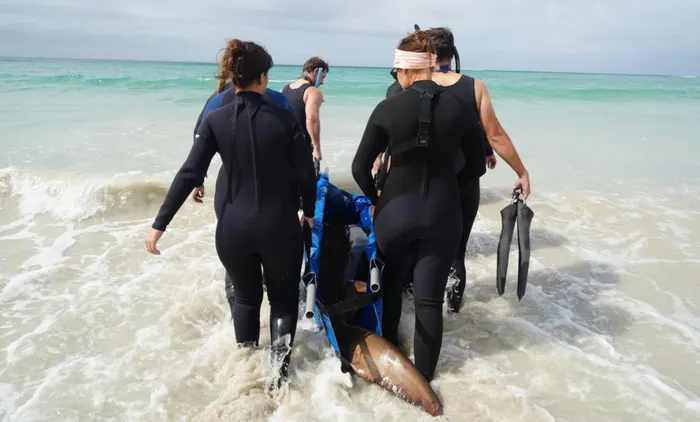
The Two Oceans Aquarium’s Curatorial team walk Blue, a female ragged tooth shark, back into the ocean for release in Struisbaai after 8 years in the Save Our Seas Shark Exhibit.
Image: Supplied
After eight years in human care, Blue the shark has been released back into the ocean, marking a poignant moment for the Two Oceans Aquarium and its supporters.
There was a quiet sense of anticipation along the shoreline at Struisbaai as a small group gathered to witness her return. Not a spectacle, but something far more meaningful. A full-circle moment.
After eight years in human care, Blue slipped beneath the waves once more, strong and steady, heading back into the wild where she belongs.
Blue’s story began in 2018 when she arrived at the aquarium alongside another ragged-tooth shark, Charlie.
At the time, she was small and vulnerable, weighing just over 26kg and measuring under two metres.
Over the years, she grew into one of the aquarium’s most recognisable residents.
Visitors returned again and again to watch her glide through the Save Our Seas Foundation Shark Exhibit.
For many, she helped shift perceptions, showing that sharks are not something to fear, but creatures to admire and protect.
Dr Ilse Jenkinson, the aquarium’s veterinarian, explains: “Catch and release is a central component of the Aquarium’s ragged-tooth shark conservation programme. The reason for temporarily including them in our exhibits is to be an ambassador species for sharks, educating our visitors on the wonder of the ocean. The message these sharks deliver is not to fear them but to be in awe and wonder of these complex animals.”
By 2026, Blue had grown into a powerful adult, weighing 201kg and measuring nearly three metres in length. The decision was made. It was time for her to go home.
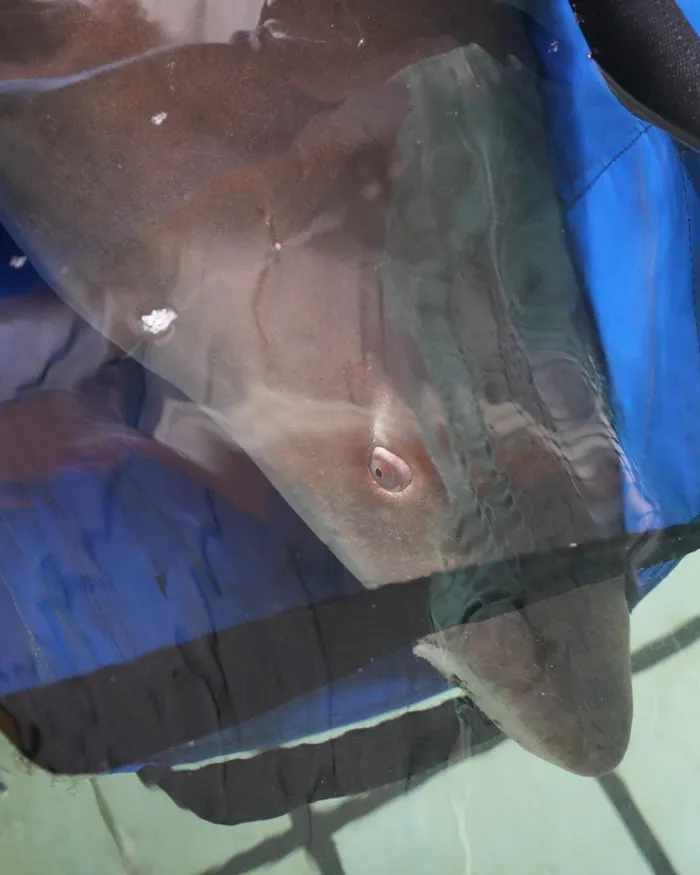
By releasing Blue as a mature female into an important marine area, there is hope she will contribute to future generations.
Image: Instagram
Releasing a shark like Blue takes careful planning.
In the weeks leading up to her release, she was moved into a separate holding space where experts could monitor her closely.
Health checks, blood tests and full physical assessments ensured she was ready for life back in the ocean.
She was also fitted with two tracking tags.
An acoustic tag will allow scientists to follow her movements along the coastline for years, while a visible spaghetti tag means valuable data can still be collected if she is encountered again.
“Tagging also raises awareness about sharks in an ocean increasingly impacted by human activity,” said Aquarium Curator Kevin Spiby.
On March 19, Blue made the journey from Cape Town to Struisbaai in a carefully controlled, oxygenated transport unit, with the aquarium team monitoring her throughout.
Once at the shoreline, final checks were completed before she was gently guided into the surf on a specially designed stretcher.
As soon as the water touched her gills, there was a noticeable shift. She was ready.
Within moments, Blue swam off into the ocean, strong and steady, disappearing into the deep.
“It was a privilege to return one of our largest ragged-tooth sharks to the big blue. Blue spent eight years with us, serving as a powerful ambassador for her species and educating thousands of visitors,” says Kevin Spiby.
Dr Jenkinson confirmed the success of the release: “Blue showed healthy vitals during the quarantine period. The transport went smoothly, and she had a good, strong response before being released.”
For the team who cared for her, the release was deeply emotional. Many had worked with Blue since the day she arrived.
Letting her go marked the end of one chapter and the beginning of another.
But her journey is far from over.
Through her tracking tags, researchers will continue to learn from her movements, gathering critical data about migration patterns, growth and habitat use.
This information plays an important role in protecting ragged-tooth sharks, a species vulnerable to population decline.
By releasing Blue as a mature female into an important marine area, there is hope she will contribute to future generations.
Blue may no longer be gliding through the aquarium’s waters, but her impact remains.
She helped thousands of people see sharks differently. Not as something to fear, but as something worth protecting.