

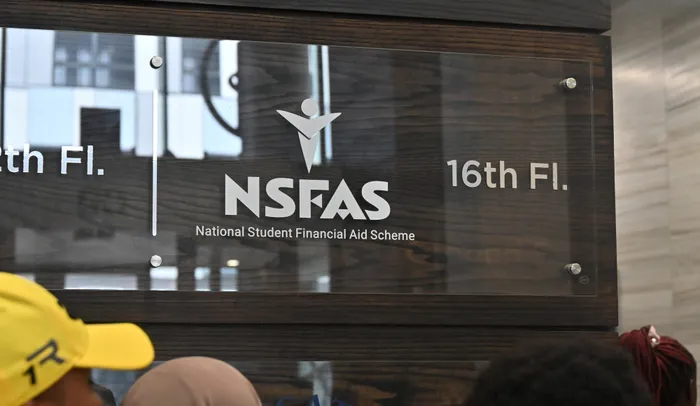
Deputy Minister of Higher Education and Training, Dr Nomosa Dube-Ncube, says it is “very disappointing” that systemic weaknesses in NSFAS allowed 822 deceased and thousands of ineligible students to continue receiving funding.
Image: Ayanda Ndamane / Independent Newspapers
Deputy Minister of Higher Education and Training, Dr Nomosa Dube-Ncube, says it is “very disappointing” that systemic weaknesses in NSFAS allowed 822 deceased and thousands of ineligible students to continue receiving funding.
This comes after a recent Auditor General report highlighted serious irregularities, showing that more than 14,000 students with household incomes above the eligibility threshold were also receiving funding.
In an interview on Newzroom Afrika, Dube-Ncube said the department has instructed the NSFAS board to provide a turnaround plan detailing what went wrong immediately.
She explained that a lapsed contract with Home Affairs prevented proper verification of students’ identities, contributing to the inclusion of deceased students on the funding list.
“It cannot be that they did not have any other measures that they were able to detect these wrongful students, because this actually means that there are other students, deserving students, who should have received this money, who then were not able to receive this money.
''And we need this money. There are a lot of other students who need this money, who should have received this money,” she said.
The Deputy Minister added that NSFAS must clarify consequences for board members and staff responsible for the oversight, and outline plans to recover misallocated funds.
“There has to be consequences, because it cannot be that such an amount of money that has been lost to NSFAS can just go like that, and nobody is going to be held responsible,” she said.
The department is also awaiting reports on three categories of students identified by the Auditor General: 822 deceased students, more than 14,000 students exceeding household income thresholds, and 321 students who received double funding while also benefiting from social relief programs.
Matters relating to accommodation have also been referred for forensic investigation, she said.
“We really believe that it’s about time that there have to be serious consequences on the governance issues of NSFAS. NSFAS is providing very important services to the poorest of the poor South Africans, and we need to make sure every cent that goes to NSFAS is utilised where it is needed.
We can’t keep on complaining about governance issues. There has to be a time where we stop complaining and take action. There has to be a time where there are people arrested, people jailed, and we clean the systems,'' she said.
On the recurring governance failures at NSFAS, Dube-Ncube said the problems persist because decisive action has not been taken.
“I think it’s because we keep on talking, but we’re not coming to a stage where we stop things. We’ve got to stop the rot. We’ve got to stop somewhere and say it’s not going to happenH
Somebody must be removed and taken somewhere, whether it’s to jail or it’s to recover the money. It can’t be that we keep on dragging things and moving somewhere.
She noted that the Auditor General’s reports highlight ongoing issues, with new irregularities being added to unresolved problems from previous years.
“From last year’s issues, maybe four have been cleaned up, but we can’t keep adding four new issues to the previous nine that were there. It cannot be,” she added.
Dube-Ncube said it has given the NSFAS board three months to begin investigations and submit a report outlining the steps and timelines for accountability.
“Within those three months, the board must give us a report, which is going to tell us when the investigations are going to start, what the steps are that are going to lead to that investigation, what’s going to be happening so that we know and can trace every month, every week what is going to be happening.
''We have committed ourselves, and we are going to be signing that off to the Auditor General so that when we ourselves are not adhering to what we are committing ourselves to, the Auditor General can also see it,” Dube-Ncube said.