

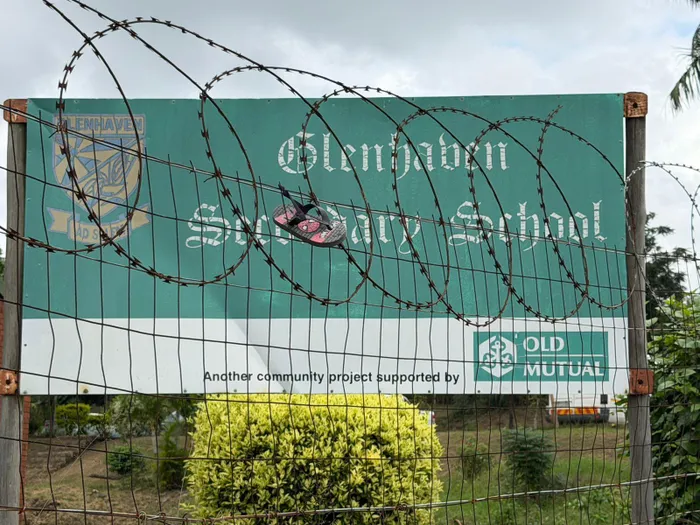
Glenhaven Secondary was allegedly used for a large Easter gathering, leading to extensive damage to the school property.
Image: Supplied
RESIDENTS of Brindhaven are outraged after Glenhaven Secondary was allegedly used for a large Easter gathering, leading to extensive damage to the school property, health concerns and calls for urgent government intervention.
According to residents, an estimated 400 congregants arrived at the school from Thursday, occupying classrooms as sleeping quarters and using the premises for a traditional Easter gathering.
The event reportedly included the slaughtering of livestock on the school grounds.
An inspection conducted on Sunday by Ward Councillor Johnson Chetty, together with members of the Brindhaven Civic Association and Community Policing Forum (CPF), revealed what officials described as “deplorable” and “hazardous” conditions.
Among the issues was blocked sewer lines, widespread infestation of flies and other pests, broken windows, and extensive structural damage.
Desks and chairs were found scattered across the premises, while waste and animal remains were strewn throughout the school grounds.
Chetty said cattle were reportedly seen on the premises, and at least one cattle carcass was found inside a classroom.
Bags containing animal intestines were also discovered in classrooms, alongside bones and other remains.
At present, the school is considered unfit for occupation by both teachers and pupils due to health risks.
Chetty expressed outrage following the inspection.
“I was alerted to bus and taxi loads of Easter worshippers that were congregating at the school. They started arriving on Thursday and left early Sunday morning.”
Chetty described the aftermath as deeply disturbing.
“I was appalled to see evidence of a cow that was slaughtered on the premises, overflowing bins, infestation of flies, an overflowing sewer, broken windows, litter strewn across the school, and even bones and skull remains of an animal on a classroom floor,” he said.
He further alleged that the event had been pre-planned and sanctioned by school authorities.
“In my discussions with the School Governing Body (SGB) Chair, it appears that this gathering was sanctioned by the acting principal and the SGB. However, there are serious questions about accountability - particularly regarding the slaughtering of animals, which the community had been assured would not take place.”
Chetty also criticised the lack of communication from school leadership.
“Neither the acting principal nor other responsible parties have returned our calls. The principal gave the community assurance that this would not happen that there would be no slaughtering but she breached their trust. This is disrespectful to the community and goes against law, order, and basic ethical standards. A school is a place of learning, not a venue for large gatherings of this nature.”
Chetty has formally requested urgent intervention from the Department of Education and Public Works to restore the school and prevent similar incidents in future.
“At the very least, the school requires immediate deep cleaning and sanitisation but more importantly, those responsible must be held accountable.”
Local residents say they were subjected to loud noise and disturbances throughout the weekend, with music playing late into the night.
Anand Jayrajh, a Management Committee Member of the Brindhaven Civic Association, said the community was “in a state of shock.”
“The residents of Brindhaven are utterly dismayed and distressed at what transpired in the heart of the community. Vehicles, including minibuses and buses, brought in hundreds of people, and live animals, including cattle, onto the school premises.”
Jayrajh described the scene discovered on Sunday as deeply unsettling.
“There was evidence of animal slaughter, with carcasses, offal, and bones lying across the premises. Animal intestines were found in plastic bags, even inside classrooms. There was an unbearable stench and thousands of flies.
“There are no facilities for hostel accommodation, and one wonders how the occupants were permitted to stay overnight.”
He added that the situation posed significant health risks.
“The toilets were clogged, the facilities clearly inadequate, and the classrooms left in a deplorable condition. With schools reopening, it is doubtful that the environment will be safe for pupils and staff.
“The incident endangers the health of not only those who would enter the premises but the wellbeing of those living in the vicinity considering the fly and insect infestations that have occurred.”
He also raised serious concerns about possible violations of municipal bylaws, public health regulations, and animal welfare standards.
“The incident raises questions about hygiene, fire hazards, and whether proper legal procedures were followed in the slaughtering of animals. School premises are sacred spaces for education and should not be used in this manner.”
“The country is presently experiencing a grave epidemic of foot and mouth disease in the country. There is uncertainty whether the slaughtering of animals on the premises complied with the legal requirements relating to slaughter of animals.”
Jayrajh highlighted that religious gatherings of this nature should have used an appropriate venue.
“If what happened has to do with religious performances and connotations, then the perpetrators should have sought out suitable areas for this. School premises are most certainly not the venue for such observations,” he said.
KwaZulu-Natal MEC for Public Works and Infrastructure, Martin Meyer, acknowledged the seriousness of the incident and indicated that an investigation would follow.
“Whilst I understand that schools have to raise money, it cannot happen in a way that damages the school or harms education,” Meyer said. “This is a shared responsibility between Public Works and Infrastructure and the Department of Education. I will request officials to inspect the school,” said Meyer.