

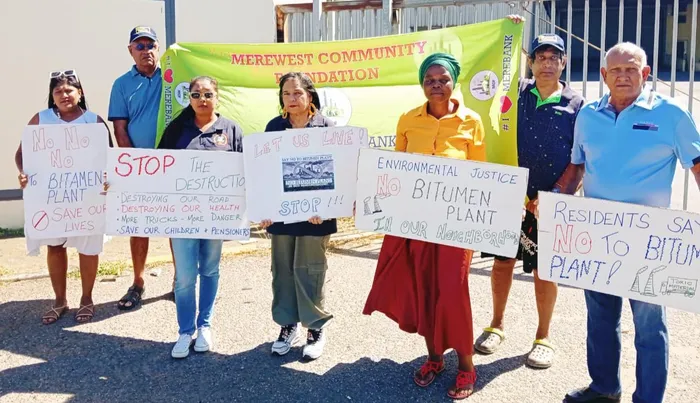
Residents of Chinatown and Navy in Merebank protested against a premises in the area being used for bitumen works.
Image: Nadia Khan
Residents of Merebank are voicing strong objections to a proposed bitumen plant, citing serious health and safety concerns.
Community leaders argue that the lack of transparency and potential environmental harm could jeopardise the wellbeing of local families.
The Chinatown and Navy residents said they recently learnt about the application for a premises in the community to be used for bitumen works.
Bitumen which is refined from crude oil, is a sticky, black, highly viscous liquid or semi-solid form of petroleum, largely used as a binder in road construction and for waterproofing in building applications.
They said the application was made to the eThekwini Municipality by Energex Commodities (Pty) Ltd for the use of the premises in Tomango Road for bitumen works which include the transportation and operations of mobile bitumen kettles.
It also called for objections to be sent within 14 days of the application notice, which was sent out on March 18.
Premilla Deonath, chairperson of the Merewest Community Foundation, said the greater community had not been informed about the application.
“Residents were kept in the dark. We found out about the application just days before the deadline for objections were to be submitted. After finding out more information, we learnt that only a few of the neighbouring businesses received the application notice. But the community, especially residents who live directly opposite to the premises, were not informed. There was no notice even placed on the premises gate.
“Not only were we not informed, but we had to submit objections without knowing the details of the proposed plant as there was no community consultation. We feel there has been a lack of transparency, and we are demanding answers. We are also looking at our legal options should our concerns not be addressed,” she said.
Deonath said the residents were concerned about the potential health and safety risks.
“We are opposing it due to concerns of environmental harm such as air and noise pollution, safety issues, and health risks. We want a healthy and sustainable future for Merebank, not a dirty industrial zone. Our community will not allow this development,” she said.
Navin Singh, chairperson of the Chinatown and Navy Civic Association, said the area was densely populated with industrial businesses
“Our air quality is already compromised. There are businesses operating alongside the premises proposed for the bitumen works, which have already compromised the health and safety of neighbouring residents.
“In addition, for years now residents have been disturbed by the noise that comes from these businesses. They have to deal with continuous hooting and reverse sirens from trucks and the revving of forklift engines throughout the day and night. We also have an influx of trucks using our roads, posing a safety risk to residents,” he said.
Singh said bitumen was a hazardous product.
“We are concerned that we will not be able to breathe as the smell is toxic. It is also highly flammable, so what will happen to the residents who live across the road if there was an explosion? It seems the health and safety of residents was not considered prior to this application being made. But we will not allow this to happen, and are objecting to any toxic plants operating in our community, “ he said.
Burton Jaganathan, a resident, said he was concerned that the pollution issues that already existed in Merebank would escalate.
“It would only result in further aggravation of health issues such as chronic respiratory illnesses, sinus and asthma. In addition, the odours and smells will make it difficult for us to keep our windows open and to engage in outdoor activities.
“Furthermore, traffic congestion will worsen with the increase in the number of trucks going to and from the plant. Roads and pavements will run the risk of increased damage, and there may be an increase in accidents involving other vehicles and people living in the area. I believe such a plant should be operated in an industrial area away from residential areas,” he said.
Prega Moodley, another resident, added that the proposed premises were in close proximity to residents’ homes, schools, and religious sites.
“The proposed premises is less than 10 metres from the nearest residential property. We also have two schools in the area, religious sites, and other cultural centres which will be directly affected by the increase of air and noise pollution. As ratepayers we should not be subjected to such conditions.”
Desmond D’Sa, coordinator of the South Durban Community Environmental Alliance, said “toxic plants” should not be allowed to operate in or close to residential areas.
“Residents have suffered the consequences of health related illnesses such as chronic asthma, and cancer from years of breathing in toxic pollution. By operating such a business it will only further compromise the residents' health.”
Gugu Sisilana, deputy head of the eThekwini Municipality’s marketing and communications, said the proposed nature of trade for the company was the storage of bitumen only.
“No processing or manufacturing activities would take place on the site. The bitumen, classified as a raw material, will be stored in fully enclosed tanks housed within a warehouse facility.”
Sisilana added that the application was formally circulated to various directorates for review, comments, and technical input.
“Upon receipt of all comments, and provided that no objections are raised, the application then proceeds to an advanced stage. At this stage, the applicant is required to submit supporting source documentation for vetting. These include medical surveillance reports for employees, risk assessments, and occupational hygiene surveys covering noise, chemical exposure, illumination, and ventilation.
“Once the vetting process has been completed, Environmental Health Services, through the permitting officer, will draft the operating permit. The permit will include strict conditions with which the company will be required to fully comply,” she said.
Energex did not respond at the time of publication.