

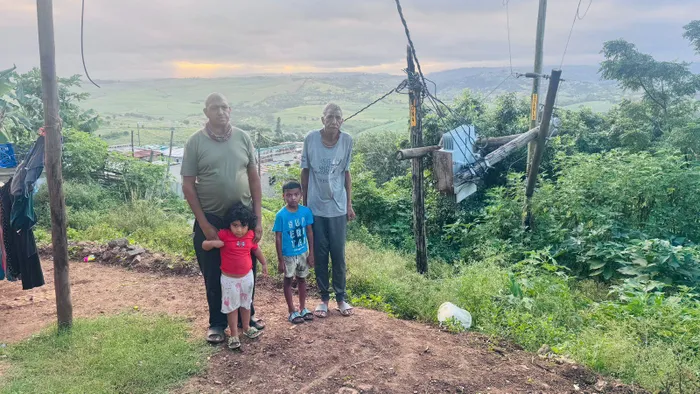
From left: Praven Ramdial with his grandchildren, Mishka and Aarav Rampersad, and his brother, Pramalall Ramdial. They are standing next to the blown transformer, where children often play.
Image: Monishka Govender
RESIDENTS of Emona, in Tongaat, said they had been left to fend for themselves for years, enduring prolonged water and electricity outages, with little or no support from the eThekwini Municipality.
For the seven households in the area, their daily life is a cycle of survival marked by frustration, fear and neglect.
For 50-year-old Reshma Bansee, who has lived in Emona for three decades with her husband, children and mother-in-law, the struggle dates back to 2010.
“From January 29, 2010, our water stopped. The pump that supplied water blew due to illegal connections. The municipality has since refused to reconnect it because it repeatedly blows up.”
As a temporary solution, Bansee was given a JoJo tank, which was meant to be refilled twice a week by the municipality.
However, during the 2022 floods, a water crisis emerged in Tongaat and tensions escalated over the JoJo tank.
“The whole community came to fight for the tank. They said it belonged to everyone. I had to go to court, and I won. But it should not have been my fight, it should have been the municipality’s,” she said.
Bansee said the conflict soon escalated, and their lives were threatened.
“The community said they would loot my house and kill my family. My husband eventually had to buy another JoJo tank for the community just to keep the peace,” she added.
While her water situation improved in late 2024 after the commissioning of an elevated reservoir, supply remained inconsistent.
“Sometimes we go without water for three or four days. When the reservoir is low, we get nothing.”
Electricity outages is a more recent crisis, she added.
In June 2025, a transformer serving the area failed due to illegal connections.
“That transformer was meant to supply 80 homes, but it was feeding hundreds, maybe thousands of informal homes. Now only seven of us are left without electricity because we refused to connect illegally.”
Despite appeals to authorities, including Eskom, Parliament and even the president’s office, no resolution has been reached.
“You can write to anyone, nobody responds. We are completely ignored,” Bansee said.
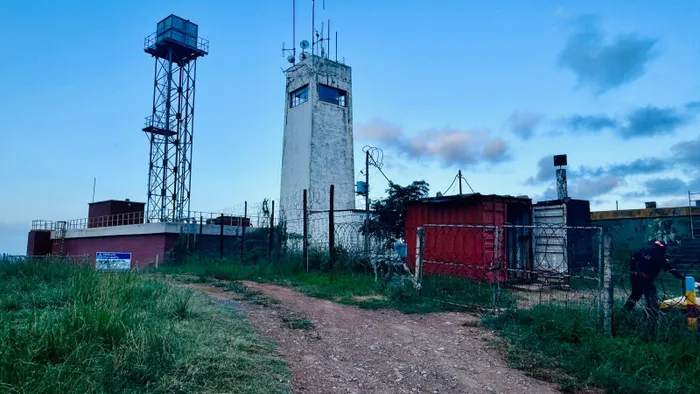
The Emona reservoir that is directly across Reshma Bansee's home.
Image: Monishka Govender
Her household turned to solar power out of necessity, but it has limitations.
“When it is cloudy, everything shuts down. The fridges and the freezers are off. The only thing that functions is the CCTV, and even that is not reliable. My alarm system is useless. As a result, we were robbed multiple times.”
She also expressed frustration with local leadership, claiming that a nearby electricity source could easily supply the affected homes.
“There is a transformer across the road. All they need to do is draw a line to feed these seven houses, but they refuse. We even submitted a petition, but nothing has been done.”
The lack of infrastructure extends beyond water and electricity. Emona residents also rely on pit latrines.
“We do not have sewer systems. We use a pit system and chemicals to manage waste. It is unhygienic, but it is our daily reality.”
Bansee also expressed anger over continued utility billing despite years without reliable services.
“I get estimated bills for water I never received. I refuse to pay for something I did not get. I am scared to see what my bill currently is.”
The prolonged hardship has taken an emotional toll.
“I even wrote to the president’s office and never got a response. It makes me frustrated and angry because nobody is helping.”
Bansee believed the situation reflected broader inequality in service delivery.
“We are paying customers. What is good for one is good for all. Basic services are a human right,” she said.
Other residents share similar frustrations.
Melanie Ramdial, 40, who lives with seven family members, described the daily strain of living without electricity for nearly a year.
“We wake up at 3am to make a fire so the kids can bath and go to school. All our appliances are not working. We do not know what will happen when the power comes back. Who will compensate us?”
Like Bansee, she said efforts to get help had been futile.
“We have asked everyone we know in Tongaat. Nobody helps. It is heartbreaking. Because we are rural, we are always left out.”
Seema Dhunpath, 49, a lifelong resident of Emona, said conditions worsened significantly over the past decade.
“Before all these water and electricity issues, we were fine. Now it is unbearable. We only have a small solar panel that can power three bulbs, and even that only lasts a few hours. Water is another issue. We do not live like others. There is a process before we can do basic tasks like bathing or cooking.”
She questioned why paying customers were being penalised for illegal connections.
“We pay our rates and taxes. Why should we suffer for other people’s actions?”
For Praven Ramdial, 55, the situation is physically taxing. Having battled throat cancer for six years, he struggles with the demands of daily life without utilities.
“We have to make fires to cook and heat water. My grandchildren do not even have lights at night. We are already struggling with high prices. This just makes it worse.
“It is difficult to see that nobody cares about us. We fend for ourselves.”
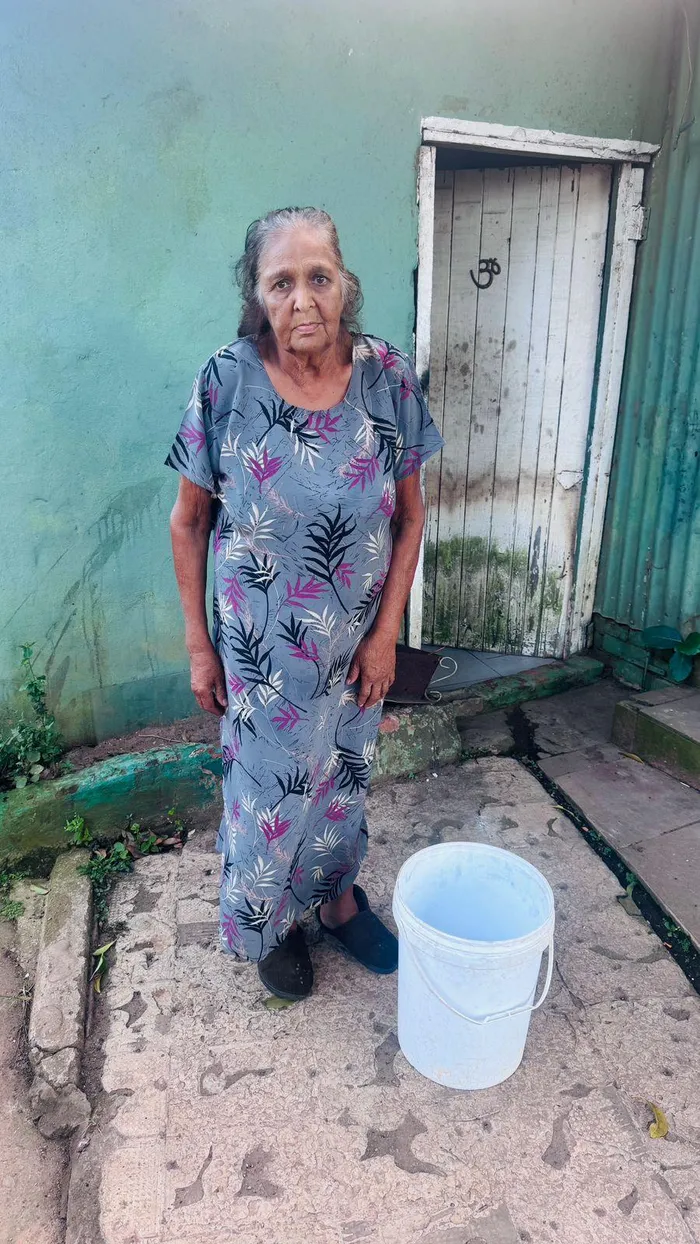
Puumathe Ramdial.
Image: Monishka Govender
The burden is especially heavy for elderly residents like 73-year-old Puumathe Ramdial.
“I am an old lady. I am struggling without lights and water. I have illnesses, and carrying buckets is not easy. Sometimes I have to boil water on an open fire just to drink.”
She added that even basic necessities were becoming unaffordable.
“Paraffin is expensive, and candles are expensive. I live off my pension, but it is not enough. How much longer must we all suffer until we are noticed?”
Residents said their safety was also a growing concern.
“Children play near damaged infrastructure. Nobody comes to check. Nobody cares. There are only seven homes here suffering like this. We are a forgotten community.”
Despite petitions, meetings and repeated pleas, the residents of Emona say they were still waiting for answers for their basic services many others take for granted.
Ward 61 councillor, Dolly Munien said, “The residents of Emona do not get their electricity from the eThekwini Municipality. They actually fall under the iLembe District Municipality.
“The electricity is only supposed to service 80 houses. Due to illegal connections, it is used by many more homes. Since so many people are not paying their bills, the iLembe District Municipality will not fix the transformer. Out of 80 people, only six pay their actual bills. However, we did sign a petition to get the eThekwini Municipality to take over the small portion from Emona, but they said it is not that easy.
“The iLembe District Municipality does not want to fix the transformer because they will get nothing out of it, once they fix it. The people will continue not paying, so the seven houses will suffer because of the others. I am trying my best to help them. I do feel for them, but there is not much I can do because I am a ward councillor for the eThekwini Municipality, and not the iLembe District Municipality,” she said.
Munien said a representative for the iLembe District Municipality stated Eskom had taken a stance to protect its infrastructure.
“The representative said Emona’s case was not the only matter where the blown transformer was not replaced. The Eskom website lists illegal connections that have blown transformers in the process. This process requires 75% of people in the area to be paying customers for the issues to be resolved. All other areas have had similar issues where the transformer is blown. If they are paying customers, they will replace it. People who are not paying, will not get a transformer replaced. People in Emona need to protect the infrastructure,” she said