

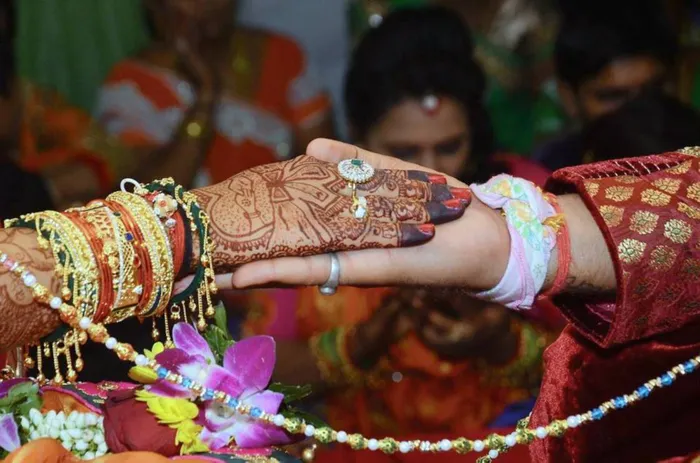
INDIAN entrepreneur Jasveer Singh sparked debate on social media after criticising extravagant spending on Indian weddings, arguing that many families prioritised social status over financial stability.
Image: MaxPixel's contributors
INDIAN entrepreneur Jasveer Singh sparked debate on social media after criticising extravagant spending on Indian weddings, arguing that many families prioritised social status over financial stability.
Singh is the co-founder and CEO of Knot.dating, an AI-driven matrimony platform based in New Delhi, India.

INDIAN entrepreneur Jasveer Singh
Image: SUPPLIED
His work focuses on rethinking how modern matchmaking works in India, combining technology with real behavioural insights.
Singh said middle-class parents often spent several years’ worth of income on a single wedding to appear wealthy, sometimes taking loans to fund the celebrations.
He described the trend as “financial self-destruction”, claiming that weddings had increasingly become performances for social validation rather than genuine celebrations.
His remarks triggered widespread discussion online about cultural expectations, social pressure, and the rising costs of weddings, baby showers, gender reveals and special events.
In an interview with the POST, Singh said he had seen the growing trend of people getting into debt to meet social expectations.
“It is a mix of social pressure, cultural expectations and ego. I have seen this repeatedly. Families are spending years of income on a single event, often with loans, just to meet social expectations. At some point you stop calling it a celebration, and start calling it what it is.
“Nowadays people do not want a good wedding. They just want validation. They want that one moment where people say ‘wow, what a marriage … and they are ready to go broke for it,” he added.
Singh said in India, people were often driven by ego and social positioning.
“They want their name to be talked about. They want to look rich within their circle. They are not just hosting a wedding, they are signaling status to friends, family, neighbours and relatives. It is about showing that they can afford the extravagance, when they actually cannot.
“That one idea pushes people to stretch far beyond their reality, just for one night where others praise them. It is a combination of cultural expectation and social pressure. But it is also a comparison. If someone else did a wedding at a certain scale, the next person wants to do more just to stay ahead socially.
“In India, weddings have clearly become performances. Social validation plays a big role. For many families, it is not just about celebration, it’s about image, ego, and how they are perceived in society.
“On the parents’ side, it is largely about status. On the bride and groom’s side, social media has added another layer. Today, a lot of weddings are designed for photos and Instagram. Life starts looking like a reel instead of a real celebration,” Singh said.
He said other events, like baby showers or gender reveals, were still not as prominent in India.
“Weddings remain the biggest stage. Pre-wedding functions have grown, but they are still extensions of the main event.
“This is where the extreme behaviour shows up. People are willing to spend several years of savings, sometimes even take loans, and then spend the next few years repaying that money. All for a one- or two-day event.
“And the irony is, the people they are trying to impress usually do not care as much as they think. But the pressure to perform is strong enough that it keeps repeating,” he added.
Singh said contributing factors included a mix of insecurity and validation loops.
He said people did not want to be seen as “less” in front of relatives or society, and social media had amplified it.
“What used to be a local comparison is now a national comparison, adding to the pressure and demands to keep up with extravagance,” Singh added.
Kas Naidoo, a Durban-based life and relationship coach, said in South Africa, the situation was very similar.
She said in many Indian communities, weddings had become larger, more elaborate, and often more financially demanding.
“It breaks my heart when I see couples and their families spend exorbitant amounts of money on a celebration that lasts a single day. I have worked with couples who spent around R200,000 on what they described as a small wedding.
“Others have exceeded spending R500,000 on a wedding. In some cases, the desire to meet cultural expectations or uphold family reputation drive costs even higher, with multiday events, designer outfits and extravagant entertainment.
“What concerns me most is what happens after the wedding. As a relationship coach, I often meet couples just months into their marriage who are already struggling, and in some cases, considering separation.
“They have invested so much time and energy into the romance of finding ‘the one’, the excitement of courtship, and the intensity of wedding planning, but very little into preparing for the reality of marriage,” she added.
Naidoo said after the "high" of the wedding faded, real life began.
“Couples are suddenly navigating careers, finances, household responsibilities, extended family dynamics and shifting identities. This is often where cracks begin to show. Many couples have not developed the tools to communicate deeply, resolve conflict in a healthy way, or understand each other’s emotional needs.
“Unresolved past wounds can surface, and differences in upbringing and expectations can create tension. Without a strong foundation, the pressure can strain not only the marriage, but also the relationship between the couple and their parents.
“The financial burden can also weigh heavily on families. In many cases, parents fund the wedding out of love and a desire to give their children the best. However, this can lead to significant stress financially and emotionally, especially if expectations are high or if there is pressure to impress the community,” added Naidoo.
She said this sometimes created unspoken obligations, or controlled dynamics that carried into the marriage itself.
“I have seen situations where couples feel torn between honouring their parents and staying true to their own desires. Others begin their married life in debt or under financial pressure, which immediately adds strain. In some cases, disagreements about the wedding itself, such as guest lists, budgets and traditions, create conflict even before the marriage begins.
“My guidance to couples is to shift the focus. They must plan the marriage, not just the wedding. Invest time in building communication skills, understanding each other’s values, discussing finances, and aligning on the life you want to create together.
“A wedding is a beautiful celebration, but it should not come at the cost of your future stability and happiness. To parents, I would gently say that they should reconsider what the best truly means.
“Is it a lavish, one-day event, or is it supporting your children in building a strong, conscious and lasting partnership? Sometimes the greatest gift is not a grand wedding, but the foundation for a thriving marriage. Ultimately, smaller, more intentional weddings, with people who truly matter, can be just as meaningful, if not more so. When the focus shifts from impressing others to honouring the union itself, couples give themselves the greatest chance at lifelong love and success,” added Naidoo.