

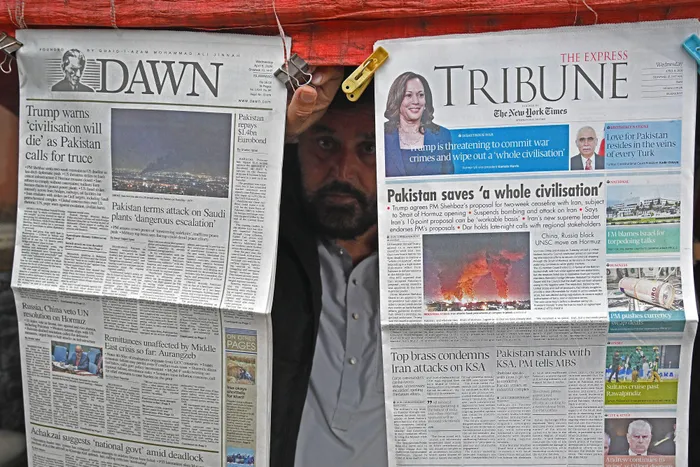
Pakistan's Prime Minister Shehbaz Sharif said on April 8 that the United States, Iran and their allies had agreed to a ceasefire "everywhere", including Lebanon, following mediation by his government to stop weeks of fighting.
Image: Aamir Qureshi / AFP
Oil prices plunged on Wednesday while stocks rallied after the United States and Iran agreed to a two-week ceasefire that will see Tehran temporarily reopen the vital Strait of Hormuz.
With Donald Trump's deadline approaching for the Islamic Republic to reopen the waterway or face obliteration, he announced a halt to attacks for two weeks and said he had received a "workable" 10-point proposal.
Iran later said it had agreed to safe passage in the Strait, through which a fifth of global oil and gas passes.
The news pushed down crude prices, with West Texas Intermediate losing almost 20 percent and Brent as much as 16 percent as investors heaved a huge sigh of relief after more than five weeks of war that has hammered supplies. On Wednesday morning around 6am (SA time) Brent Crude oil was trading at around $94.71 per barrel, down from a high of $111 the previous day.
The euphoria sent equities rocketing on hopes the crisis that has shocked the global economy for more than a month will come to an end.
Seoul jumped more than six percent and Tokyo more than five percent, while Taipei added 4.2 percent, and Sydney and Hong Kong advanced more than two percent. Shanghai, Mumbai, Bangkok, Manila, Jakarta, Singapore and Wellington were also sharply higher.
Trump had threatened on Tuesday that if Hormuz was not reopened, "a whole civilisation will die tonight, never to be brought back again". That came after he vowed to bomb bridges, power plants and other civilian infrastructure in Iran.
Iran warned it would deprive the United States and its allies of oil and gas "for years" if Washington crossed Tehran's "red lines".
However, as the world counted down to the cutoff, the US president took to social media to say: "Subject to the Islamic Republic of Iran agreeing to the COMPLETE, IMMEDIATE, and SAFE OPENING of the Strait of Hormuz, I agree to suspend the bombing and attack of Iran for a period of two weeks."
He added that it "will be a double sided CEASEFIRE!" and that "we have already met and exceeded all Military objectives, and are very far along with a definitive Agreement concerning Longterm PEACE with Iran, and PEACE in the Middle East".
Prime Minister Shehbaz Sharif of Pakistan, which has played a key mediator role, said the ceasefire would start immediately.
He said the United States "along with their allies" had agreed to a ceasefire everywhere including Lebanon, implying that Israel had agreed to halt its invasion of its northern neighbour.
However, Tel Aviv said it supported the suspension of the bombing of Iran, but maintained the ceasefire did not include Lebanon.
Iran clamied victory, with the Iranian Supreme National Security Council saying: "The enemy has suffered an undeniable, historic and crushing defeat in its cowardly, illegal and criminal war against the Iranian nation."
The ceasefire also led to a sharp drop in the dollar, which had become the safe-haven while the war raged, with the yen, euro and pound all strengthening.
Gold rallied, having been hit by concerns of a sharp rise in inflation that will keep interest rates elevated, while bitcoin rose.
"Unsurprisingly, the initial market reaction has been a positive one, albeit perhaps not as sizeable as one might've expected, largely owing to the grind higher in risk assets seen since the tail end of Tuesday's cash session," said Michael Brown at Pepperstone.
"Participants have been desperate for anything resembling good news for some weeks now, and even more desperate to see concrete steps being taken towards de-escalation.
"Now that we seem able to put a tick in both of those boxes, participants are unsurprisingly willing to significantly take up risk levels once more."
Stephen Innes of SPI Asset Management added that the deal "matters enormously for Asia", where several governments have been forced to introduce measures to combat rising energy costs.
"Lower oil prices remove the chokehold that has weighed on regional risk sentiment, especially in markets that feel imported energy shocks first and hardest," he said.
"With crude backing off, the pressure on inflation expectations and front-end yields eases at the margin, and that is enough to let capital rotate back toward risk, at least for now."
AFP