

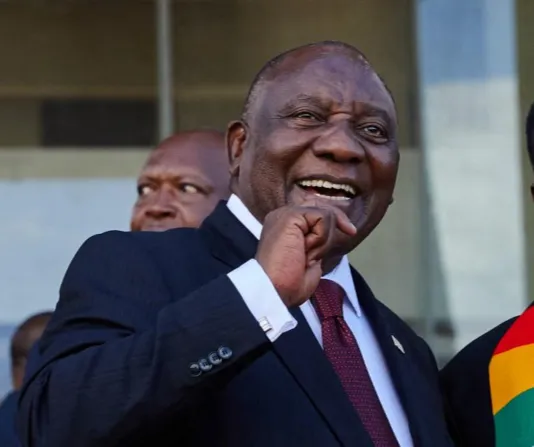
President Cyril Ramaphosa.
Image: AFP
Following ongoing lifestyle audits, 24 officials in President Cyril Ramaphosa’s Cabinet are being investigated for potential undeclared income and concealed assets.
In a response to ActionSA parliamentary leader Athol Trollip, Ramaphosa said the lifestyle audits for the members of his executive are spearheaded by the office of the director-general in the Presidency and the Secretary of the Cabinet Phindile Baleni.
He said all members of the executive have granted consent for the lifestyle audits to be conducted.
“The lifestyle audit process is still ongoing,” said Ramaphosa.
Meanwhile, Public Service and Administration Minister Mzamo Buthelezi has given an update on the 24 officials flagged for suspected undeclared income or concealed assets.
These anomalies were referred for internal investigations after officials made financial disclosures.
Responding to DA MP Eleanore Bouw-Spies, Buthelezi confirmed that his department was responsible for monitoring lifestyle audits across the public service.
However, a capacity issue within the Presidency to effectively investigate the flagged cases has prompted plans to engage an external service provider for support.
“As a result, plans are being undertaken by the Presidency to refer the cases to an external service provider to assist with investigation,” said Buthelezi.
He also said that where potential criminality was identified, matters would be referred to the relevant law enforcement authorities.
In another development, Buthelezi indicated that 117 officials have been flagged for potential financial disclosure anomalies, with various cases still under investigation across different departments.
He would not say the specific departments the officials are employed at, nor indicate their seniority levels or the estimated monetary value of any undeclared income, assets, or financial discrepancies.
“This information will be maintained from the new financial year.”
However, Buthelezi said the investigation outcomes painted a mixed picture: 22 were still under investigation, 24 remained pending investigation by external service providers, seven concluded without any wrongdoing, while 53 resulted in sanctions that consisted of verbal and written warnings.
Additionally, 11 cases were closed after seven officials resigned and four others left for other departments.
Buthelezi said the departments that closed cases of resigned officials have been requested to reopen the cases and to continue to finalise them.
Buthelezi also said none of the finalised investigations required referral to the Directorate of Priority Crime Investigation for criminal investigations.
He said that when the Central Register for Discipline becomes effective this month, it would become incumbent on national and provincial departments, as well as municipalities, to reflect criminality as an outcome of these investigations on the register.
The initiative will require departments and municipalities to consult the register before making any appointments.
“This will address the current lack of keeping individuals accountable who move between departments to circumvent responsibility.”
Buthelezi explained to MK Party MP Mandlenkosi Matutu that heads of departments and executive authority of national and provincial departments were responsible for implementing lifestyle audits.
“These officials are tasked with ensuring that executive and senior managers undergo lifestyle audits as part of their ethics management, risk management, and anti-corruption measures.”
He also said the conducting of lifestyle audits was not yet compulsory in local government.
“The Department of Public Service and Administration is currently supporting the Department of Cooperative Governance and Traditional Affairs and the South African Local Government Association with technical guidance to prepare policy to roll out lifestyle audits across the three spheres of government,” said Buthelezi.