

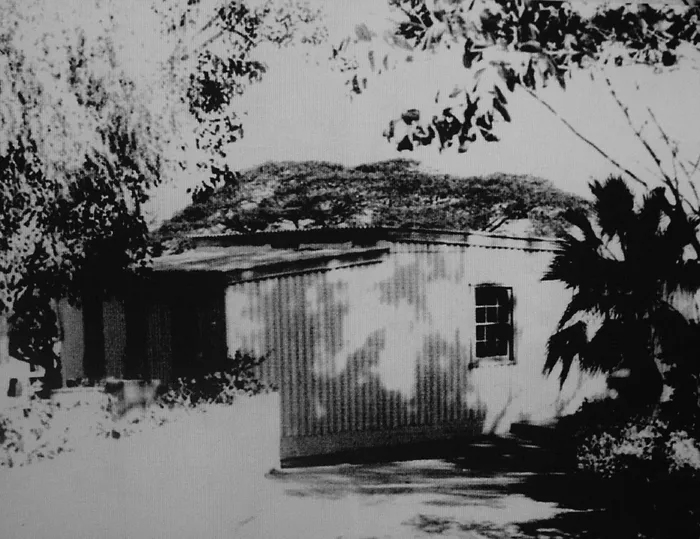
Mahatma Gandhi's home at the Phoenix settlement. He built his house, called Sarvodaya, (meaning universal uplift or progress of all), when he came to Durban in 1904. On the same plot of land, he built his famous printing house where he published his newspaper, Indian Opinion. His house, as shown in the black and white image, was burnt down in the 1985 Inanda riots, which was a fight between Indians and blacks during the apartheid years. After 1994, his house was rebuilt, keeping as much to the original design as possible. The house contains an exhibition of his life and work.
Image: MARILYN BERNARD
This year, Phoenix celebrates 50 years of existence. DR MUNI KOOBLAL explores the townships rich history, from its origins with Mahatma Gandhi's settlement to the modern-day challenges of service delivery and community resilience.
PHOENIX is a large township situated approximately 20 kilometres north of Durban in KwaZulu-Natal. It is widely recognised as one of the most historically-significant Indian communities in South Africa.
The development of Phoenix spans more than a century, and reflects the country’s broader political, social and economic changes. From its origins in the early 20th century to the current challenges of water and electricity shortages, Phoenix has evolved into a resilient, but struggling urban community.
Mahatma Gandhi
The history of Phoenix begins in 1904 when Mahatma Gandhi established the Phoenix Settlement. Gandhi founded this settlement as a communal living experiment, and as the home of his printing press for the newspaper Indian Opinion. It was here that Gandhi began developing the philosophy of Satyagraha, or passive resistance, which later became central to India’s struggle for independence.
The Phoenix Settlement therefore holds both national and international historical significance, and remains a heritage site today.
While the original settlement laid the foundation, the modern township of Phoenix emerged much later during the apartheid era. In the 1970s, the apartheid government implemented the Group Areas Act, which enforced racial segregation and forced many Indian families to relocate from mixed suburbs such as Cato Manor.
Phoenix was developed as an Indian township to accommodate these displaced communities. The area, originally consisting of sugar cane farms, was divided into various residential “units” and designed as a buffer zone between racial groups.
This period shaped Phoenix as a working-class residential township with strong family and community networks.
Over the following decades, Phoenix experienced rapid population growth and urban development. By the early 2000s, the township had become home to a large and vibrant population.
Schools, religious institutions, small businesses and community organisations flourished, and many residents pursued education and entrepreneurship as pathways to social mobility. Phoenix also became closely connected to nearby industrial areas such as the Phoenix Industrial Park and Riverhorse Valley, providing employment opportunities for many residents.

Motor vehicles were set alight on Phoenix Highway during the unrest in Phoenix, north of Durban, in July 2021
Image: Picture: Motshwari Mofokeng/African News Agency (ANA)
July 2021 riots:
A major turning point in the modern history of Phoenix occurred during the July 2021 unrest in KwaZulu-Natal. Following the imprisonment of former president Jacob Zuma, widespread rioting and looting erupted across the province. In Phoenix, residents formed community patrols in response to limited police presence and fears of further violence.
Tragically, clashes occurred between Phoenix residents and people from neighbouring communities, resulting in the deaths of 36 people in the area. The unrest caused deep trauma, damaged social cohesion, and left lasting economic and emotional impacts on the community. This event remains one of the most significant and painful milestones in Phoenix’s recent history.

Phoenix residents barricaded the roads demanding water services be restored to the area.
Image: Picture: Doctor Ngcobo
Service delivery challenges:
Today, Phoenix faces serious service delivery challenges, particularly in relation to water supply. The eThekwini Municipality has been experiencing an ongoing water crisis, which has significantly affected the township. Rapid population growth has increased demand for water beyond the capacity of existing infrastructure. Ageing pipelines, water leaks and maintenance backlogs have further reduced supply. In addition, electricity load shedding has disrupted water pumping stations, while the devastating floods of 2022 caused further damage to water infrastructure.
As a result, some communities in the broader Durban area have experienced extended periods without water, severely affecting households, schools and businesses. Residents often rely on water tankers and community distribution points, highlighting the severity of the crisis.
Electricity challenges have also become a daily reality for Phoenix residents. Like the rest of South Africa, the area is affected by national load shedding, which is implemented to protect the national electricity grid. However, Phoenix also experiences local electricity problems caused by ageing infrastructure, storm damage and maintenance backlogs. Frequent power outages affect homes, schools, health services and small businesses. The combined impact of electricity and water shortages has placed significant pressure on families and vulnerable residents, particularly the elderly and low-income households.
In response to these challenges, community members have organised protests and advocacy efforts to demand improved service delivery. Civil society organisations and local leaders continue to highlight the impact of these shortages on daily life, education and economic activity.
Despite these difficulties, Phoenix remains a community characterised by resilience, strong social networks, and a history of activism and community engagement.

Dr Muni Kooblal
Image: SUPPLIED
Dr Muni Kooblal is an academic, community leader, and lifelong advocate for social development whose contribution to the Phoenix community spans nearly five decades.
As a founder member of key community structures, including the Phoenix Working Committee, Phoenix Community Centre, Phoenix Ubuntu Forum, and Phoenix Child Welfare, Kooblal has played an instrumental role in shaping the social fabric and development trajectory of Phoenix since its earliest days.
His journey of service began in 1976, the same year the first residents moved into Phoenix following the devastating Tin Town floods of March 31, 1976. As a young volunteer with the Verulam Child Welfare Local Committee from 1976 to 1980, he demonstrated an early commitment to community upliftment. In 1981, while still a university student, he was elected as the first president of Phoenix Child Welfare – marking the beginning of a lifelong association with child protection and welfare services.