

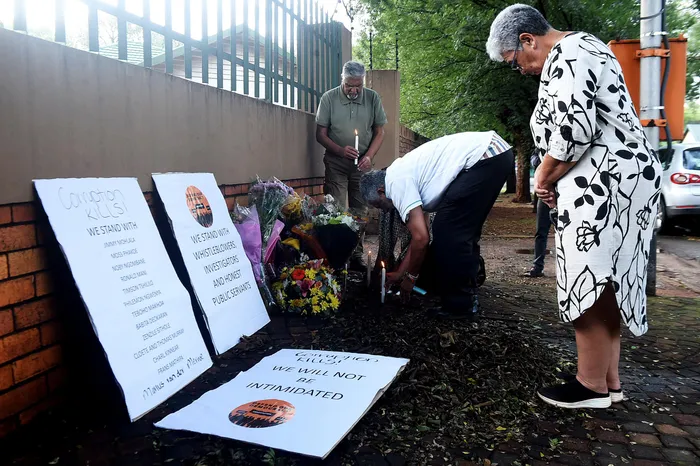
The Ahmed Kathrada Foundation and other civil society organisations held a candlelight vigil to honour 'Witness D' Marius van der Merwe, who was assassinated outside his Brakpan home. ACM has sharply criticised the proposed Protected Disclosures Bill 2026, warning that it falls far short of what South Africa urgently needs to protect whistle-blowers, and combat corruption effectively.
Image: Itumeleng English/ Independent Newspapers
THE Active Citizens Movement (ACM) has sharply criticised the proposed Protected Disclosures Bill 2026, warning that it falls far short of what South Africa urgently needs to protect whistle-blowers, and combat corruption effectively.
Reformist instead of transformative
ACM’s position is unequivocal – South Africa needs not inadequate, piecemeal and incremental reform, but a new, standalone whistle-blower protection law.
Our view aligns with repeated references by the president to a forthcoming Whistleblower Protection Bill. However, instead of introducing such transformative legislation, the current draft merely tinkers with the existing Protected Disclosures Act.
What the bill gets right
ACM acknowledges that the bill introduces some important improvements:
* A broader definition of who qualifies as a whistle-blower.
* Stronger recognition of confidentiality protections.
* Expanded mechanisms for making disclosures.
* Limited provisions for legal assistance and witness protection.
These elements suggest that government has considered input from civil society. However, ACM stresses that these improvements are largely procedural rather than substantive.
Critical gaps that undermine protection
A detailed comparative analysis shows that several of the most critical protections advocated by the ACM and the National Anti-Corruption Advisory Council (Nacac) are either partially included or entirely absent.
Among the most serious omissions:
* No independent whistle-blower protection authority.
* No reverse onus to protect whistle-blowers in retaliation cases.
* No criminalisation of retaliation.
* No guaranteed financial or psychosocial support.
* No protection for anonymous disclosures.
* No specialised tribunal or court.
The ACM warns that these gaps leave whistle-blowers exposed to job loss, financial ruin, intimidation, psychological harm, and threats to life and limb.
Legally recognised, practically unprotected
According to the ACM, the bill creates a dangerous illusion of protection.
While it provides formal mechanisms for disclosure, the absence of enforcement mechanisms and support systems continues to leave whistle-blowers exposed. This is aptly described as a “protection versus exposure paradox”, where the law encourages disclosure, but does not adequately protect those who come forward.
The likely result is fewer disclosures, continued impunity, and entrenched corruption.
High-risk consequences for the state
If adopted without significant amendments, the ACM warns the bill will create serious systemic risks:
* Legal risk: whistle-blowers lose cases due to lack of reverse onus.
* Enforcement failure: no central authority leads to fragmented responses.
* Retaliation risk: perpetrators act without fear of criminal consequences.
* Access to justice barriers: whistle-blowers cannot afford the costs of legal action.
* Governance failure: corruption remains undetected and unreported.
* Legal challenges to the bill and possible declaration of unconstitutionality.
These risks collectively undermine public trust in, and accountability by the state
and private actors.
The case for a Whistle-blower Protection Act
The ACM argues that the current bill reflects a fundamentally flawed approach. Instead, South Africa requires a standalone Whistleblower Protection Act, as elaborated below.
A call to Parliament
The ACM is calling on Parliament to use the public comment process to fundamentally rethink the bill, not merely refine it.
Key priority amendments include:
Conclusion
The Draft Protected Disclosures Bill 2026 signals intent, but not impact. It constitutes a superficial, tick-box exercise of the recommendations of the Zondo Commission and the Nacac.
The drafters of the bill have failed to grasp the nettle to deal with a serious societal issue – the scourge of corruption and the proper protection of the front line defenders in that battle.
This is a signal warning to Parliament to do the right thing, go back to the drawing board and deliver a truly transformative law. Nothing else will suffice.
Pops Rampersad, member of the executive committee and Dr Nora Saneka, chairperson
The Active Citizens Movement